


























Views
Downloads

Add or Subtract Within 20 | Grade 1 Math Printable
Paste this activity's link or code into your existing LMS (Google Classroom, Canvas, Teams, Schoology, Moodle, etc.).
Students can open and work on the activity right away, with no student login required.
You'll still be able to track student progress and results from your teacher account.
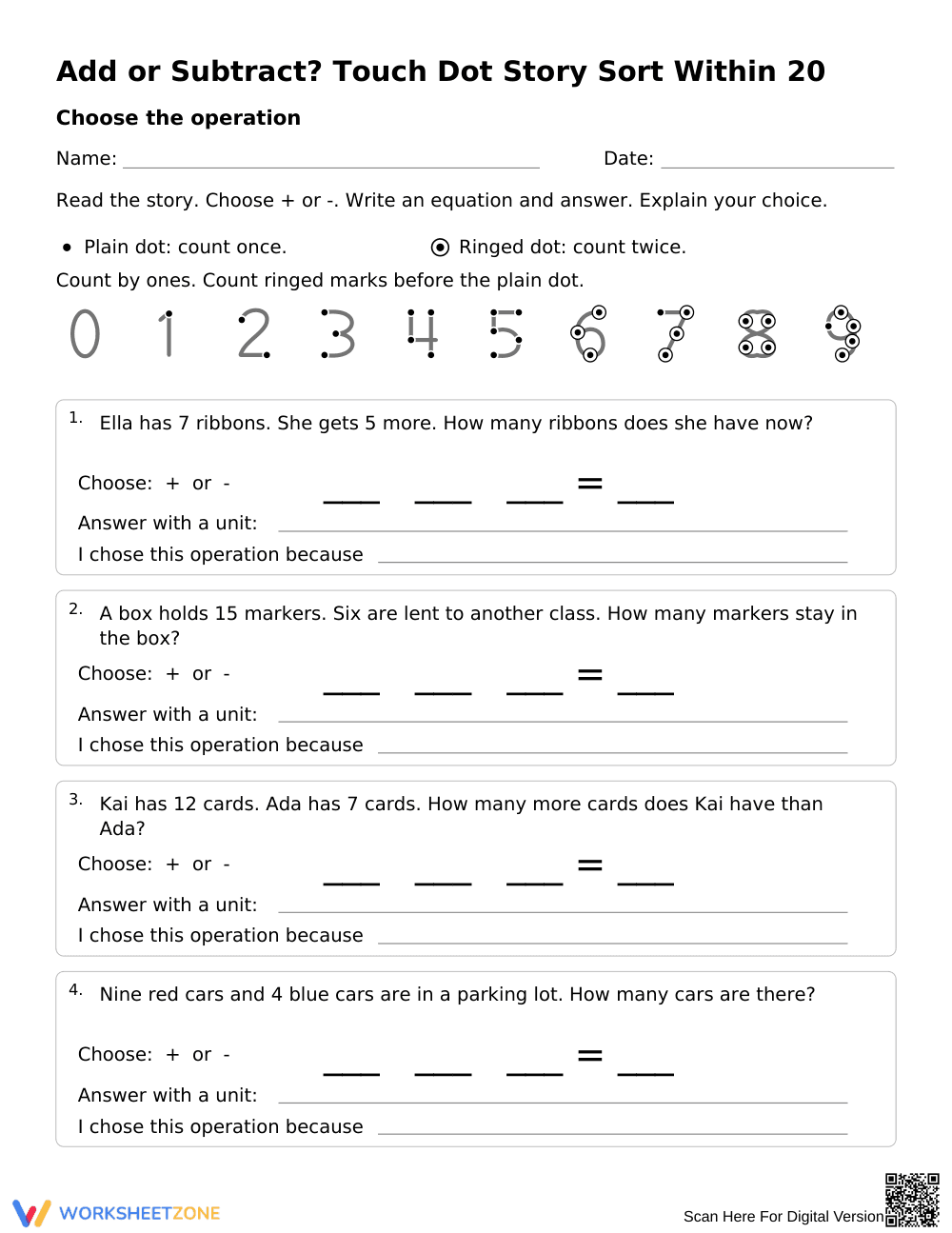
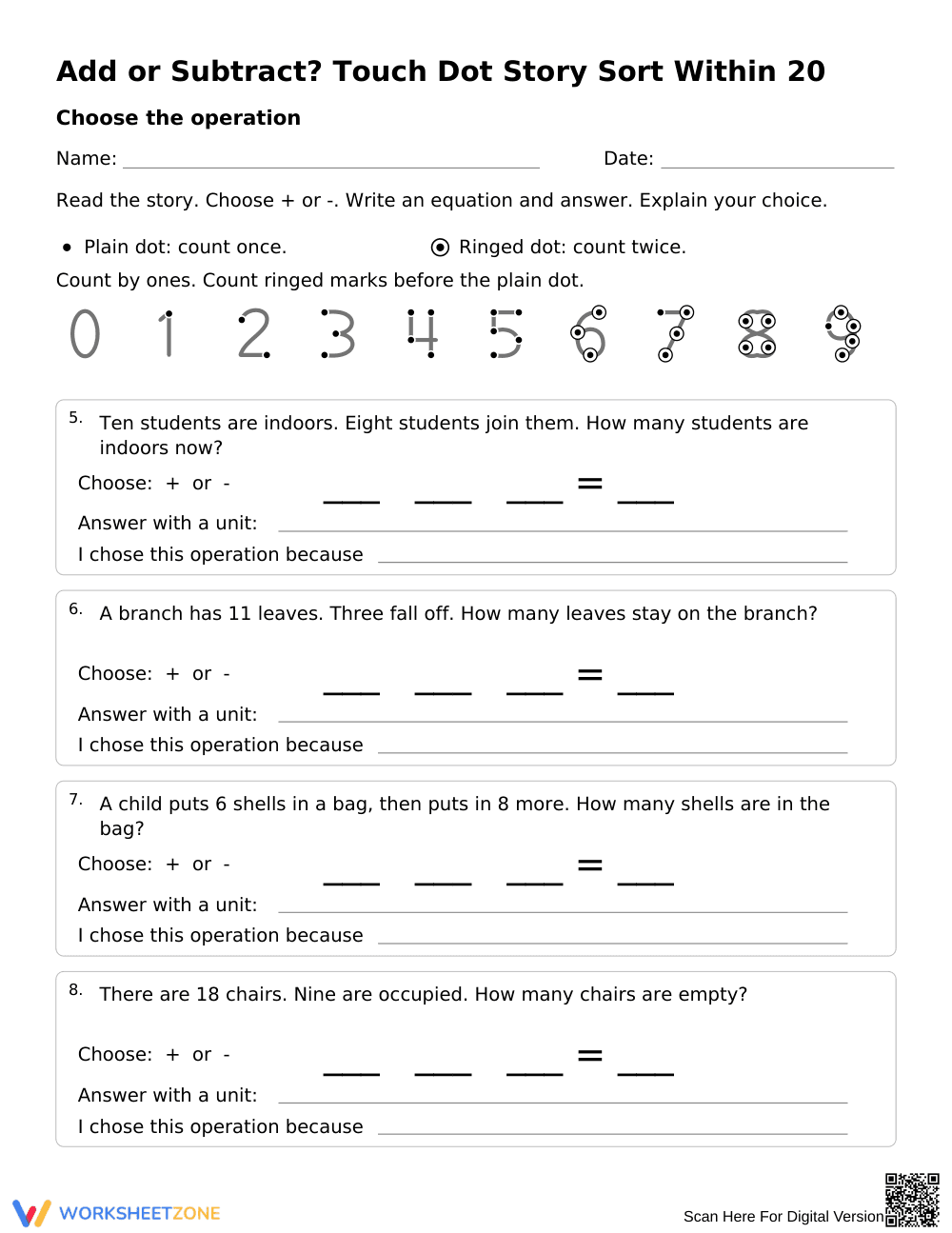
This first-grade math worksheet builds operational fluency by requiring learners to determine whether real-world story scenarios call for addition or subtraction within 20. Through eight targeted story situations, students analyze joining, separating, and comparing contexts, construct complete equations, and articulate their reasoning while utilizing touch-dot number supports to verify their computational work.
At a Glance
- Grade: 1 · Subject: Math
- Standard:
CCSS.MATH.CONTENT.1.OA.A.1— Solve word problems within 20 by adding to, taking from, or comparing- Skill Focus: Selecting addition or subtraction in story problems
- Format: 2 pages · 8 problems · Answer key included · PDF
- Best For: Targeted small group intervention
- Time: 20–30 minutes
What's Inside
The resource spans 2 student activity pages featuring 8 distinct story problems alongside a complete 1-page teacher answer key. Each problem frame provides an operation toggle (+ or -), a blank equation template, dedicated lines for answering with units, and a structured sentence starter for written justification. A touch-point reference guide at the top of each page supplies visual counting dots for numerals 0 through 9.
Skill Progression
- Guided practice: Problems 1 and 2 introduce transparent 'add to' and 'take from' actions with low vocabulary load and explicit visual touch anchors.
- Supported practice: Problems 3 through 5 challenge learners to interpret comparison and combining language, requiring students to isolate the unknown quantity and write operational justifications.
- Independent practice: Problems 6 through 8 require autonomous operation selection across multi-step scenarios, equation formulation, and accurate multi-sensory counting to reach the solution.
This structured layout follows the gradual-release framework, moving students systematically from supported operational sorting to independent problem formulation.
Standards Alignment
This activity aligns primarily with `CCSS.MATH.CONTENT.1.OA.A.1`: Use addition and subtraction within 20 to solve word problems involving situations of adding to, taking from, putting together, taking apart, and comparing, with unknowns in all positions. It also supports `CCSS.MATH.CONTENT.1.OA.C.5` by leveraging counting-on strategies. Both standard codes can be copied directly into lesson plans, IEP goals, or district curriculum mapping tools.
How to Use It
Implement this worksheet after direct instruction on word problem context clues or during targeted math intervention. In a small group setting, have students highlight action verbs before selecting their operational sign, taking roughly 20 to 25 minutes. During independent desk work, monitor whether learners correctly distinguish comparison prompts from standard take-away prompts in problem 3 to gauge conceptual mastery.
Who It's For
Designed for first-grade general education students, this task is equally effective for second graders needing math intervention and students with dyscalculia or visual tracking needs who benefit from touch-point multisensory supports. Pair this activity with concrete math counters or a story-problem anchor chart detailing operational keywords.
According to Fisher & Frey (2014), structured scaffolds that pair concrete counting representations with explicit mathematical reasoning enable developing problem-solvers to transition successfully from procedural computation to conceptual application. Aligned with CCSS.MATH.CONTENT.1.OA.A.1, this instructional resource equips early elementary learners with eight authentic scenarios requiring them to evaluate situation models, select appropriate addition or subtraction operations within 20, compute sums and differences, and justify their reasoning in writing. Touch-dot visual references ground abstract counting in multi-sensory tactile practice, preventing working memory overload while students focus on semantic text analysis. The included answer key documents model explanations emphasizing joining, separating, and comparing relationships, providing educators with reliable formative benchmarks. By combining visual counting anchors, explicit operational selection, equation modeling, and written synthesis, this tool establishes a durable foundation for algebraic thinking and arithmetic problem-solving in early primary mathematics curricula.


