


























Views
Downloads

Grade 2 Verbs — Printable No-Prep Worksheet
Paste this activity's link or code into your existing LMS (Google Classroom, Canvas, Teams, Schoology, Moodle, etc.).
Students can open and work on the activity right away, with no student login required.
You'll still be able to track student progress and results from your teacher account.
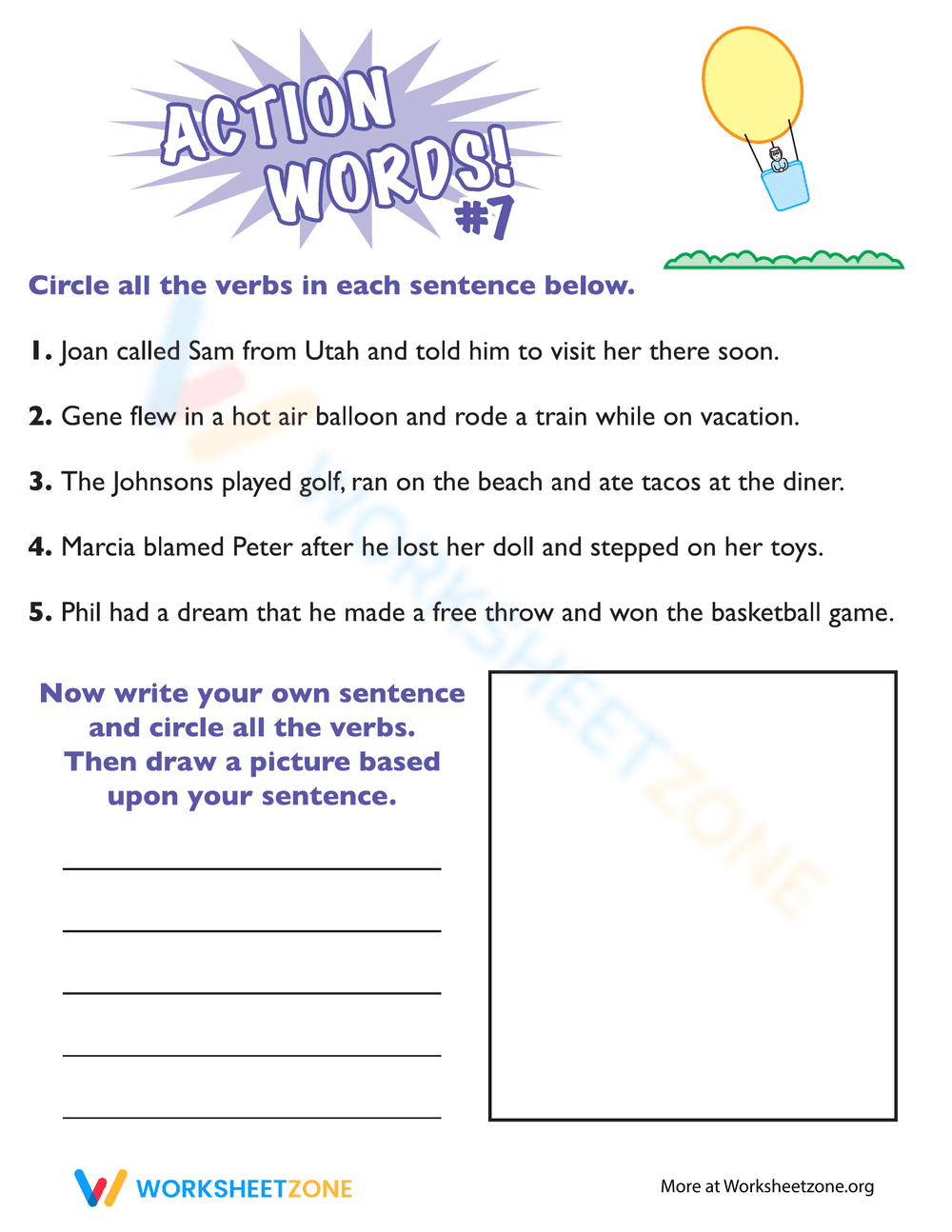
This Grade 2 grammar worksheet helps students identify and use action verbs in sentences to improve their writing clarity. By finding verbs in context and writing their own sentences, young learners build essential parts of speech recognition. Students practice identifying action words to strengthen sentence structure and reading comprehension skills.
At a Glance
- Grade: 2 · Subject: English Language Arts
- Standard:
CCSS.ELA-LITERACY.L.2.1— Demonstrate command of the conventions of standard English grammar and usage when writing- Skill Focus: Action verb identification and sentence construction
- Format: 1 page · 7 tasks · No answer key · PDF
- Best For: Independent grammar practice and quick formative assessment
- Time: 15–20 minutes
This clean, single-page PDF contains five structured sentences featuring various regular and irregular past-tense verbs. Below the sentence identification tasks, a dedicated creative writing section prompts students to compose an original sentence, circle their verbs, and illustrate their writing in a designated drawing box. This multi-sensory layout supports diverse learning styles without visual clutter.
This resource requires under 2 minutes of total teacher preparation, making it an ideal emergency sub plan or morning work activity. Follow this simple three-step workflow:
- Print (1 minute): Photocopy the single-page sheet for your class size.
- Distribute (30 seconds): Hand out the sheets along with pencils and coloring materials.
- Review (5 minutes): Project the worksheet to review the five sentences together as a whole group.
This activity aligns directly with the primary standard `CCSS.ELA-LITERACY.L.2.1`, which requires students to demonstrate command of standard English grammar and usage when writing or speaking. Additionally, it supports `CCSS.ELA-LITERACY.L.2.1.D` by focusing on the recognition of past-tense verbs in context. Both standard codes can be copied directly into lesson plans, IEP goals, or district curriculum mapping tools.
Use this worksheet during the independent practice portion of your grammar lesson, immediately following direct instruction on action verbs. Alternatively, assign it as a quick exit ticket to assess individual student mastery. While students work, walk around and observe if they can distinguish verbs from nouns in the sentences. The entire activity takes approximately 15 to 20 minutes to complete.
This worksheet is designed for second-grade students learning parts of speech, but it also serves as an excellent intervention tool for third graders needing review. Pair this activity with a shared reading passage or an anchor chart displaying common action verbs to scaffold the writing portion for struggling writers.
According to research by Fisher & Frey (2014) on the gradual release of responsibility, structured independent practice tasks that require students to apply grammatical concepts in their own writing are critical for long-term retention. This worksheet directly supports that model by transitioning students from identifying action verbs in pre-written sentences to generating their own original sentences. By aligning tasks to `CCSS.ELA-LITERACY.L.2.1`, educators ensure that students practice the exact conventions required for early elementary literacy development. The inclusion of a drawing task further reinforces comprehension by allowing students to visualize the action words they write, bridging the gap between abstract grammar rules and concrete meaning. This evidence-based design helps teachers efficiently measure student progress toward standard mastery during daily ELA instruction.


