


























Views
Downloads

Math & Geometry Vocabulary Worksheet | Grade 5 Printable
Paste this activity's link or code into your existing LMS (Google Classroom, Canvas, Teams, Schoology, Moodle, etc.).
Students can open and work on the activity right away, with no student login required.
You'll still be able to track student progress and results from your teacher account.
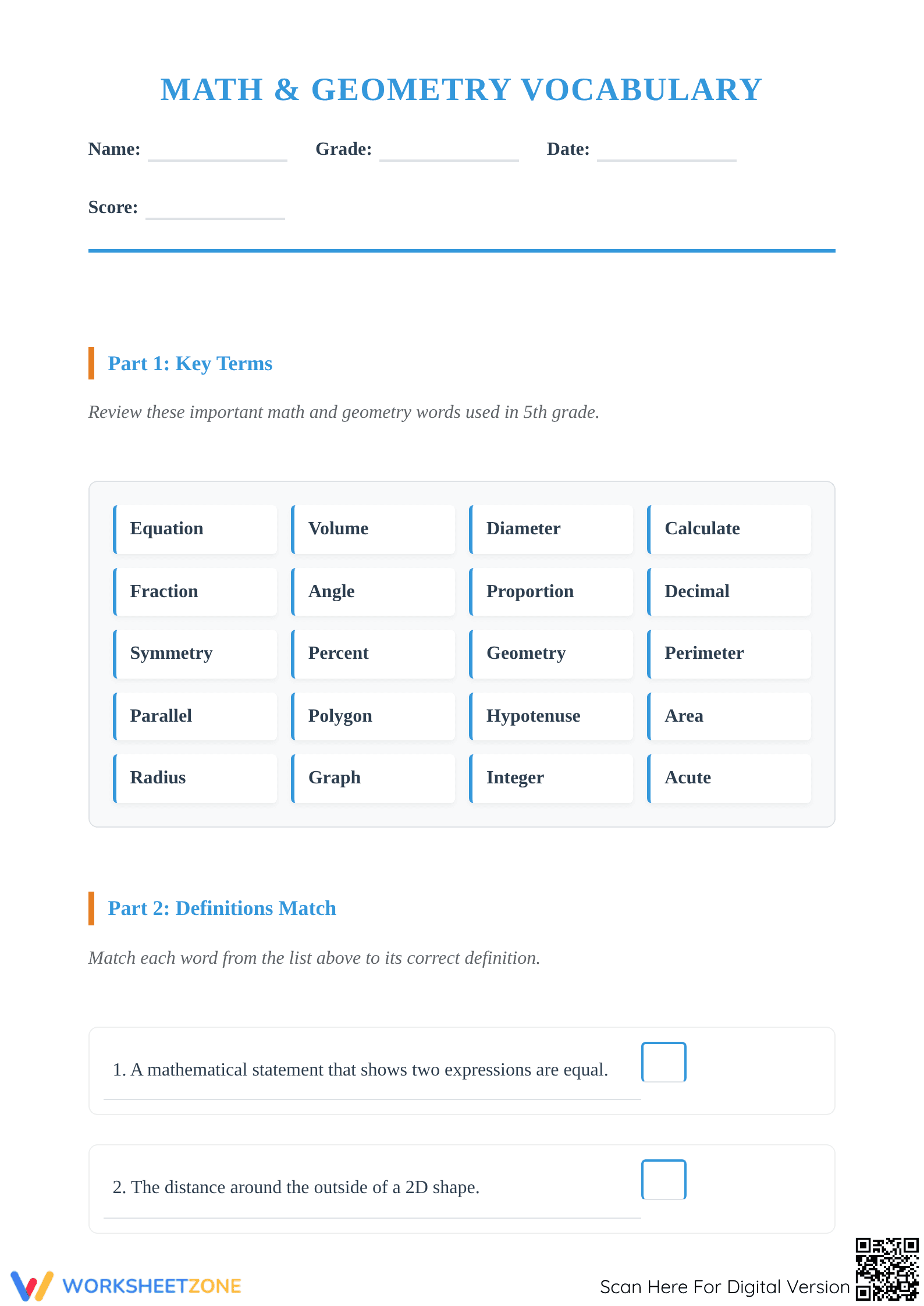
This comprehensive math and geometry vocabulary worksheet helps fifth graders master essential mathematical terminology. By matching definitions and applying terms in context, students build the academic language necessary for solving complex word problems and understanding advanced geometric concepts with confidence.
At a Glance
- Grade: 5 · Subject: Math
- Standard:
CCSS.MATH.CONTENT.5.G.B.3— Understand attributes of two-dimensional figures- Skill Focus: Math and Geometry Vocabulary
- Format: 3 pages · 11 problems · Answer key included · PDF
- Best For: Independent practice and review
- Time: 15–20 minutes
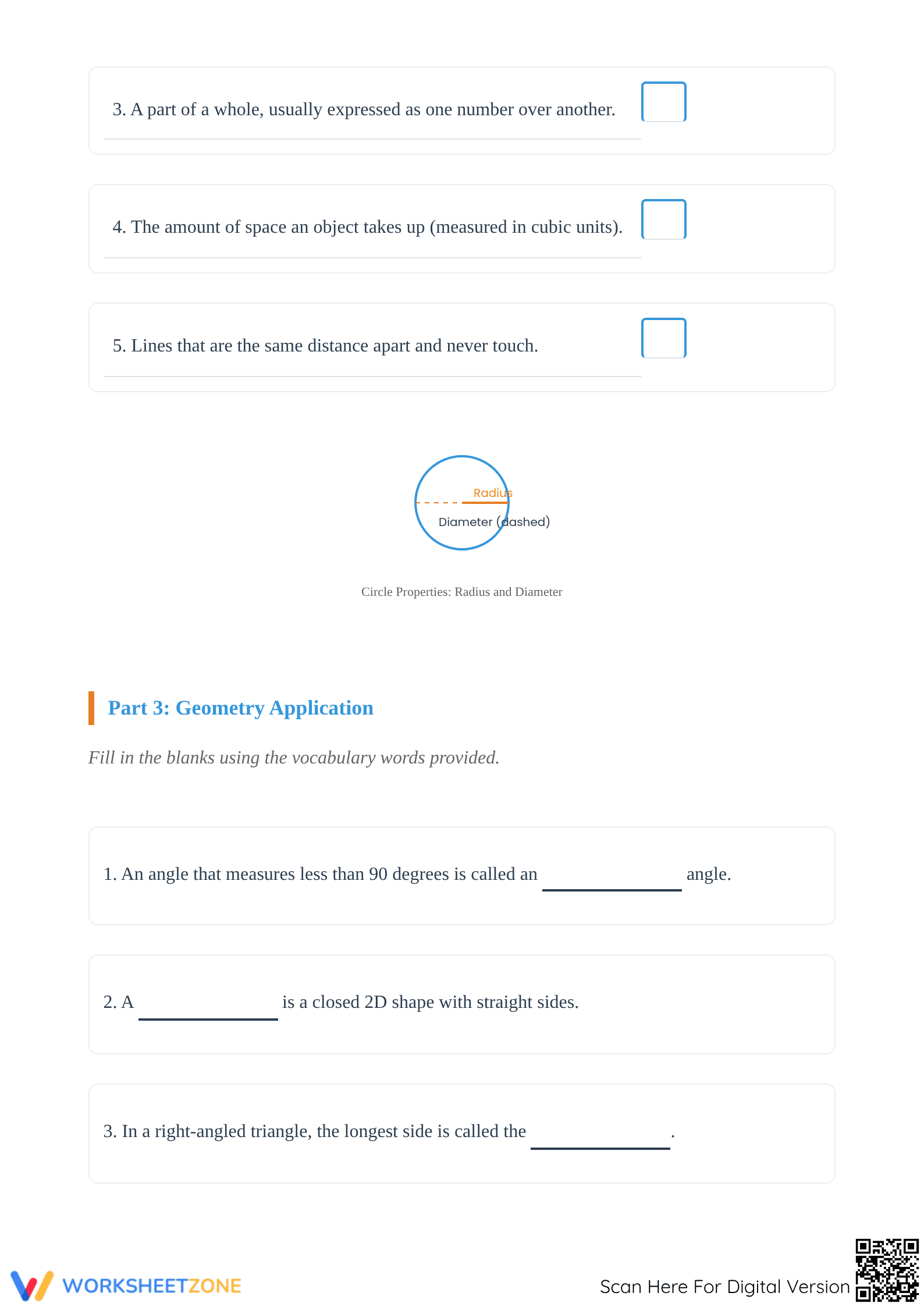
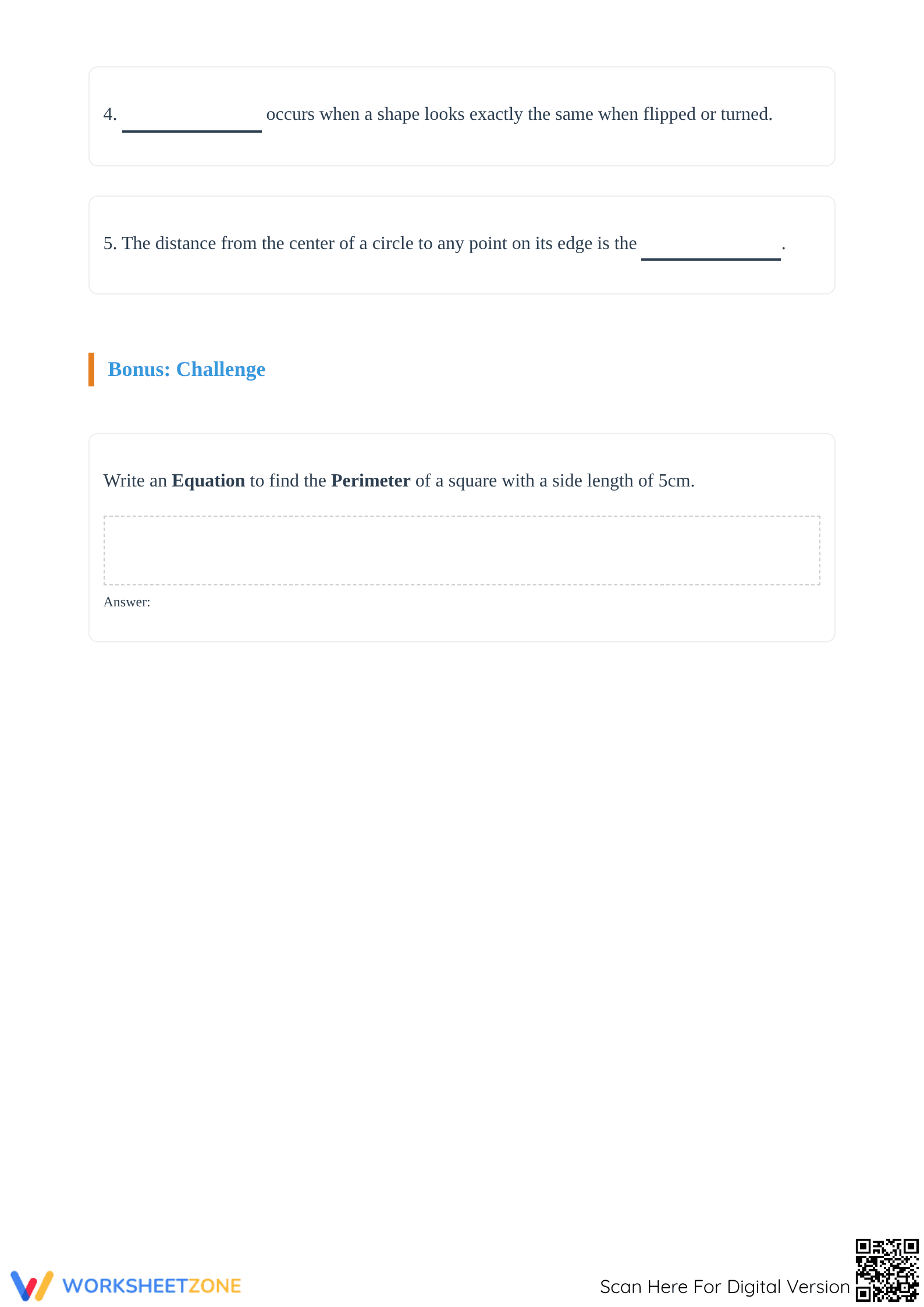
This three-page resource features a structured approach to vocabulary acquisition. It begins with a comprehensive word bank containing 18 key terms, followed by a definition matching section. Students then progress to a geometry application activity where they fill in the blanks using the provided vocabulary. A visual diagram of a circle reinforces spatial concepts, and a bonus challenge question asks students to write an equation to find the perimeter of a square. A complete answer key is provided for quick grading.
- Guided practice: Students review the 18-word vocabulary bank, familiarizing themselves with terms like hypotenuse, symmetry, and volume before beginning the tasks.
- Supported practice: Five matching questions require students to connect clear, concise definitions to their corresponding mathematical terms.
- Independent practice: Five fill-in-the-blank application questions and one bonus challenge assess students' ability to use the vocabulary accurately in mathematical contexts.
This gradual-release approach ensures students move from basic recognition to active application of academic language.
Aligned to CCSS.MATH.CONTENT.5.G.B.3, this worksheet supports students as they understand that attributes belonging to a category of two-dimensional figures also belong to all subcategories of that category. Mastery of these specific vocabulary words is the foundation for classifying and analyzing shapes. Both standard codes can be copied directly into lesson plans, IEP goals, or district curriculum mapping tools.
This resource is highly effective as a pre-assessment before starting a new geometry unit or as a review activity before a chapter test. During independent work time, teachers can use the definition matching section as a formative assessment to identify which specific terms require additional whole-class instruction. Most students will complete the activities within 15 to 20 minutes.
Designed primarily for fifth-grade math students, this worksheet is also an excellent tool for English Language Learners who need explicit instruction in academic math vocabulary. It pairs perfectly with a math word wall or an introductory lesson on classifying two-dimensional polygons.
Explicit vocabulary instruction in mathematics is critical for student success, particularly when addressing standards like CCSS.MATH.CONTENT.5.G.B.3, which requires students to understand attributes of two-dimensional figures. According to Fisher & Frey (2014), students who receive targeted practice with academic language demonstrate significantly higher comprehension and problem-solving abilities in STEM subjects. This worksheet provides the structured repetition necessary to move terms from short-term memory into active working vocabulary. By requiring students to not only match definitions but also apply terms in context, the activities bridge the gap between rote memorization and conceptual understanding. Providing multiple exposures to words like diameter, polygon, and equation ensures that language barriers do not impede mathematical achievement, allowing all learners to access rigorous grade-level content with greater independence and accuracy.


