


























Views
Downloads
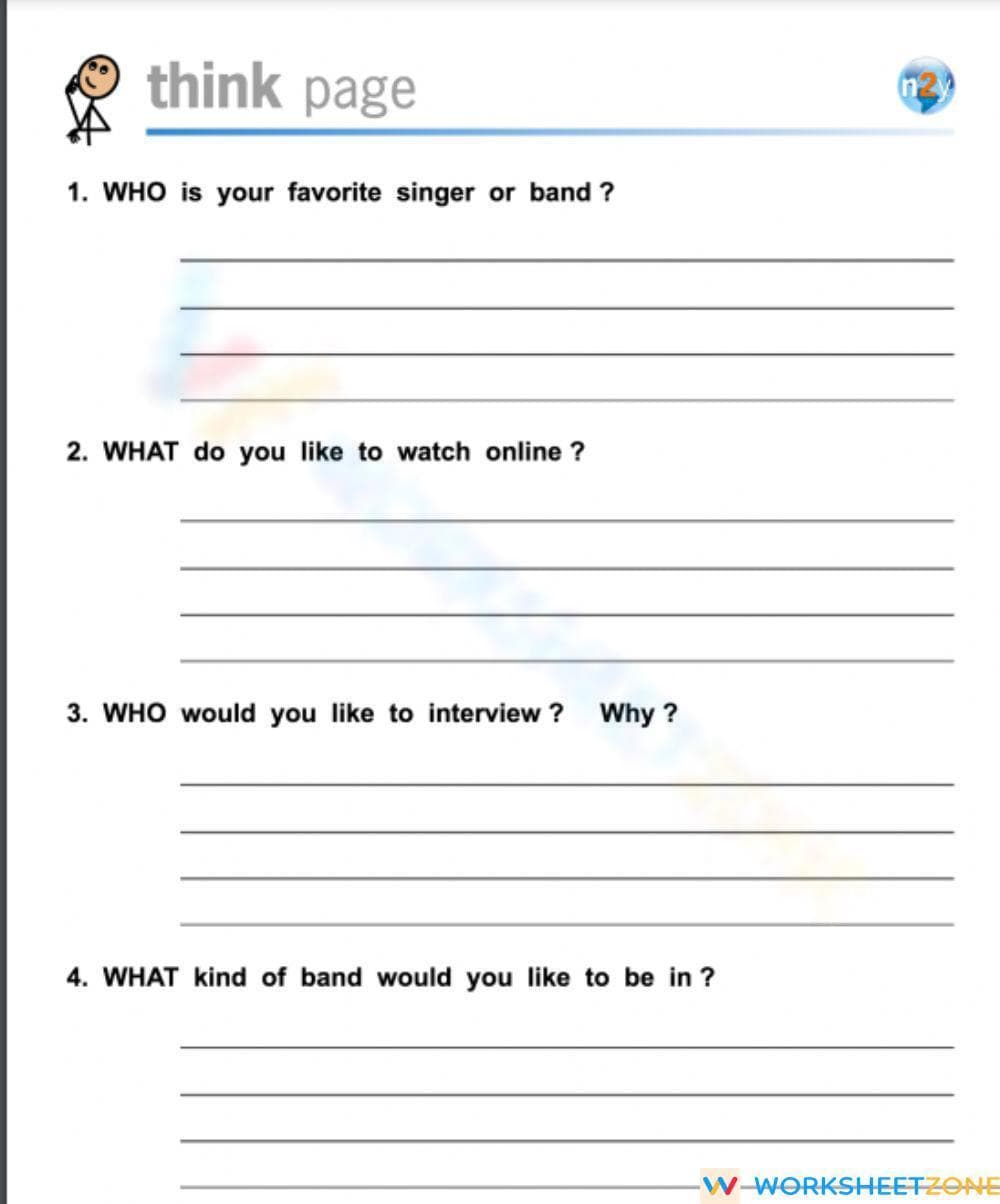

Essential 5 W's Worksheet: Personal Response Grade 3
Paste this activity's link or code into your existing LMS (Google Classroom, Canvas, Teams, Schoology, Moodle, etc.).
Students can open and work on the activity right away, with no student login required.
You'll still be able to track student progress and results from your teacher account.
Students often struggle to move beyond simple yes-or-no responses when engaging with personal reflection tasks. This 5 W's worksheet bridges that gap by requiring learners to construct complete sentences in response to "Who" and "What" prompts. By focusing on these core elements, students quickly strengthen their ability to communicate specific details clearly.
At a Glance
- Grade: 3 · Subject: ELA
- Standard:
CCSS.ELA-LITERACY.RL.3.1— Ask and answer questions to demonstrate understanding by referring to specific details- Skill Focus: 5 W's (Who & What)
- Format: 1 page · 4 problems · Answer key included · PDF
- Best For: Morning routine or personal reflection activity
- Time: 10–15 minutes
What's Inside
This "Think Page" features a clean layout designed to encourage thoughtful writing. The document contains four primary questions, each provided with ample horizontal lines to accommodate varying handwriting sizes. Its structure focuses on the "Who" and "What" components of the 5 W's framework, facilitating a smooth transition from identification to descriptive sentence construction.
Skill Progression
- Guided practice: The initial prompts use simple "Who" and "What" structures to help students identify favorite subjects with direct answers.
- Supported practice: Tasks introduce "Why" questions, requiring students to provide reasoning for their choices.
- Independent practice: Final prompts require students to synthesize preferences into complex sentences, demonstrating mastery of the descriptive format.
This gradual-release approach ensures every learner achieves success while moving toward independent communication.
Standards Alignment
This resource is explicitly aligned to `CCSS.ELA-LITERACY.RL.3.1`, which requires students to answer questions to demonstrate understanding by referring to specific details. While these prompts are personal, they develop the cognitive architecture necessary for text-based evidence extraction. This standard code can be copied directly into lesson plans, IEP goals, or district curriculum mapping tools.
How to Use It
Integrate this worksheet into your morning routine as a "Do Now" activity to settle students and activate their prior knowledge. It also serves as an excellent formative-assessment tool; teachers should observe whether students begin their answers with capital letters and include appropriate punctuation. Expect most Grade 3 learners to complete the entire set of four questions within a 12-minute window.
Who It's For
This resource is ideal for Grade 3 students and English Language Learners (ELLs) who need scaffolded sentence-starter practice. The "Who" and "What" focus provides a low-floor, high-ceiling entry point for diverse learners. We recommend pairing this activity with an anchor chart detailing the 5 W's to reinforce the conceptual framework during independent writing blocks.
The use of the 5 W's framework as a cognitive scaffold is a cornerstone of effective literacy instruction. According to the RAND AIRS 2024 report, structured question-and-answer routines significantly improve student ability to identify key details and synthesize information. By isolating "Who" and "What" within a personal context, this worksheet reduces cognitive load, allowing students to focus on sentence mechanics and descriptive accuracy. This method aligns with Fisher & Frey (2014) regarding the importance of scaffolding in the gradual release of responsibility model. Specifically, the ability to answer questions by referring to specific details—as codified in `CCSS.ELA-LITERACY.RL.3.1`—is a primary predictor of later reading proficiency. Educators can use these four tasks to establish a baseline for student writing fluency and detail-oriented communication. This standalone summary highlights the essential link between question-driven inquiry and long-term academic success in English Language Arts.


