


























Views
Downloads
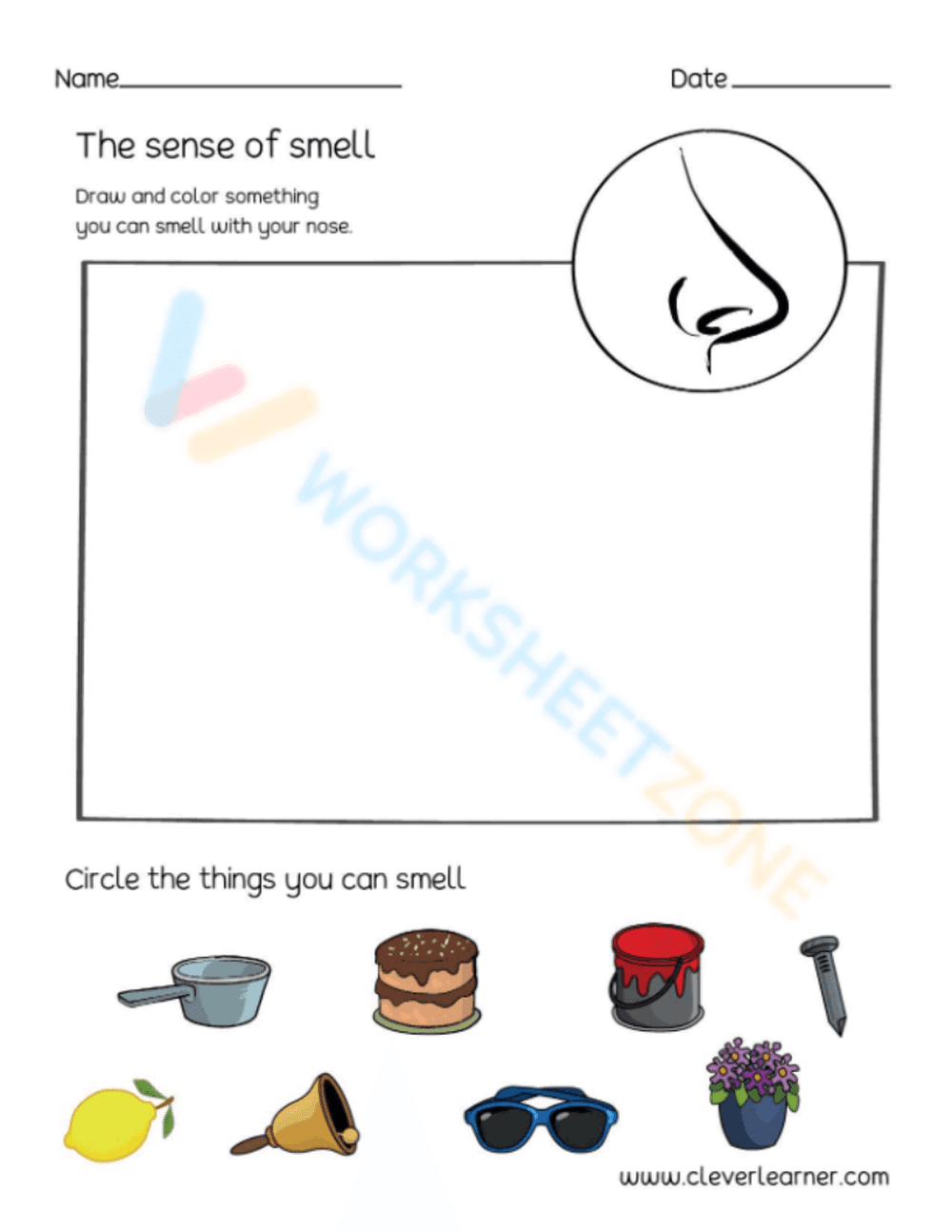

Sense of Smell Printable Worksheet | Kindergarten Science
Paste this activity's link or code into your existing LMS (Google Classroom, Canvas, Teams, Schoology, Moodle, etc.).
Students can open and work on the activity right away, with no student login required.
You'll still be able to track student progress and results from your teacher account.
This foundational science worksheet helps early learners identify and classify objects using their sense of smell. By connecting a specific body part—the nose—to its sensory function, students develop critical observation skills. The simple, visual format ensures young learners can successfully demonstrate their understanding of how we perceive the world around us.
At a Glance
- Grade: Kindergarten · Subject: Science
- Standard:
K-PS1-1— Classify materials by their observable properties- Skill Focus: Identifying objects by sense of smell
- Format: 1 page · 2 problems · No answer key needed · PDF
- Best For: Independent practice or centers
- Time: 10–15 minutes
Inside this single-page resource, educators will find two distinct task types for early learners. The first section features a creative drawing prompt where students illustrate an object they can smell, anchored by a nose icon. The second section provides a visual classification activity with eight familiar items—like a lemon and a cake—requiring students to circle only the objects that produce a scent. The clean layout utilizes recognizable clip art to support independent work.
This resource is designed for a zero-prep workflow, making it an ideal addition to any science unit.
- Print (30 seconds): Download the PDF and print a class set.
- Distribute (1 minute): Hand out the sheets with crayons. No special materials are required.
- Review (2 minutes): Quickly scan student drawings to check comprehension. Total teacher prep time is under two minutes, making this a perfect emergency sub plan.
This activity aligns directly with K-PS1-1: Plan and conduct an investigation to describe and classify different kinds of materials by their observable properties. By categorizing objects based on whether they can be smelled, students practice early scientific classification based on sensory input. Both standard codes can be copied directly into lesson plans, IEP goals, or district curriculum mapping tools.
Teachers can utilize this worksheet during a "Five Senses" unit, ideally after direct instruction. It serves as an excellent independent center activity. For a formative assessment observation tip, watch how students evaluate tricky items like the nail; ask them to explain their reasoning to gauge understanding. Expected completion time ranges from 10 to 15 minutes.
This resource is primarily designed for Kindergarten and Pre-K students, though it serves as a helpful review for first graders. The heavy reliance on visual cues makes it highly accessible for English Language Learners (ELLs) and students requiring modified assignments. It pairs naturally with a read-aloud book about the five senses or a hands-on smelling jars science station.
Integrating sensory classification tasks into early childhood education significantly enhances cognitive development and scientific reasoning. According to a recent ScienceDirect TpT Analysis, instructional materials that require students to map physical senses to environmental objects improve long-term retention of foundational science concepts. This worksheet supports that methodology by asking learners to classify materials by their observable properties, directly supporting the K-PS1-1 standard. When young students actively engage in identifying objects by sense of smell, they transition from passive observers to active categorizers of their environment. The dual approach of creative illustration and analytical selection ensures multiple neural pathways are activated during the learning process. By providing structured, visual frameworks for these abstract concepts, educators can foster a deeper, more intuitive understanding of human biology and physical science in early learners.


