


























Views
Downloads

Printable 3-Digit Integer Addition Worksheet | Grade 5 Math
Paste this activity's link or code into your existing LMS (Google Classroom, Canvas, Teams, Schoology, Moodle, etc.).
Students can open and work on the activity right away, with no student login required.
You'll still be able to track student progress and results from your teacher account.
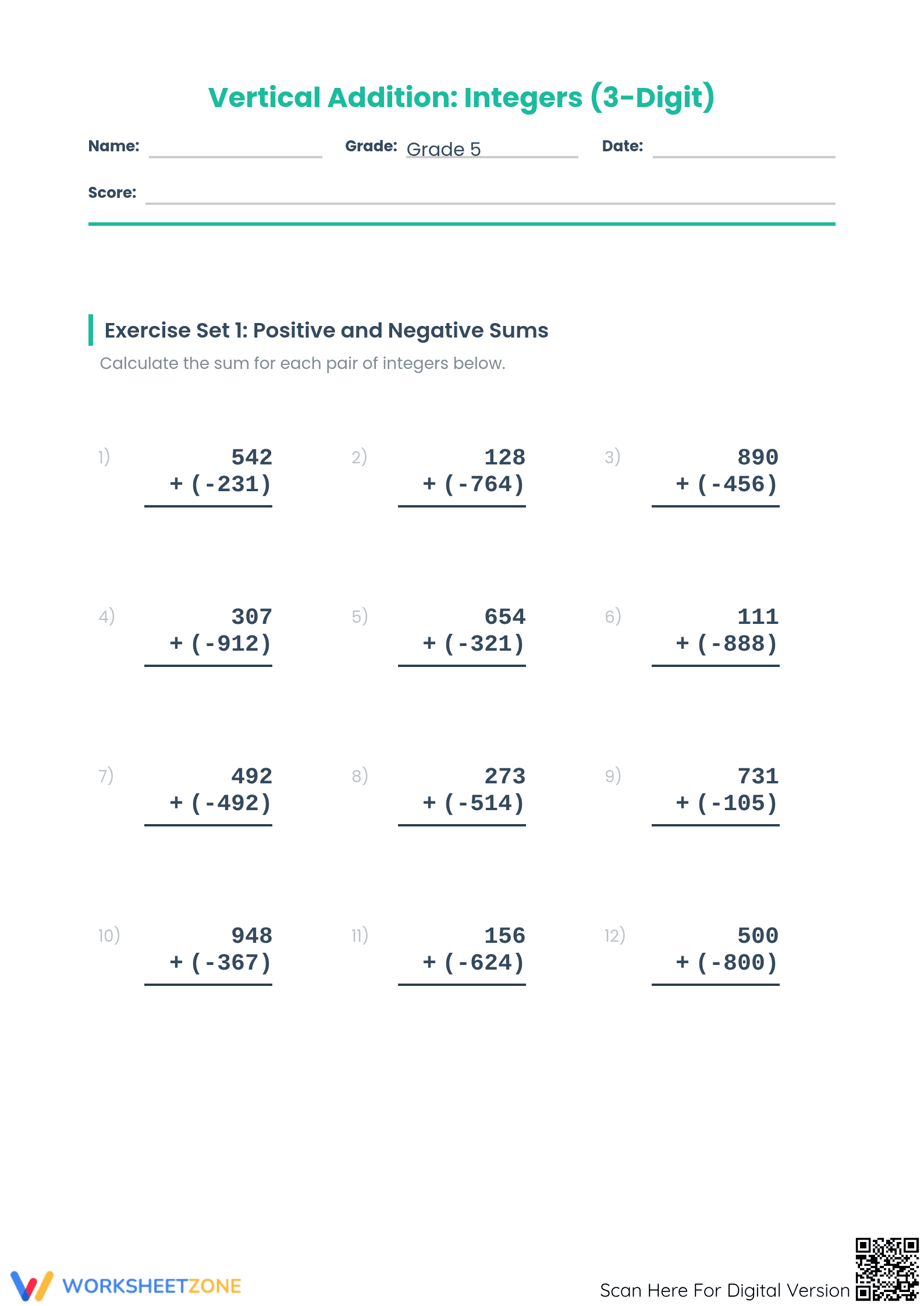
Build robust mathematical foundations with this Grade 5 worksheet focused on 3-digit vertical addition with integers. This resource helps students master the complexities of adding positive and negative values using the standard vertical algorithm. By engaging with 34 targeted problems, learners strengthen their mental math flexibility and operational accuracy across three varied exercise sets.
At a Glance
At a Glance
- Grade: 5 · Subject: Math Addition
- Standard:
CCSS.MATH.CONTENT.7.NS.A.1— Apply understandings of addition to add and subtract rational numbers including integers.- Skill Focus: 3-Digit Vertical Integer Addition
- Format: 3 pages · 34 problems · Answer key included · PDF
- Best For: Homework, independent practice, or math centers.
- Time: 25–40 minutes
What's Inside
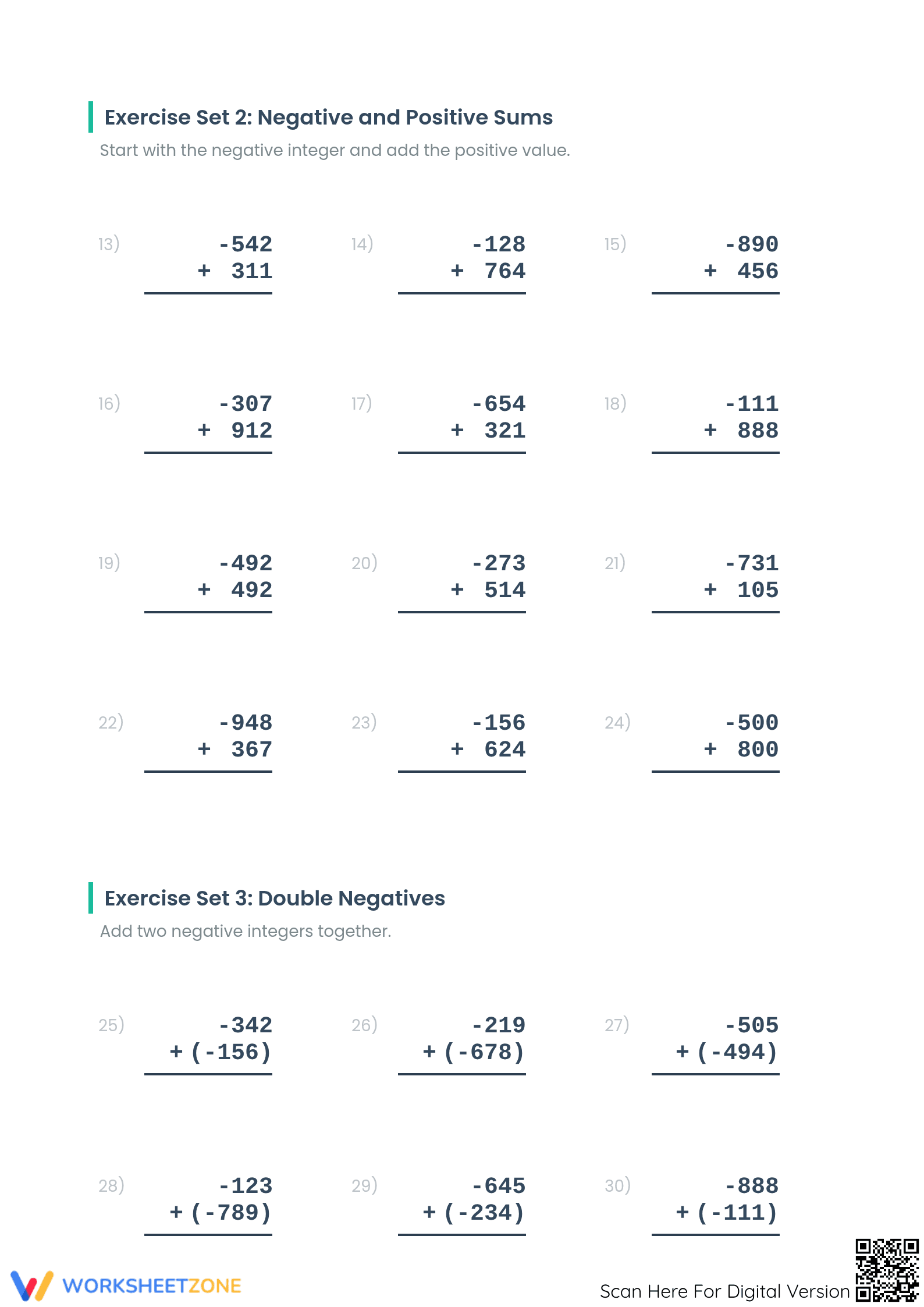
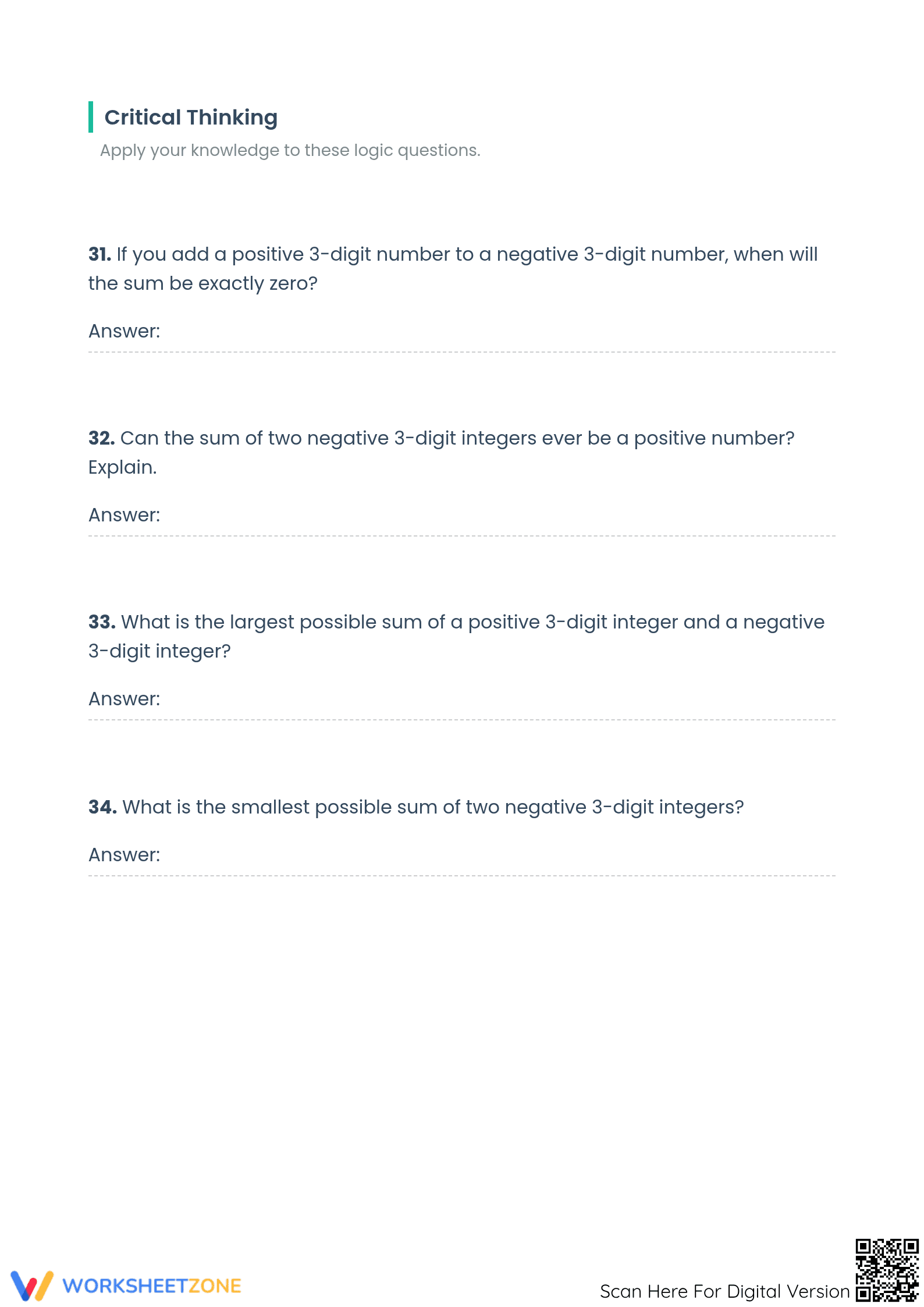
This three-page PDF provides a comprehensive look at integer operations. The first two pages feature 30 vertically aligned problems: positive and negative sums, negative and positive sums, and double-negative combinations. The third page presents four critical thinking questions requiring students to explain their reasoning. A complete answer key is included for rapid, zero-prep grading.
Skill Progression
- Guided Practice: Exercise Set 1 features 12 problems focused on adding negative values to positive integers, helping students visualize basic sign changes.
- Supported Practice: Exercise Set 2 reverses the order with negative-first problems, reinforcing commutative properties and absolute value comparisons.
- Independent Mastery: Set 3 and the Critical Thinking section demand total mastery of double-negative sums and conceptual logic behind zero-sum results.
The worksheet utilizes a gradual-release model, moving from structured calculation to abstract logical reasoning.
Standards Alignment
This resource is aligned with `CCSS.MATH.CONTENT.7.NS.A.1`. Students extend previous understandings of addition to calculate sums of integers. The vertical alignment bridges the gap between whole-number arithmetic and abstract signed integers. Both standard codes can be copied directly into lesson plans, IEP goals, or district curriculum mapping tools.
How to Use It
Use this worksheet as a summative assessment or a rigorous homework assignment. Teachers should observe students during the 'Double Negative' section to ensure they apply the correct sign rules. Expect completion of the 34-task set within 30 to 45 minutes. It serves as an excellent formative check for students transitioning to middle school algebra.
Who It's For
This material is ideal for Grade 5 students ready for accelerated topics or Grade 6-7 students requiring remedial support. It pairs well with a visual number line anchor chart. Differentiation is easy; teachers can assign specific sets based on a student's operational mastery or focus solely on the critical thinking prompts.
This instructional resource focuses on the computational fluency required for `CCSS.MATH.CONTENT.7.NS.A.1`, emphasizing the addition of positive and negative 3-digit integers. By transitioning from whole-number operations to signed sums, students develop a deeper understanding of the number line. Research by Fisher & Frey (2014) underscores that structured, repetitive practice with immediate feedback—facilitated by the included answer key—is essential for internalizing integer arithmetic rules. The worksheet provides 34 varied tasks, including critical thinking prompts that bridge procedural calculation and conceptual logic. As students move from positive-plus-negative sets to double-negative combinations, they build the cognitive scaffolding necessary for future algebraic success. This standalone PDF is designed for immediate classroom integration, serving as a robust tool for initial skill acquisition or remedial reinforcement in middle-grade mathematics curricula.


