


























Views
Downloads


Grade 1 Synonyms Matching — Printable No-Prep Worksheet
Paste this activity's link or code into your existing LMS (Google Classroom, Canvas, Teams, Schoology, Moodle, etc.).
Students can open and work on the activity right away, with no student login required.
You'll still be able to track student progress and results from your teacher account.
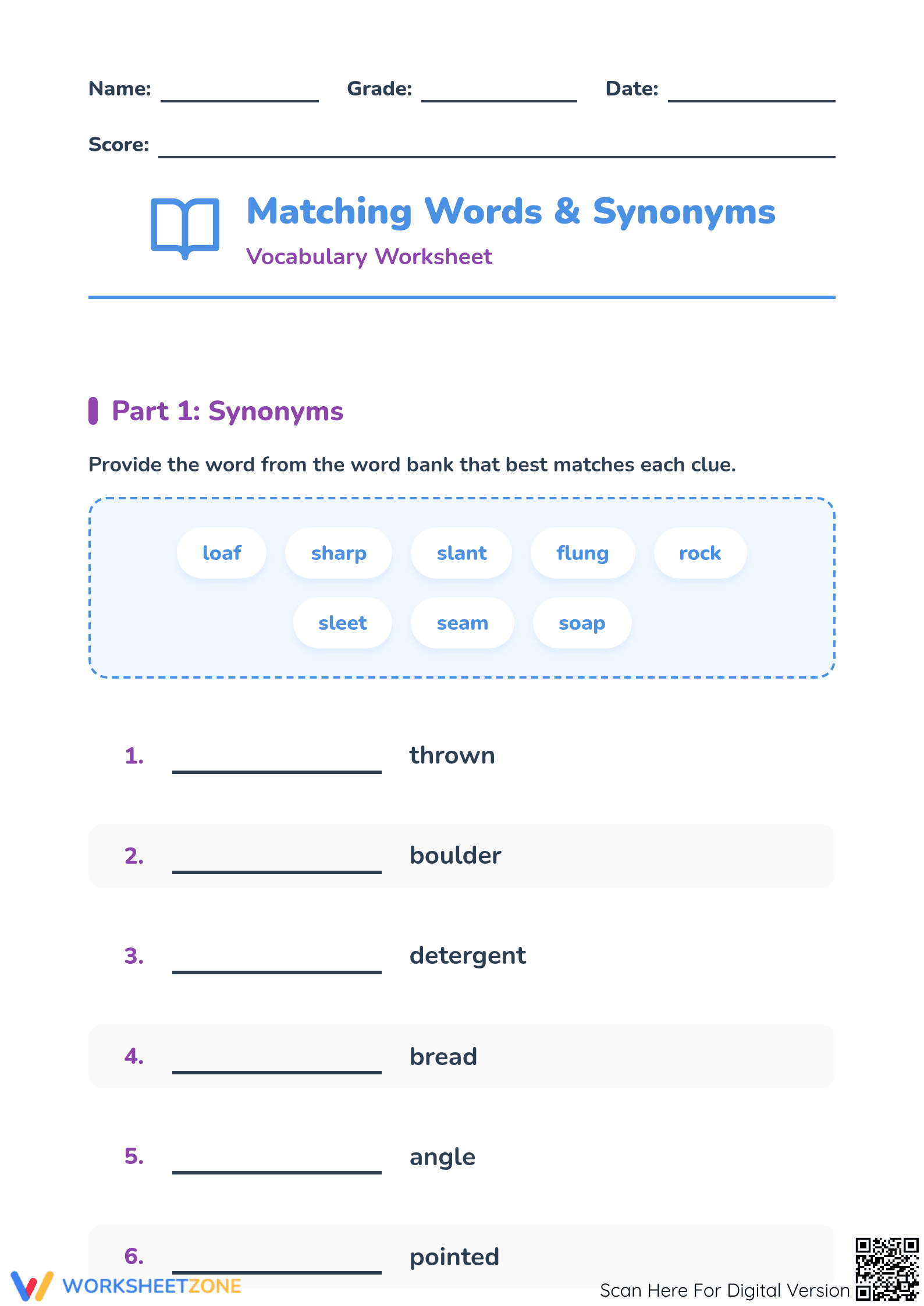
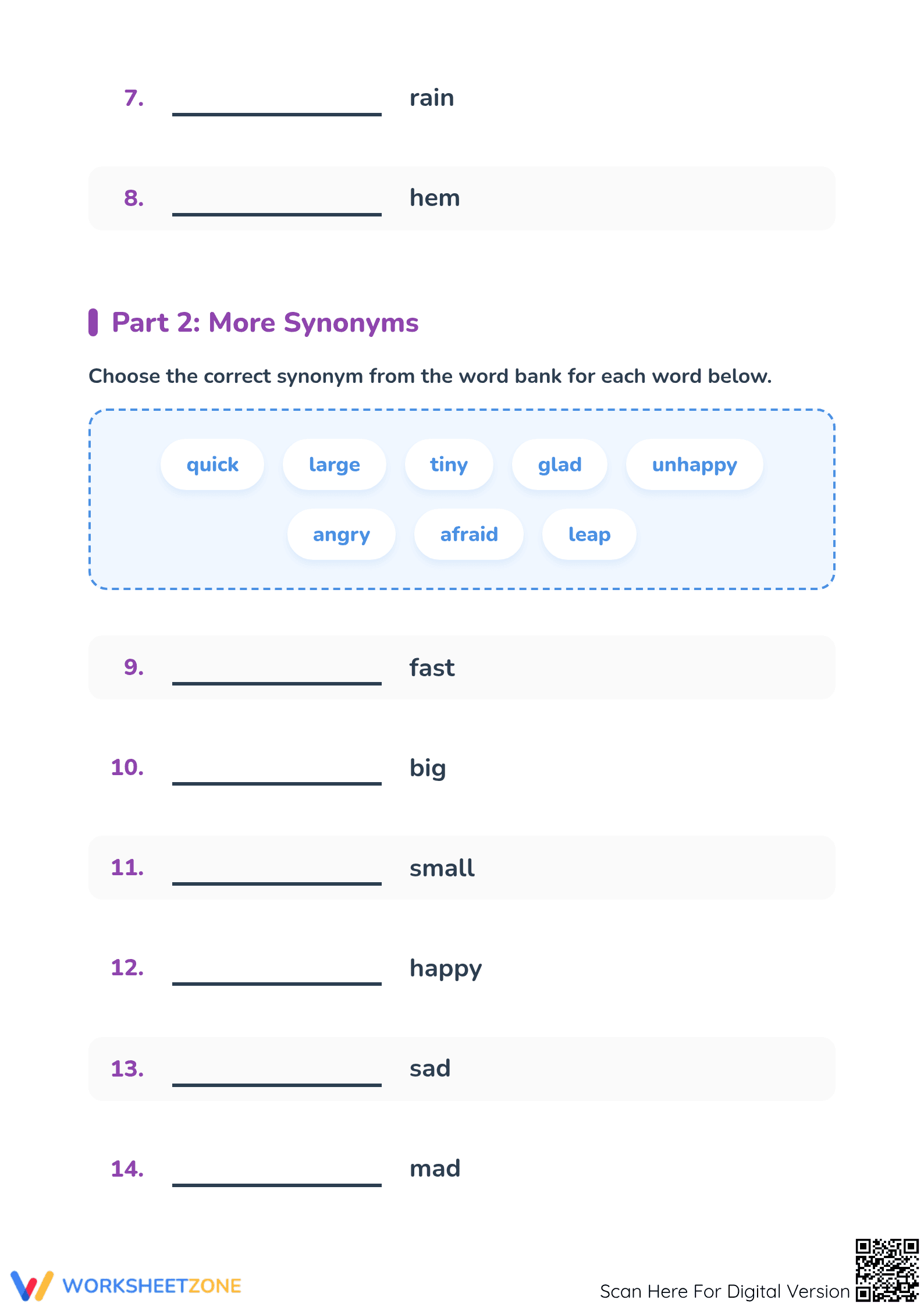
This Grade 1 synonym matching worksheet helps students identify words with similar meanings to expand their expressive vocabulary. By connecting familiar terms like big and large, learners strengthen their lexical retrieval and reading comprehension. This resource provides 16 structured opportunities for students to practice word substitution and semantic categorization in a clear, accessible format.
At a Glance
- Grade: 1 · Subject: English Language Arts
- Standard:
CCSS.ELA-LITERACY.L.1.5— Demonstrate understanding of word relationships and nuances in word meanings- Skill Focus: Synonym Identification
- Format: 3 pages · 16 problems · Answer key included · PDF
- Best For: Independent practice or morning work
- Time: 15–20 minutes
This comprehensive three-page PDF features two distinct sections of vocabulary practice. Part 1 focuses on eight specific nouns and verbs, such as boulder and thrown, while Part 2 introduces eight common adjectives and verbs like quick and leap. Each page includes a clear word bank to support spelling and word recognition, alongside a full answer key for rapid grading and immediate student feedback.
Zero-Prep Workflow
- Print (30 seconds): Select the specific pages needed for your lesson and print enough copies for your class.
- Distribute (30 seconds): Hand out the worksheets as a quiet transition activity or a focused literacy center task.
- Review (1 minute): Use the provided answer key to check student work or project it for a whole-class self-correction session.
Total teacher preparation time is under two minutes, making this an ideal resource for emergency sub plans or last-minute morning work.
Standards Alignment
This resource is aligned with CCSS.ELA-LITERACY.L.1.5, which requires students to demonstrate understanding of word relationships. By matching synonyms, students explore how different words can represent the same concept, a foundational skill for later writing development. Both standard codes can be copied directly into lesson plans, IEP goals, or district curriculum mapping tools.
How to Use It
Assign this worksheet during your independent practice phase of a gradual release lesson on vocabulary. It serves as an excellent formative assessment to see which students can independently identify semantic links. Alternatively, use it as a fast finisher activity to keep students engaged with meaningful language work while you provide small-group intervention to others. Expect completion in 15 to 20 minutes.
Who It's For
This worksheet is designed for first-grade students but is also suitable for second-grade review or English Language Learners (ELLs) building basic vocabulary. It pairs naturally with a classroom anchor chart displaying common synonym pairs or a direct instruction lesson on using a thesaurus to improve word choice in creative writing.
Research by Fisher & Frey (2014) emphasizes that vocabulary instruction is most effective when students are asked to manipulate words and identify relationships between them rather than simply memorizing definitions. This worksheet applies that principle by requiring students to actively match synonyms within a structured word bank, reinforcing the CCSS.ELA-LITERACY.L.1.5 standard. By engaging in these 16 lexical tasks, students build the cognitive pathways necessary for advanced reading comprehension and precise writing. Studies from the NAEP suggest that a robust understanding of word relationships in early elementary years is a significant predictor of long-term literacy success. This resource provides the repetitive, low-stakes practice needed to move vocabulary from short-term recognition to long-term mastery. Educators can use the results of this activity to identify specific gaps in semantic knowledge, allowing for targeted vocabulary interventions that support overall language development and academic growth across all subject areas.


