


























Views
Downloads

Essential Synonym Practice Worksheet | Grade 1 ELA
Paste this activity's link or code into your existing LMS (Google Classroom, Canvas, Teams, Schoology, Moodle, etc.).
Students can open and work on the activity right away, with no student login required.
You'll still be able to track student progress and results from your teacher account.
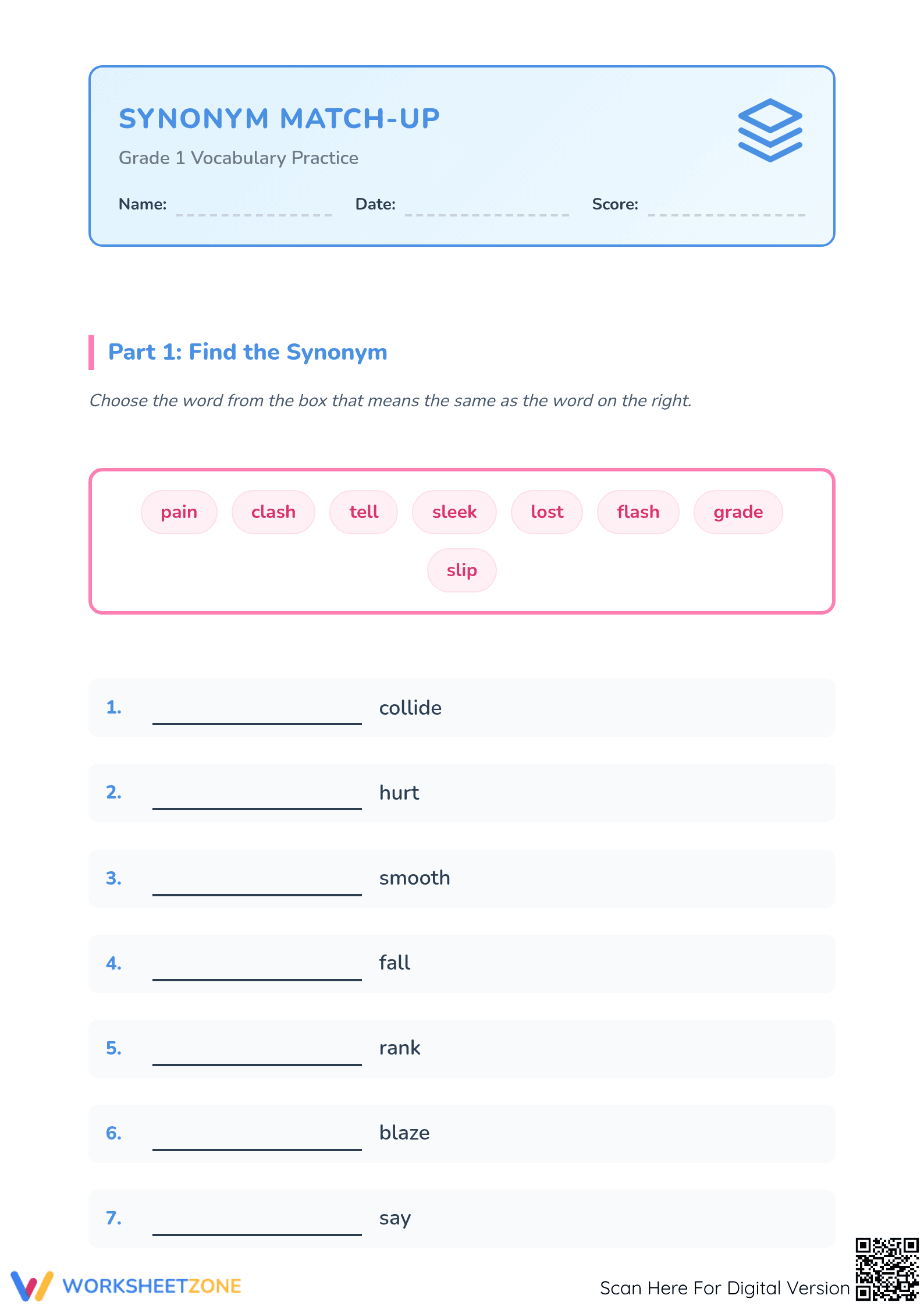
This Grade 1 synonym worksheet helps students identify and produce words with similar meanings to expand their early vocabulary. By engaging with 14 distinct lexical tasks, learners strengthen their understanding of how different words can describe the same concept. This resource provides immediate practice for foundational language skills essential for reading comprehension and expressive writing.
At a Glance
- Grade: 1 · Subject: ELA
- Standard:
CCSS.ELA-LITERACY.L.1.5.D— Distinguish shades of meaning among verbs and adjectives with similar meanings- Skill Focus: Synonym Identification and Production
- Format: 2 pages · 14 problems · Answer key included · PDF
- Best For: Independent practice or morning work
- Time: 15–20 minutes
What's Inside
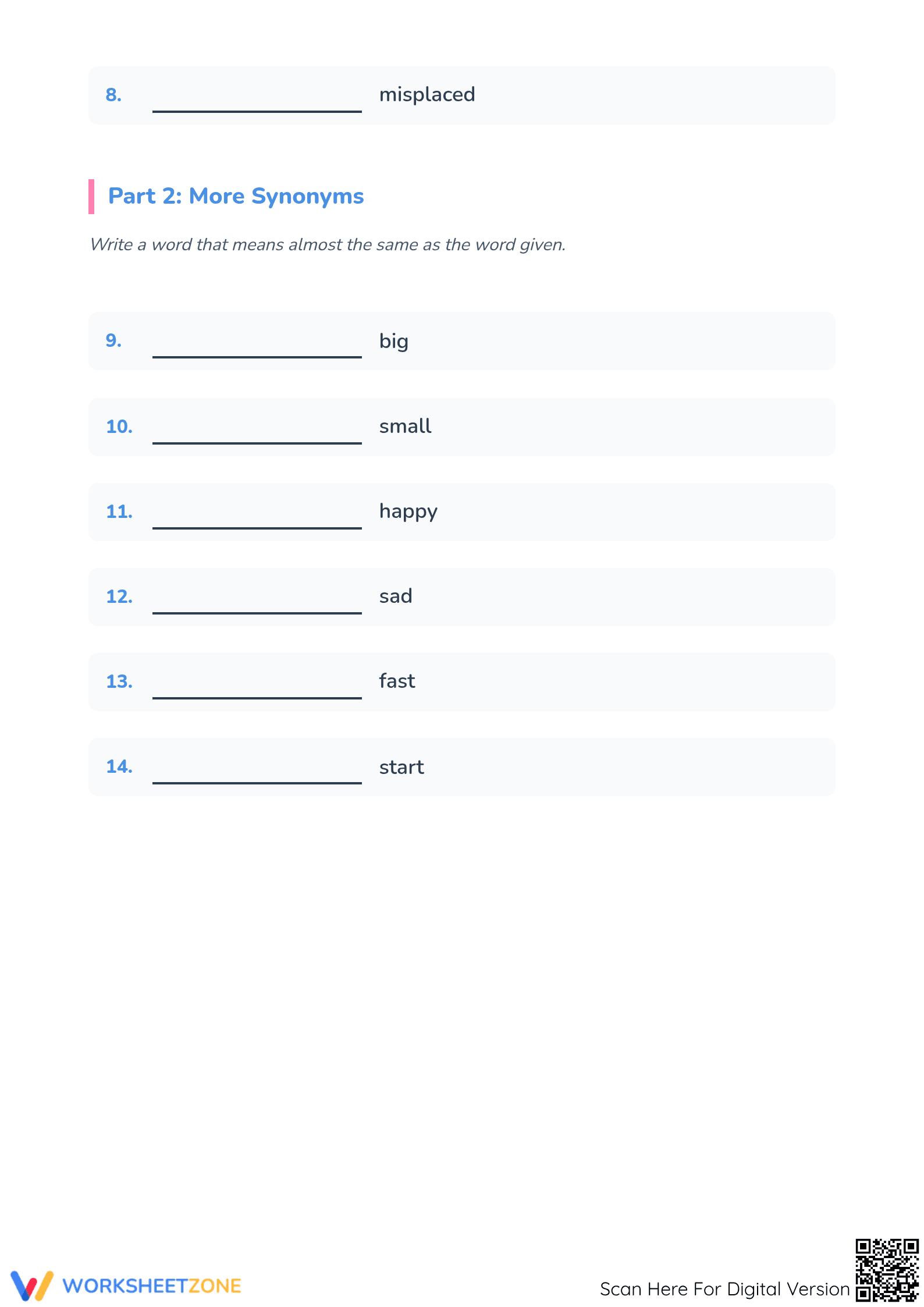
This two-page PDF features a structured approach to lexical development. The first page contains a word bank with eight terms and eight matching items, requiring students to select the correct synonym for words like "collide" and "blaze." The second page transitions to independent production, where students must generate their own synonyms for high-frequency adjectives such as "big," "happy," and "fast." A full answer key is provided for quick grading.
Zero-Prep Workflow
- Print: Generate the two-page document for your entire class in under 30 seconds.
- Distribute: Hand out the sheets and briefly explain the word bank mechanic for the first section.
- Review: Use the included answer key to facilitate quick grading or student self-correction.
Total teacher preparation time is under three minutes, making it an ideal choice for substitute plans or unexpected schedule gaps.
Standards Alignment
The primary focus is `CCSS.ELA-LITERACY.L.1.5.D`, which requires students to distinguish shades of meaning among verbs and adjectives. By matching "clash" with "collide" or "blaze" with "flash," students explore the nuances of word choice. This activity also supports `CCSS.ELA-LITERACY.L.1.6` by helping students acquire and use grade-appropriate words and phrases. Both standard codes can be copied directly into lesson plans, IEP goals, or district curriculum mapping tools.
How to Use It
Assign this worksheet during the independent practice phase of a gradual release lesson on vocabulary. It works effectively as a formative assessment after a direct instruction session on synonyms. Teachers should observe if students struggle with the transition from the word bank on page one to the independent writing on page two. Completion typically takes 15 to 20 minutes depending on student reading levels.
Who It's For
This worksheet is tailored for first-grade students but serves as an excellent review for second graders or a scaffolded resource for English Language Learners (ELLs). It pairs naturally with a classroom synonym anchor chart or a read-aloud focused on descriptive language. The clear layout and large font support students with fine motor challenges or those requiring visual clarity.
Research from Fisher & Frey (2014) emphasizes that vocabulary acquisition is most effective when students are asked to manipulate word meanings through matching and generative tasks. This worksheet implements those findings by moving from recognition (matching) to production (writing). By focusing on CCSS.ELA-LITERACY.L.1.5.D, the resource addresses the critical need for students to understand shades of meaning, a skill that NAEP data suggests is a significant predictor of long-term reading proficiency. The inclusion of 14 targeted tasks ensures sufficient repetition for memory retention without overwhelming young learners. Educators can rely on this structured approach to build the lexical flexibility required for complex text analysis in later grades. This evidence-based design ensures that students are not just memorizing definitions but are actively categorizing and retrieving related linguistic concepts in a way that mirrors natural language development.


