


























Views
Downloads
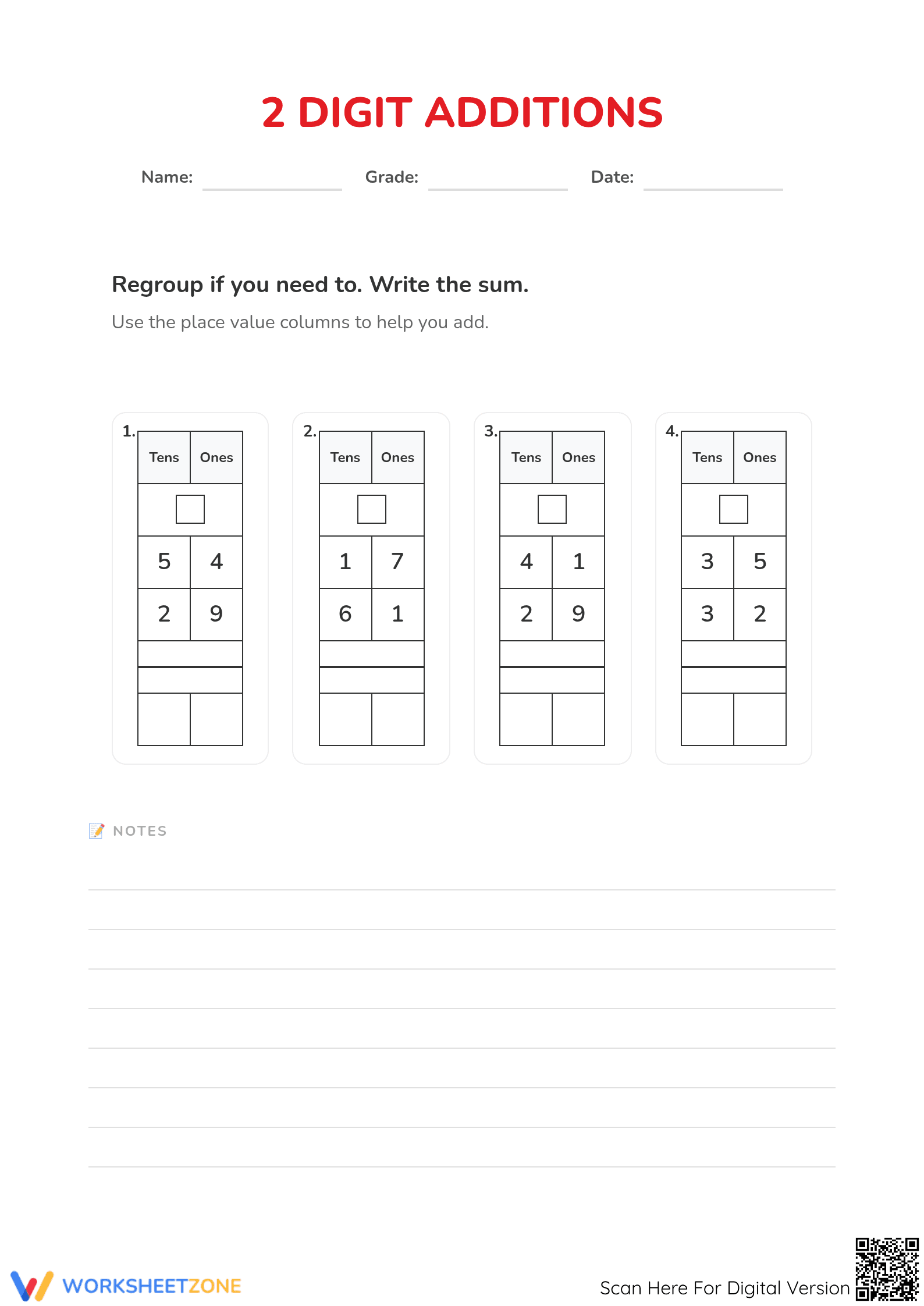


2-Digit Addition with Regrouping Essential Worksheet
Paste this activity's link or code into your existing LMS (Google Classroom, Canvas, Teams, Schoology, Moodle, etc.).
Students can open and work on the activity right away, with no student login required.
You'll still be able to track student progress and results from your teacher account.
Strengthen foundational numeracy with this comprehensive 2-digit addition with regrouping practice set. Designed for second-grade students, this worksheet focuses on the critical transition from basic addition to multi-digit operations. Students master the mechanics of carrying over ones to the tens place, ensuring a deep understanding of mathematical structure and regrouping principles.
At a Glance
- Grade: 2 · Subject: Math
- Standard:
CCSS.MATH.CONTENT.2.NBT.B.5— Add numbers within 100 using place value strategies and regrouping- Skill Focus: 2-Digit Addition with Regrouping
- Format: 4 pages · 36 problems · Answer key included · PDF
- Best For: Independent practice and homework assignments
- Time: 25–40 minutes
This four-page instructional resource contains 36 carefully sequenced problems. The first two pages utilize a vertical column format with explicit 'Tens' and 'Ones' labels and regrouping boxes to scaffold the learning process. The final two pages transition students to standard vertical addition without labels, encouraging fluency and independent mastery. A comprehensive answer key is provided to facilitate quick grading and self-correction.
Zero-Prep Workflow
Implementing this resource into your daily routine is efficient and straightforward. First, print the four-page PDF, which takes less than 30 seconds. Next, distribute the packets to your class; the clear instructions and modeled columns mean no additional teacher setup or complex explanations are required. Finally, use the provided answer key to review student work in under two minutes. This zero-prep workflow makes it an ideal choice for emergency sub plans or last-minute assessments.
Standards Alignment
This resource is strictly aligned with CCSS.MATH.CONTENT.2.NBT.B.5, which requires students to fluently add within 100 using strategies based on place value and properties of operations. It also supports the foundational skills needed for CCSS.MATH.CONTENT.2.NBT.B.6, adding up to four two-digit numbers. Both standard codes can be copied directly into lesson plans, IEP goals, or district curriculum mapping tools to track student progress toward mastery.
How to Use It
Assign this packet during the 'Independent Practice' phase of your math block to reinforce direct instruction on regrouping. For a formative check, observe students during the first four problems on page one to ensure they are correctly placing the 'carried' ten in the regrouping box. Expect most students to complete the 36-problem set within 35 minutes, though the structured pages allow for easy segmenting across multiple days or as targeted intervention.
Who It's For
This worksheet is specifically tailored for second-grade learners but serves as excellent remediation for third graders struggling with fluency. It pairs naturally with place value mats or base-ten block manipulatives for students requiring additional concrete support. The graduated difficulty from labeled columns to standard vertical formats provides built-in differentiation for diverse classroom populations, ensuring all students can access the curriculum successfully.
The effectiveness of scaffolded place value columns in multi-digit addition is supported by Fisher & Frey (2014) in their research on the Gradual Release of Responsibility model. By providing explicit 'Tens' and 'Ones' visual cues on the initial pages, this worksheet reduces the cognitive load on early learners, allowing them to focus on the procedural logic of regrouping before moving to abstract vertical formats. This approach aligns with NAEP findings suggesting that students who master place value strategies in second grade show significantly higher proficiency in complex arithmetic by the end of primary school. The 36-problem volume ensures sufficient repetition for neural encoding while the answer-key-driven feedback loop supports self-regulated learning. Educators can rely on this standard-aligned resource to build the procedural fluency required by CCSS.MATH.CONTENT.2.NBT.B.5 and ensure students are prepared for the higher-order demands of third-grade mathematics.


