


























Views
Downloads

2-Digit + 1-Digit Addition Worksheet | Printable
Paste this activity's link or code into your existing LMS (Google Classroom, Canvas, Teams, Schoology, Moodle, etc.).
Students can open and work on the activity right away, with no student login required.
You'll still be able to track student progress and results from your teacher account.
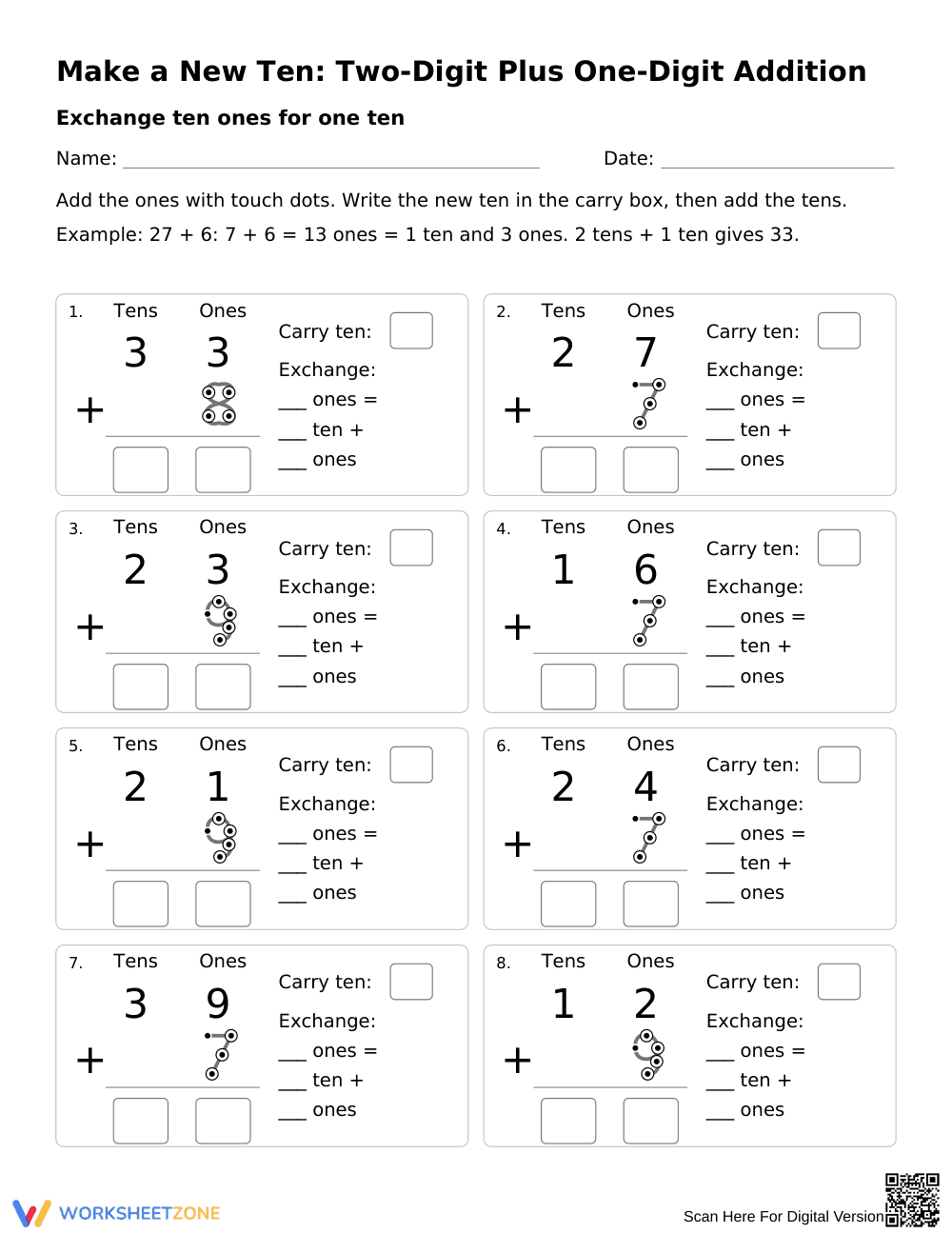
This printable Grade 1 math worksheet helps students master two-digit plus one-digit addition by explicitly teaching how to compose a new ten. By using visual touch dots and structured regrouping boxes, young learners build a strong foundational understanding of place value and addition with regrouping.
At a Glance
- Grade: 1 · Subject: Math
- Standard:
CCSS.MATH.CONTENT.1.NBT.C.4— Add a two-digit and a one-digit number, composing a ten.- Skill Focus: Addition with regrouping
- Format: 2 pages · 16 problems · Answer key included · PDF
- Best For: Independent practice and scaffolding
- Time: 15–20 minutes
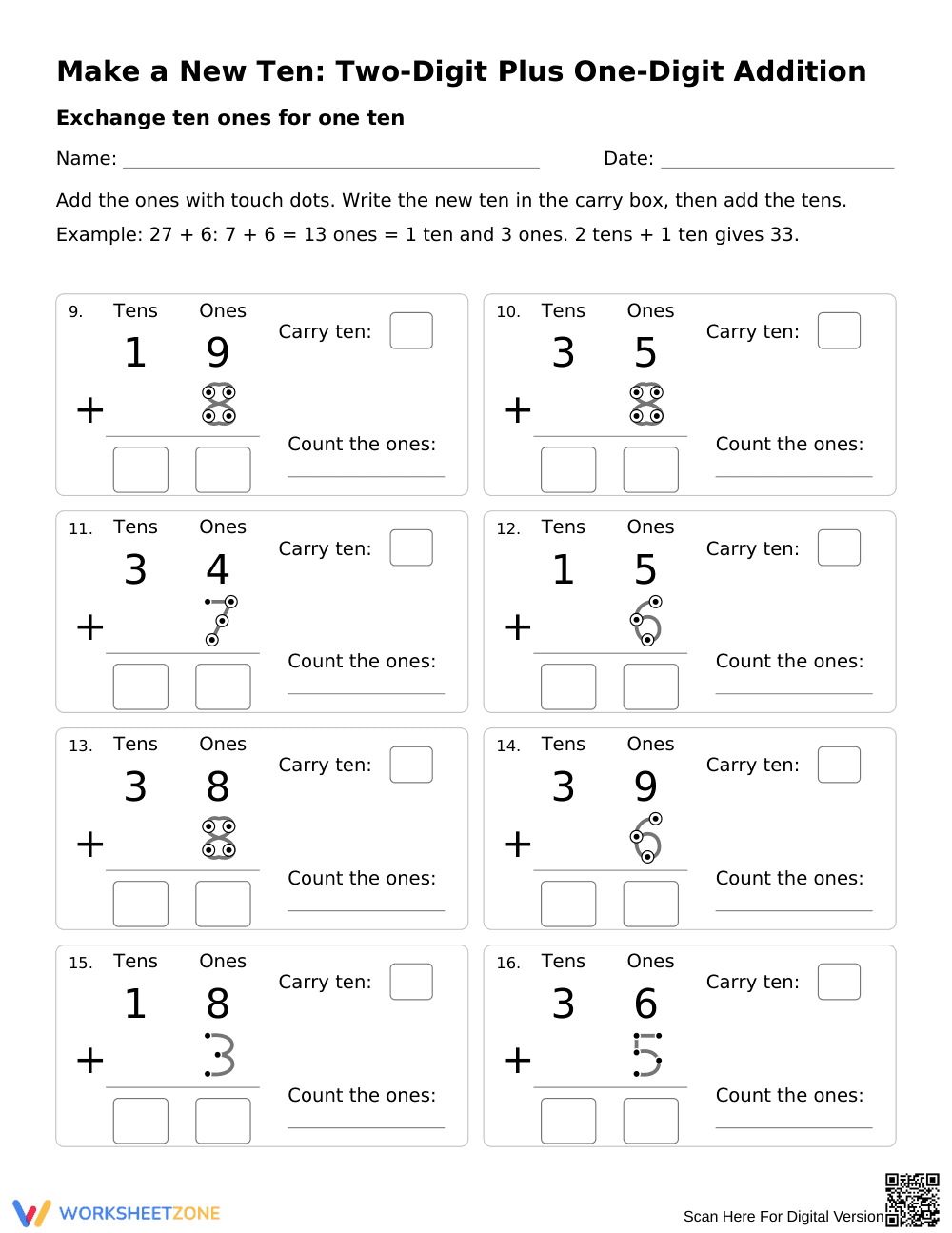
This resource includes two pages of targeted practice featuring 16 total problems. The first page provides heavy scaffolding, requiring students to explicitly write out the exchange of ten ones for one ten. The second page slightly reduces the scaffolding by asking students to count the ones while still providing the carry box. A complete answer key is provided, detailing the exact number of ones and the carried ten for every single equation.
- Guided practice: The first 8 problems feature detailed exchange prompts, asking students to break down the ones into a new ten and remaining ones.
- Supported practice: The next 8 problems transition to a slightly more streamlined format, prompting students to count the ones and use the carry box.
- Independent practice: Visual touch dots on the single-digit numbers remain consistent throughout, providing a reliable counting-on strategy for all 16 tasks.
This gradual-release structure ensures students internalize the "I Do, We Do, You Do" progression of regrouping.
Aligned to primary standard CCSS.MATH.CONTENT.1.NBT.C.4, this worksheet ensures students can add within 100, specifically focusing on adding a two-digit number and a one-digit number while understanding that it is sometimes necessary to compose a ten. The visual models reinforce place value concepts. Both standard codes can be copied directly into lesson plans, IEP goals, or district curriculum mapping tools.
Use this worksheet during independent math centers after direct instruction on regrouping. It also serves as an excellent targeted intervention tool for small groups struggling with place value. As a formative assessment observation tip, watch how students interact with the touch dots; if they rely heavily on counting every dot rather than counting on from the two-digit number, they may need additional number sense review. Expected completion time is 15 to 20 minutes.
This resource is designed for first-grade students learning to regroup for the first time, as well as second-grade students needing a foundational review. The explicit visual scaffolds make it highly effective for special education students or those requiring concrete place value supports. Pair this worksheet with base-ten blocks or a place value anchor chart for maximum instructional impact.
Mastering place value and regrouping is a critical milestone in early elementary mathematics. According to the RAND AIRS 2024 report, explicit visual scaffolding and structured practice significantly improve student retention of complex mathematical procedures. This worksheet directly supports CCSS.MATH.CONTENT.1.NBT.C.4 by requiring students to add a two-digit and a one-digit number, composing a ten. By breaking down the abstract concept of "carrying" into a concrete exchange of ones for a ten, the resource minimizes cognitive overload. The inclusion of touch dots provides an embedded counting strategy, allowing students to focus on the place value exchange rather than basic fact retrieval. Consistent practice with these structured visual models ensures that young learners develop the procedural fluency and conceptual understanding necessary for advanced arithmetic in later grades.


