


























Views
Plays
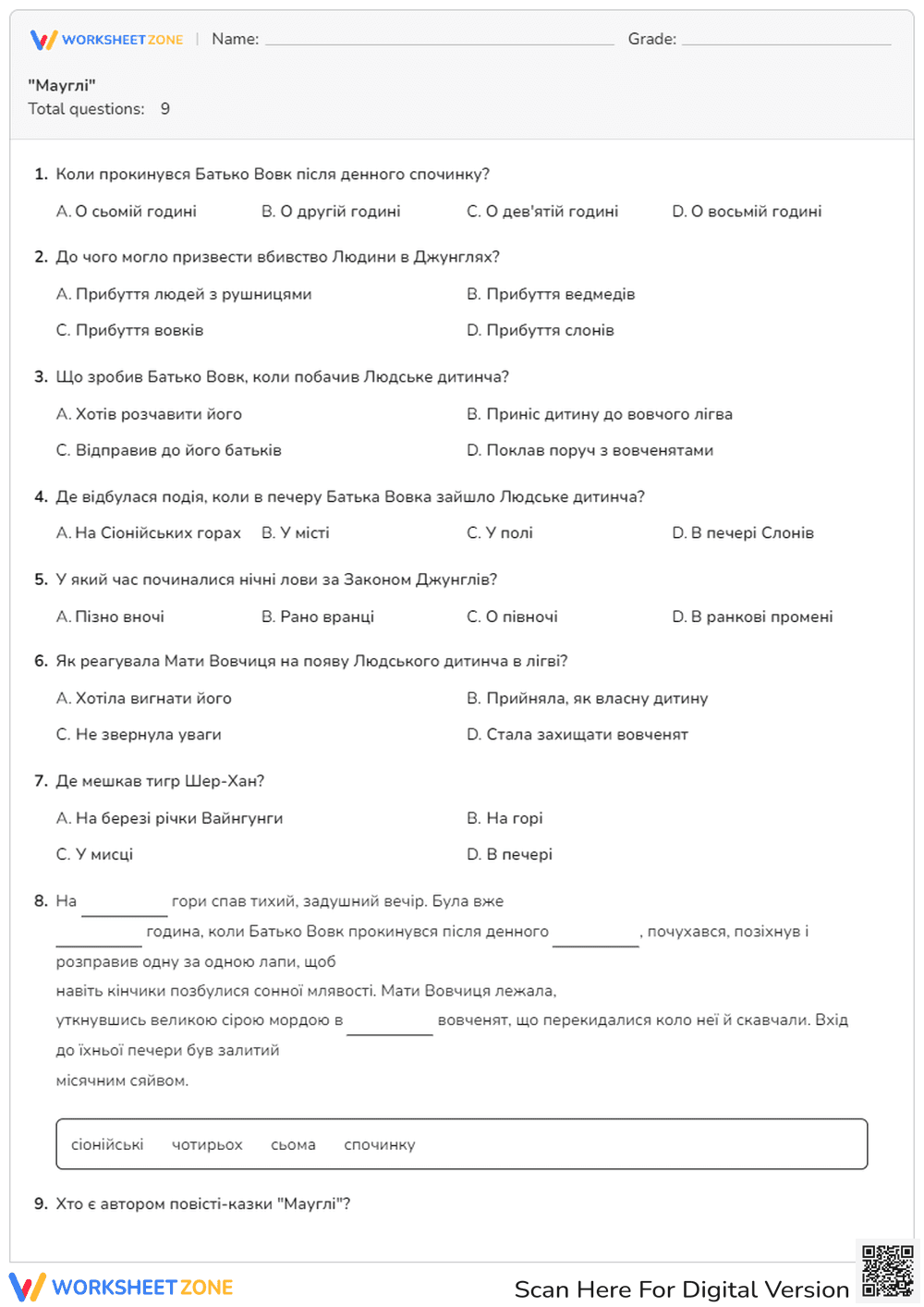


Mowgli Reading Quiz | Grade 5 Essential ELA Worksheet
Paste this activity's link or code into your existing LMS (Google Classroom, Canvas, Teams, Schoology, Moodle, etc.).
Students can open and work on the activity right away, with no student login required.
You'll still be able to track student progress and results from your teacher account.
This Grade 5 reading comprehension worksheet provides students with 9 structured problems to demonstrate mastery of literary details from the story of Mowgli. Students analyze character actions, setting, and plot points through multiple-choice and fill-in-the-blank tasks. It ensures learners can cite specific evidence from the narrative to support their answers effectively.
At a Glance
- Grade: 5 · Subject: ELA
- Standard:
CCSS.ELA-LITERACY.RL.5.1— Quote accurately from a text when explaining what the text says explicitly- Skill Focus: Literary Comprehension
- Format: 2 pages · 9 problems · Answer key included · PDF
- Best For: Quick formative assessment or sub plans
- Time: 15–20 minutes
The resource features a 2-page layout including a 9-question assessment and a lined notes page for extended responses. The quiz contains 7 multiple-choice questions focusing on specific plot points, a cloze-style paragraph with a 4-word bank for contextual vocabulary, and a final author identification task. The clean formatting allows for immediate student engagement without visual clutter or unnecessary distractions.
This worksheet is designed for a 3-step classroom workflow. First, print the 2-page PDF (30 seconds). Second, distribute to students for independent work or a quiet reading check (15 minutes). Finally, review the answers as a whole group to address misconceptions (5 minutes). Total teacher preparation time is under 2 minutes, making it an ideal addition to any emergency sub-plan folder.
This resource aligns with `CCSS.ELA-LITERACY.RL.5.1`, which requires students to quote accurately from a text when explaining what the text says explicitly and when drawing inferences. It also supports RL.5.3 by asking students to identify specific interactions between characters and the setting. Both standard codes can be copied directly into lesson plans, IEP goals, or district curriculum mapping tools.
Use this worksheet as an exit ticket after reading the initial chapters of the story to gauge student understanding of the Jungle Law and character introductions. Alternatively, assign it as a formative assessment during a literature circle rotation. Teachers should observe if students struggle with the cloze paragraph, which indicates a need for more support with narrative sequence. Completion typically takes 15 to 20 minutes.
This worksheet is designed for Grade 5 students but is adaptable for Grade 4 or Grade 6 learners needing focused comprehension practice. It serves as an excellent resource for English Language Learners (ELL) due to the clear word bank and structured question format. Pair this with an anchor chart on citing text evidence for a complete instructional block.
According to the RAND AIRS 2024 report, structured comprehension checks that require students to return to the text for specific details significantly improve long-term retention of literary themes. This worksheet targets CCSS.ELA-LITERACY.RL.5.1 by forcing engagement with explicit text details, such as character names and specific times of day mentioned in the narrative. By utilizing a mix of multiple-choice and fill-in-the-blank tasks, the resource provides the scaffolded retrieval recommended by Fisher & Frey (2014) for developing readers. Research from EdReports 2024 suggests that high-quality, standards-aligned materials like this one help bridge the gap between surface-level reading and deep literary analysis. This 9-task assessment ensures that Grade 5 students are not just reading but actively processing the text for mastery.


