


























Views
Downloads

Essential Addition and Subtraction Worksheet | Grade 2
Paste this activity's link or code into your existing LMS (Google Classroom, Canvas, Teams, Schoology, Moodle, etc.).
Students can open and work on the activity right away, with no student login required.
You'll still be able to track student progress and results from your teacher account.
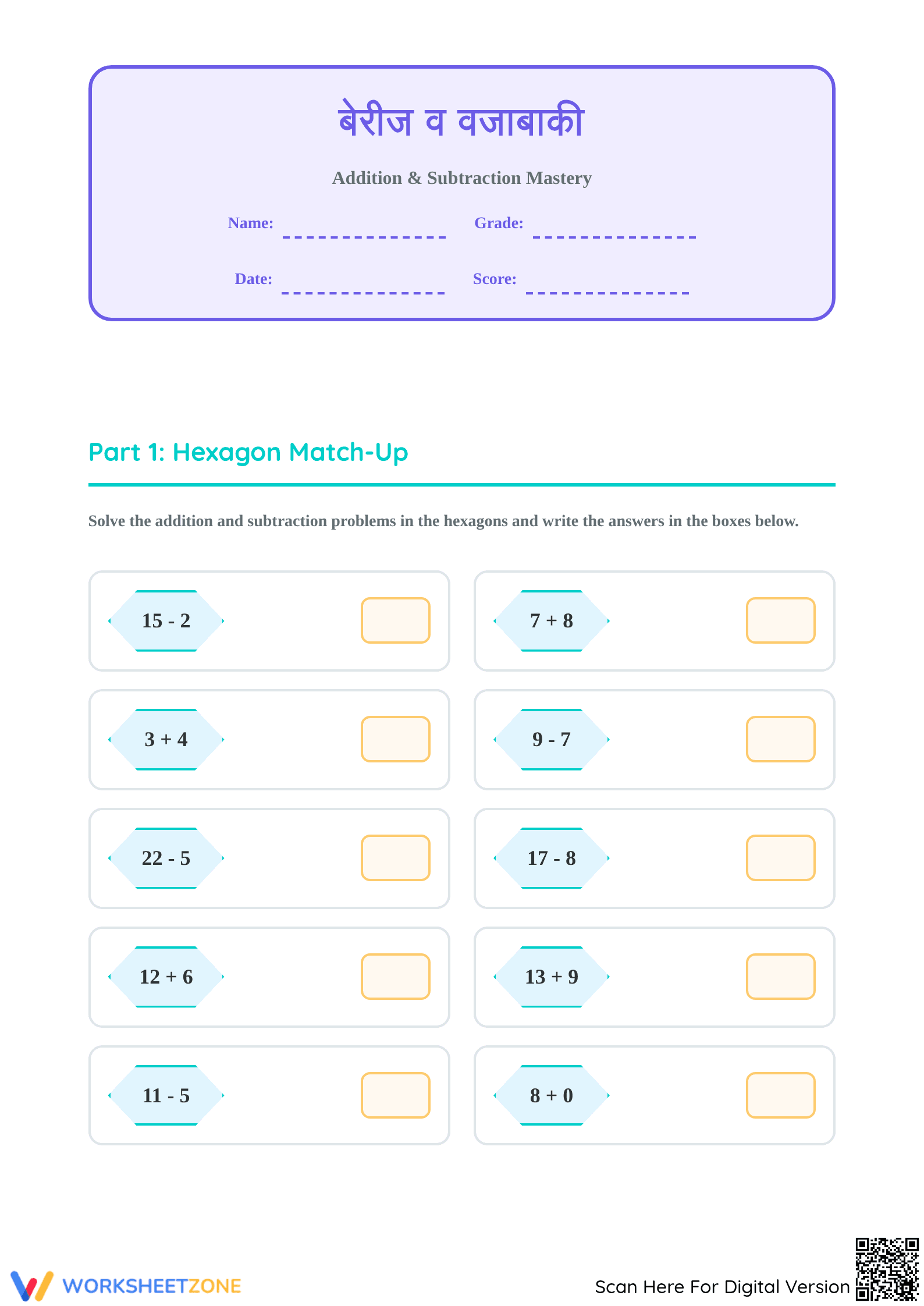
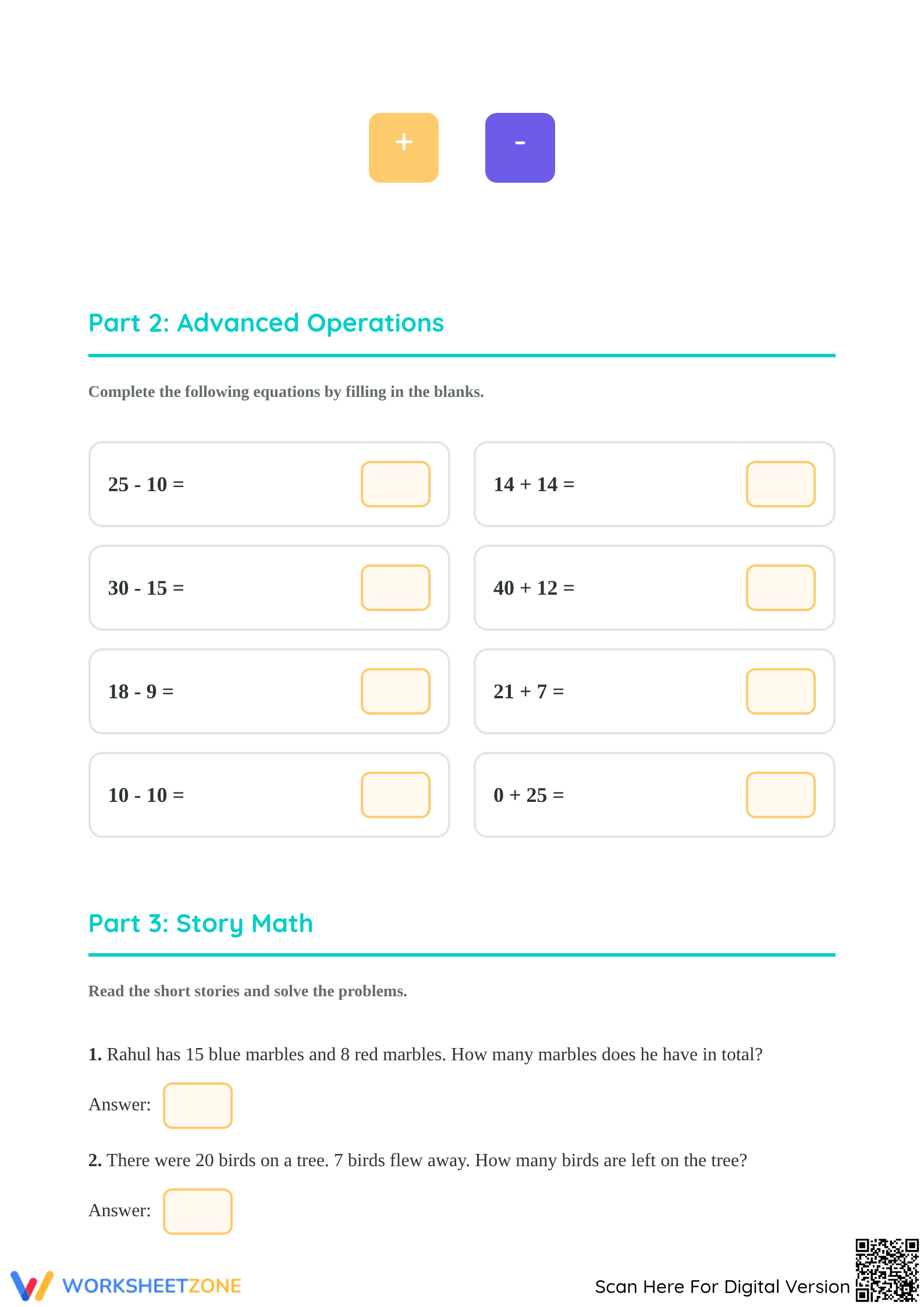
This three-page math worksheet provides essential practice in mixed addition and subtraction for elementary learners. Students build computational fluency by progressing from hexagon match-up tasks to advanced operations and complex story problems. The resource ensures students develop a deep understanding of inverse operations and mathematical relationships through focused practice.
At a Glance
- Grade: Grade 2 · Subject: Math
- Standard:
CCSS.MATH.CONTENT.2.NBT.B.5— Fluently add and subtract within 100 using strategies based on place value- Skill Focus: Mixed addition and subtraction operations
- Format: 3 pages · 30 problems · Answer key included · PDF
- Best For: Homework, independent practice, or math centers
- Time: 25–40 minutes
What's Inside
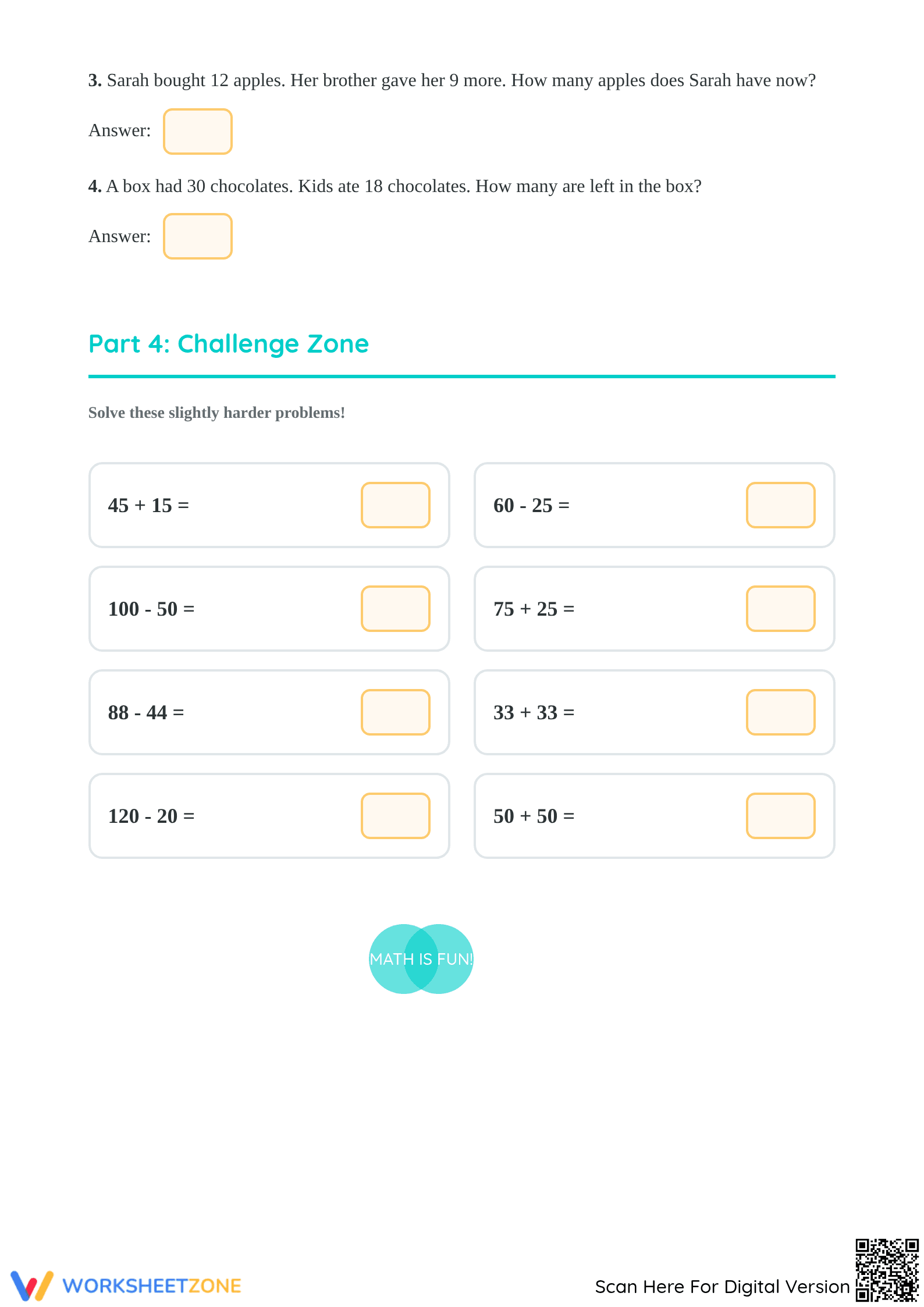
The three-page PDF features Marathi and English headings with ten Hexagon Match-Up problems for initial confidence, eight Advanced Operations for mental math, and four Story Math word problems. The Challenge Zone offers eight high-complexity problems reaching up to 120. A full answer key is included to ensure easy grading and provide immediate student feedback.
Skill Progression
- Guided Practice: The Hexagon Match-Up section uses visual cues to help students solve ten fundamental addition and subtraction problems within 25.
- Supported Practice: The Advanced Operations and Story Math sections provide twelve problems that bridge the gap between simple computation and practical application.
- Independent Practice: The Challenge Zone presents eight rigorous problems requiring students to apply mental math strategies to larger numbers independently.
This gradual-release model follows the proven I Do, We Do, You Do instructional framework to support student success.
Standards Alignment
The primary alignment is CCSS.MATH.CONTENT.2.NBT.B.5: "Fluently add and subtract within 100 using strategies based on place value, properties of operations, and/or the relationship between addition and subtraction." Additionally, the word problems support CCSS.MATH.CONTENT.2.OA.A.1 for solving one-step story problems. Both standard codes can be copied directly into lesson plans, IEP goals, or district curriculum mapping tools for easy tracking.
How to Use It
Assign this worksheet during independent practice after teaching place value strategies for addition and subtraction. It serves as a strong formative assessment tool; observe if students use finger counting or more efficient mental strategies like making a ten. Expected completion time ranges from 25 to 40 minutes. Use the story problems to spark class discussions about real-world math applications during review.
Who It's For
This resource is tailored for second-grade students mastering double-digit operations, though it offers meaningful review for third graders or extension for advanced first graders. The inclusion of word problems and a challenge section allows for easy differentiation for diverse learners. It pairs naturally with base-ten blocks or number line anchor charts to support visual learners during the instructional cycle.
Effective math instruction requires a balance of procedural fluency and conceptual understanding, as emphasized in the CCSS.MATH.CONTENT.2.NBT.B.5 standard. This worksheet targets the plain-English skill of adding and subtracting within 100 by providing varied practice formats that reduce cognitive load while increasing task complexity. Research by Fisher & Frey (2014) indicates that a gradual release of responsibility, moving from scaffolded matching tasks to independent story problems, significantly improves retention of mathematical operations. By including thirty distinct tasks, the resource provides the necessary repetition for students to internalize place value strategies and the relationship between inverse operations. Such structured practice is vital for developing the mental agility required for higher-order mathematics. Educators can rely on this assessment-aligned tool to bridge the gap between direct instruction and mastery, ensuring students meet grade-level expectations with precision across multiple instructional contexts.


