


























Views
Downloads


Essential Grade 2: 1-100 Number Chart & Pattern Worksheet
Paste this activity's link or code into your existing LMS (Google Classroom, Canvas, Teams, Schoology, Moodle, etc.).
Students can open and work on the activity right away, with no student login required.
You'll still be able to track student progress and results from your teacher account.
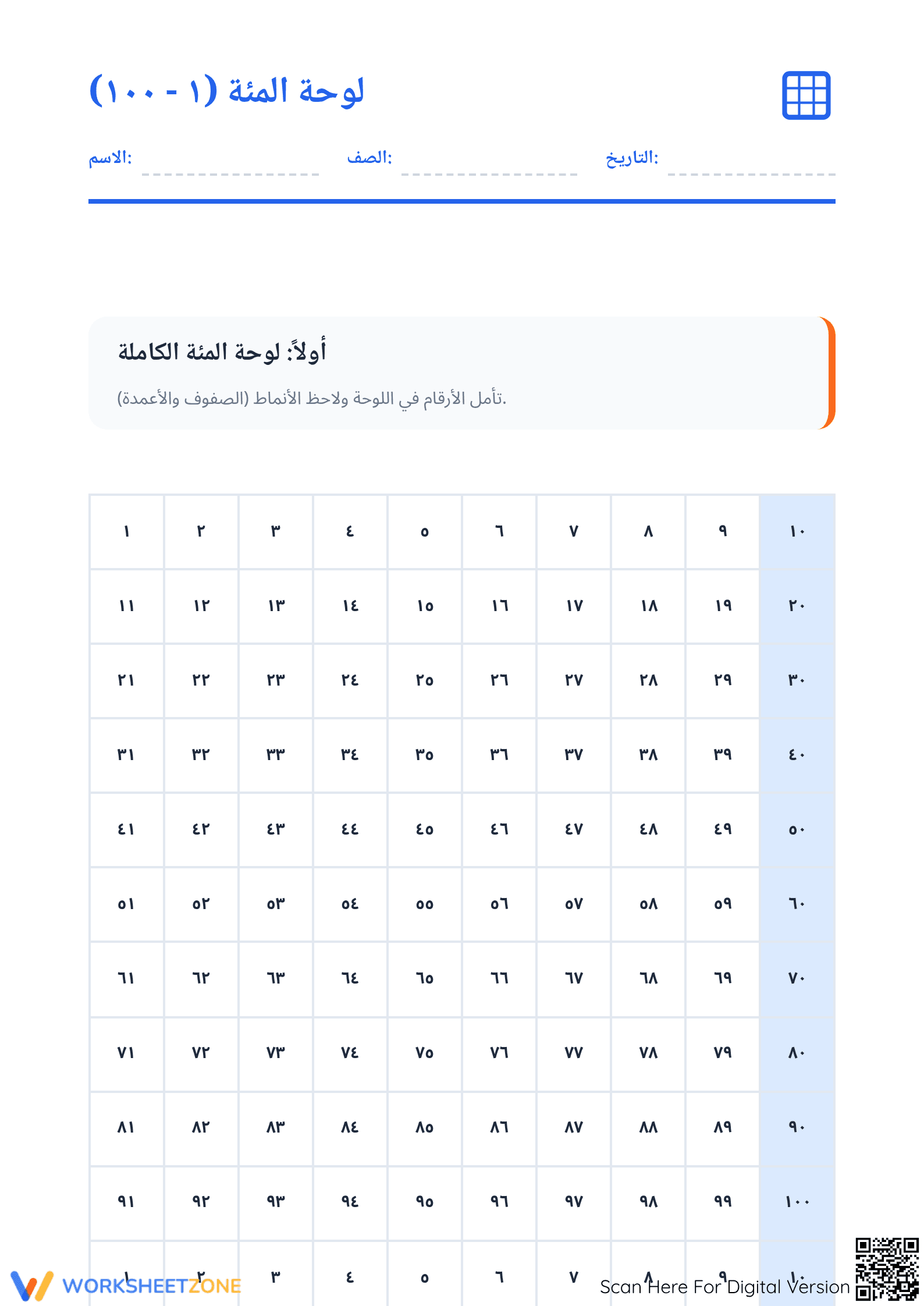
This comprehensive 4-page worksheet helps Grade 2 students master number sequences from 1 to 100 through structured practice and pattern analysis. Students will complete partial charts, practice skip counting by various intervals, and identify even or odd numbers. It serves as an essential tool for building a strong foundation in place value and number operations.
At a Glance
- Grade: 2 · Subject: Math
- Standard:
CCSS.MATH.CONTENT.2.NBT.A.2— Skip-count by 5s and 10s within 100 to build number sense- Skill Focus: Number sequences and patterns 1-100
- Format: 4 pages · 12 problems · Answer key included · PDF
- Best For: Daily number sense or morning work
- Time: 20–30 minutes
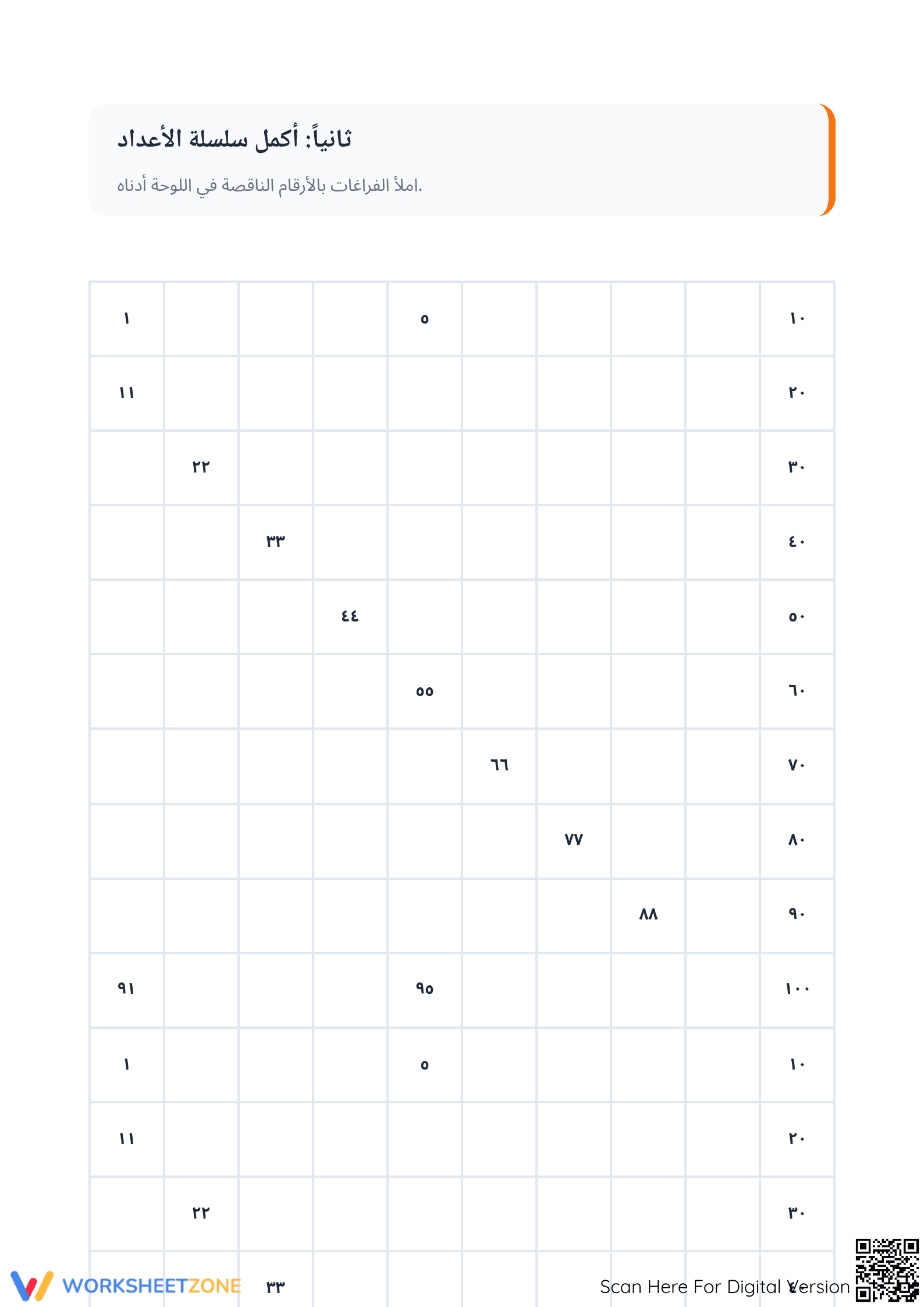
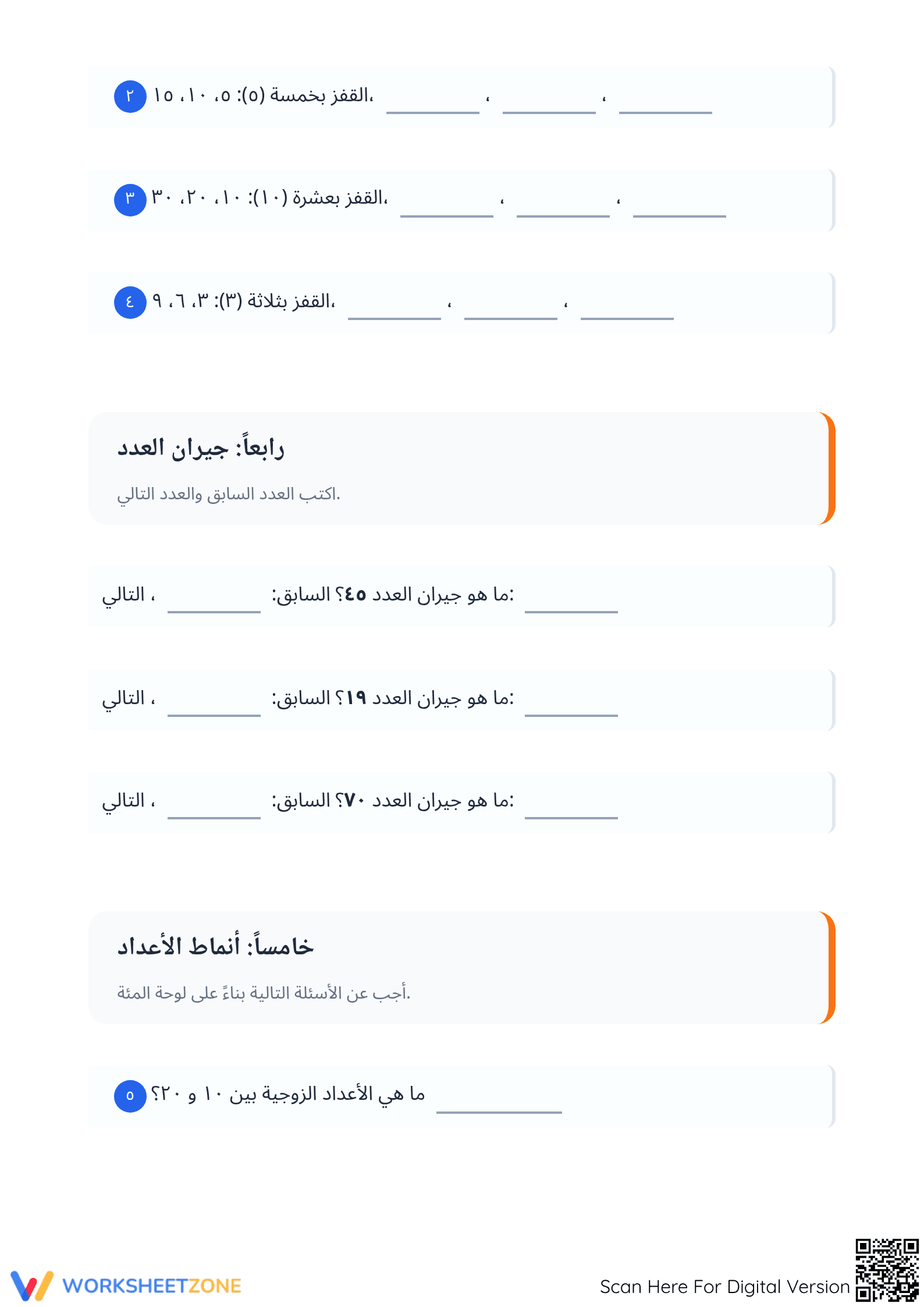
Inside this resource, educators will find four distinct pages designed to guide students through the mechanics of the hundreds chart. The first page serves as a full 1-100 reference chart, while subsequent pages challenge students to fill in missing numbers, practice skip counting by 3s, 5s, and 10s, and solve logic puzzles regarding "neighboring" numbers. The packet includes a full answer key for rapid grading.
Skill Progression and Scaffolding
- Guided Reference: Students begin by observing the complete 1-100 chart, identifying the vertical and horizontal patterns inherent in a base-ten grid system.
- Supported Application: The missing-number tasks provide anchor points every few squares, allowing students to use sequence logic to fill in the gaps with 15-20 empty cells.
- Independent Extension: Final tasks require students to identify even/odd numbers and count backward from 20 without visual aids, promoting the internalization of number order.
This resource follows a gradual-release model, moving from visual recognition to abstract mental math.
Standards Alignment
This worksheet is primarily aligned to CCSS.MATH.CONTENT.2.NBT.A.2: "Count within 1000; skip-count by 5s, 10s, and 100s." It also supports foundational skills in 1.NBT.A.1 by reinforcing counting to 100. These standard codes can be copied directly into lesson plans, IEP goals, or district curriculum mapping tools.
How to Use This Worksheet
Deploy this as a morning warm-up to activate prior knowledge before a lesson on place value or addition. Alternatively, use page 3 as a quick formative assessment to see which students struggle with skip counting by non-standard intervals like 3s. Teachers should observe if students use the physical chart or count on their fingers to gauge their level of number-line internalization. Expect completion within 20 to 30 minutes.
Who It's For
This material is designed for Grade 2 students but is highly effective for Grade 1 enrichment or Grade 3 intervention. It naturally pairs with a physical hundreds-chart anchor chart or a digital number line. The clear layout is particularly beneficial for students needing visual structure to process numerical relationships.
According to the RAND AIRS 2024 report on mathematics instructional materials, structured number sense practice is a critical predictor of later algebraic success. This worksheet aligns with CCSS.MATH.CONTENT.2.NBT.A.2 by requiring students to skip-count by various intervals and identify number patterns within a 1-100 framework. Developing a fluid understanding of number neighbors and the distinction between even and odd integers allows students to internalize the base-ten system more effectively than isolated calculation drills. The integration of visual charts alongside abstract pattern questions supports dual-coding theory, ensuring that learners can transition from concrete representation to symbolic manipulation. Educators can use these tasks to identify specific gaps in number-line mental imagery or place-value understanding. By consistently engaging with 100-chart dynamics, students build the prerequisite fluency for complex multi-digit addition and subtraction, bridging the gap between basic counting and operational mastery in the primary grades.


