




























Views
Downloads

Printable Letter Z Sounds Worksheet | Pre-K

Paste this activity's link or code into your existing LMS (Google Classroom, Canvas, Teams, Schoology, Moodle, etc.).
Students can open and work on the activity right away, with no student login required.
You'll still be able to track student progress and results from your teacher account.
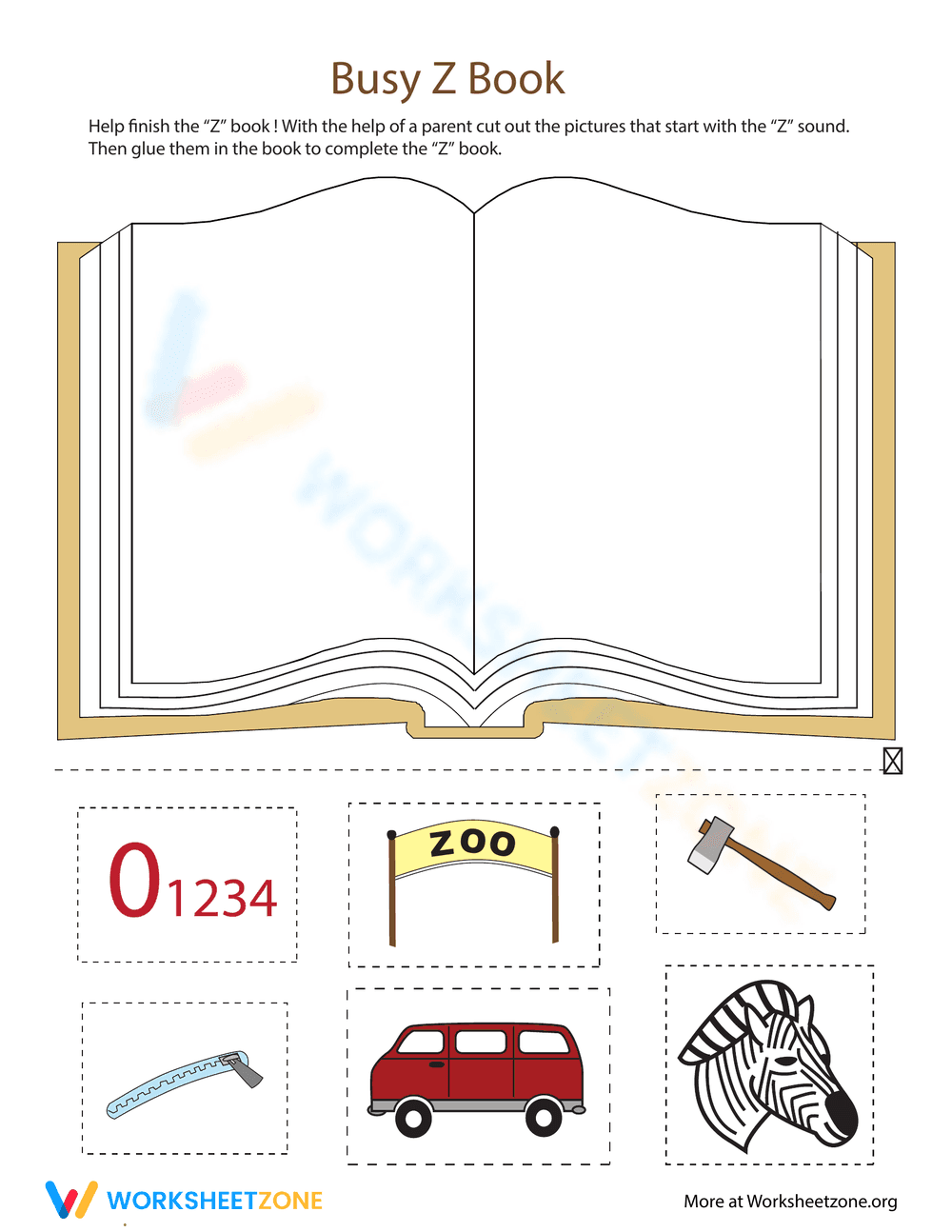
This engaging beginning sounds worksheet helps early learners master the letter Z through a hands-on sorting activity. Students evaluate six different images, isolating the initial phoneme to determine which words start with the /z/ sound. This interactive cut-and-paste task builds foundational phonemic awareness while strengthening fine motor skills.
At a Glance
- Grade: Pre-K · Subject: ELA
- Standard:
CCSS.ELA-LITERACY.RF.K.2.D— Isolate and pronounce initial sounds in words- Skill Focus: Letter Z Beginning Sounds
- Format: 1 page · 6 problems · No answer key · PDF
- Best For: Independent practice and centers
- Time: 10–15 minutes
This single-page printable features a "Busy Z Book" illustration alongside six dashed cut-out boxes. The cut-outs include a zebra, zipper, zoo sign, number zero, van, and axe. Students use phonics knowledge to select only the four images beginning with the target letter. Bold outlines make it easy for young children to practice scissor skills before gluing the correct items.
- Guided practice: Introduce the /z/ sound using target images (zebra, zipper) and model emphasizing the initial phoneme.
- Supported practice: Have students name all six pictures aloud, listening for the /z/ sound.
- Independent practice: Children cut out the images, sort them, and glue matching pictures into their book.
This gradual-release approach ensures students transition from I Do modeling to independent You Do application.
This resource is aligned to primary standard CCSS.ELA-LITERACY.RF.K.2.D, requiring students to isolate and pronounce the initial, medial vowel, and final sounds (phonemes) in spoken words. By focusing specifically on the initial phoneme of the letter Z, early learners build the auditory discrimination necessary for reading readiness. Both standard codes can be copied directly into lesson plans, IEP goals, or district curriculum mapping tools.
Deploy this worksheet during morning literacy centers or as a follow-up activity after direct instruction on the letter Z. For a formative assessment observation tip, listen closely as students name the pictures aloud; note whether they correctly identify the distractor images (van, axe) and can explain why they do not belong in the Z book. Expected completion time ranges from 10 to 15 minutes, depending on the child's scissor proficiency.
This activity is designed for Pre-K and Kindergarten students developing early phonemic awareness and fine motor control. For differentiation, teachers can pre-cut the images for students who struggle with scissor skills, allowing them to focus purely on the auditory sorting task. It pairs perfectly with a read-aloud book featuring heavy alliteration of the letter Z or a classroom alphabet anchor chart.
Developing strong phonemic awareness, particularly the ability to isolate initial sounds, is a critical predictor of future reading success. This worksheet targets CCSS.ELA-LITERACY.RF.K.2.D, helping students isolate and pronounce initial sounds in words through targeted practice with the letter Z. According to a recent EdReports 2024 analysis of early literacy curricula, integrating multisensory tasks—such as cutting and pasting—with phoneme isolation significantly improves retention and engagement in early childhood classrooms. By physically moving the correct images into the "Busy Z Book," students reinforce their auditory learning with tactile kinesthetic feedback. This dual-modality approach ensures that foundational phonics concepts are anchored securely in the student's working memory, bridging the gap between spoken language and written text recognition. Early mastery of these discrete sounds paves the way for fluent decoding.


