


























Views
Downloads

Essential Young Sheep and Lamb Worksheet | Grades K-2
Paste this activity's link or code into your existing LMS (Google Classroom, Canvas, Teams, Schoology, Moodle, etc.).
Students can open and work on the activity right away, with no student login required.
You'll still be able to track student progress and results from your teacher account.
This Essential Young Sheep and Lamb Science Worksheet helps early learners identify the relationship between adult animals and their offspring. By focusing on the specific pairing of sheep and lambs, students develop foundational observation skills necessary for biological classification. This simple yet effective resource ensures children understand that young animals grow to resemble their parents.
At a Glance
- Grade: K–2 · Subject: Science
- Standard:
1-LS3-1— Make observations to show that young animals are like their parents- Skill Focus: Animal offspring identification
- Format: 1 page · 1 task · Visual learning · PDF
- Best For: Introduction to life cycles and animal traits
- Time: 10–15 minutes
What's Inside
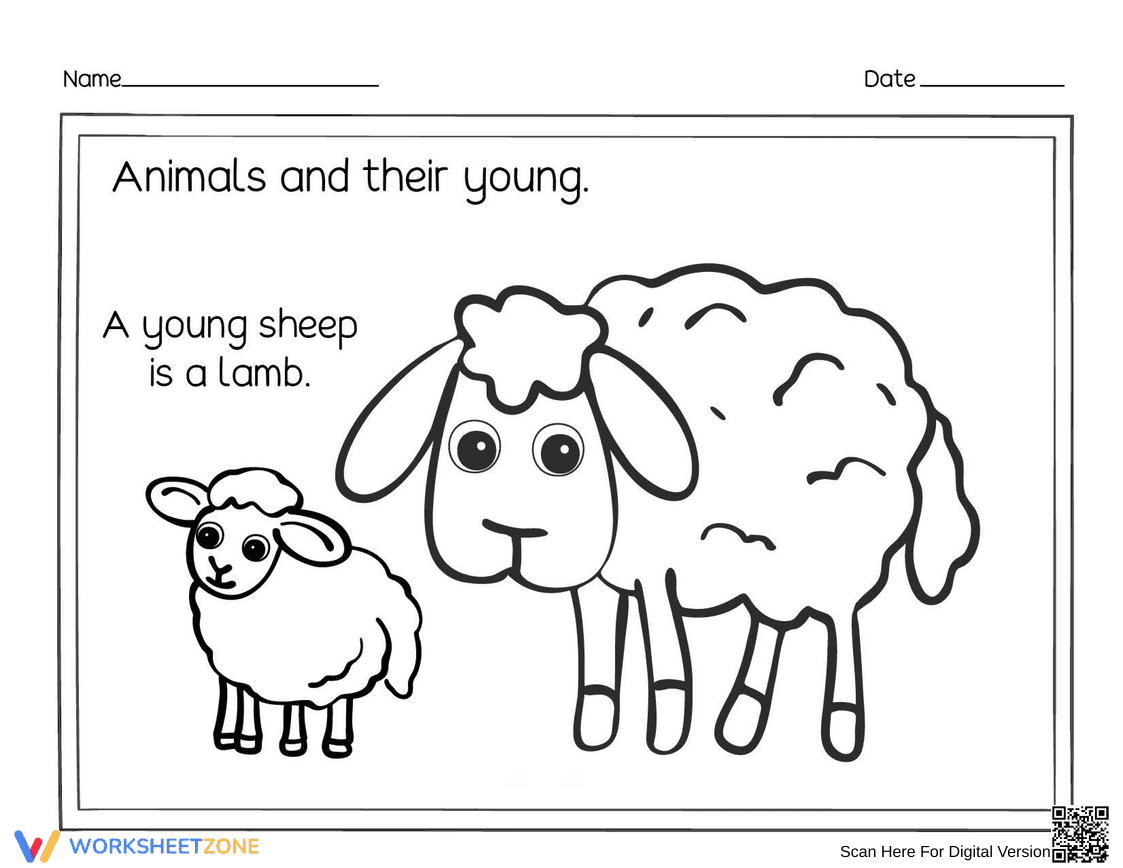
This single-page PDF features a clear, high-contrast illustration of an adult sheep alongside its young lamb. The worksheet includes large-print text that explicitly states the vocabulary pairing: "A young sheep is a lamb." The clean design serves as both an informational guide and a creative coloring activity, allowing students to engage tactilely with the science concept.
Skill Progression
- Guided Discovery: Students observe the visual differences and similarities between the adult sheep and the lamb, identifying key physical traits like fleece and shape.
- Supported Vocabulary: The bold, easy-to-read text provides a sentence frame that reinforces the specific name of the animal baby, aiding in language acquisition.
- Independent Creative Expression: Students color the figures, which encourages prolonged engagement with the subject matter and builds fine motor skills.
This approach mirrors the "I Do, We Do, You Do" model by providing the fact before asking for creative participation.
Standards Alignment
This resource is directly aligned with 1-LS3-1: "Make observations to construct an evidence-based account that young plants and animals are like, but not exactly like, their parents." By visually comparing the sheep and the lamb, students begin to understand heredity and biological patterns. This standard code can be copied directly into lesson plans, IEP goals, or district curriculum mapping tools.
How to Use It
Use this worksheet during an introductory lesson on life cycles or as a science center activity. Teachers should first show images of various animals and their young to establish the concept before distributing this page for independent coloring. For a formative assessment, ask students to point to the lamb and describe one way it looks like the sheep and one way it looks different. Expected completion time is 15 minutes.
Who It's For
This worksheet is ideal for Preschool, Kindergarten, and Grade 1 students, as well as English Language Learners (ELLs) who need visual support for animal vocabulary. It serves as an excellent companion resource to picture books about farm animals or a classroom visit to a local nature center.
Scientific literacy in the early grades is built upon the ability to observe and categorize the natural world, a concept emphasized in the RAND AIRS 2024 report on foundational STEM education. This Young Sheep and Lamb worksheet provides a focused entry point for 1-LS3-1 alignment by requiring students to recognize that young animals are distinct from but related to their adult counterparts. By introducing specific terminology like "lamb" in conjunction with visual stimuli, educators help students move beyond generic labels toward precise scientific communication. Research suggests that combining visual identification with motor tasks like coloring enhances memory retention in learners aged four to seven. This printable resource ensures that the core objective—understanding animal offspring relationships—is achieved through a low-barrier, high-engagement format that supports both classroom instruction and home-based learning environments. It is a vital tool for establishing the observational patterns necessary for higher-level biology.


