




























Views
Downloads

Essential Piglet Worksheet | Animals and Their Young (K-2)

Paste this activity's link or code into your existing LMS (Google Classroom, Canvas, Teams, Schoology, Moodle, etc.).
Students can open and work on the activity right away, with no student login required.
You'll still be able to track student progress and results from your teacher account.
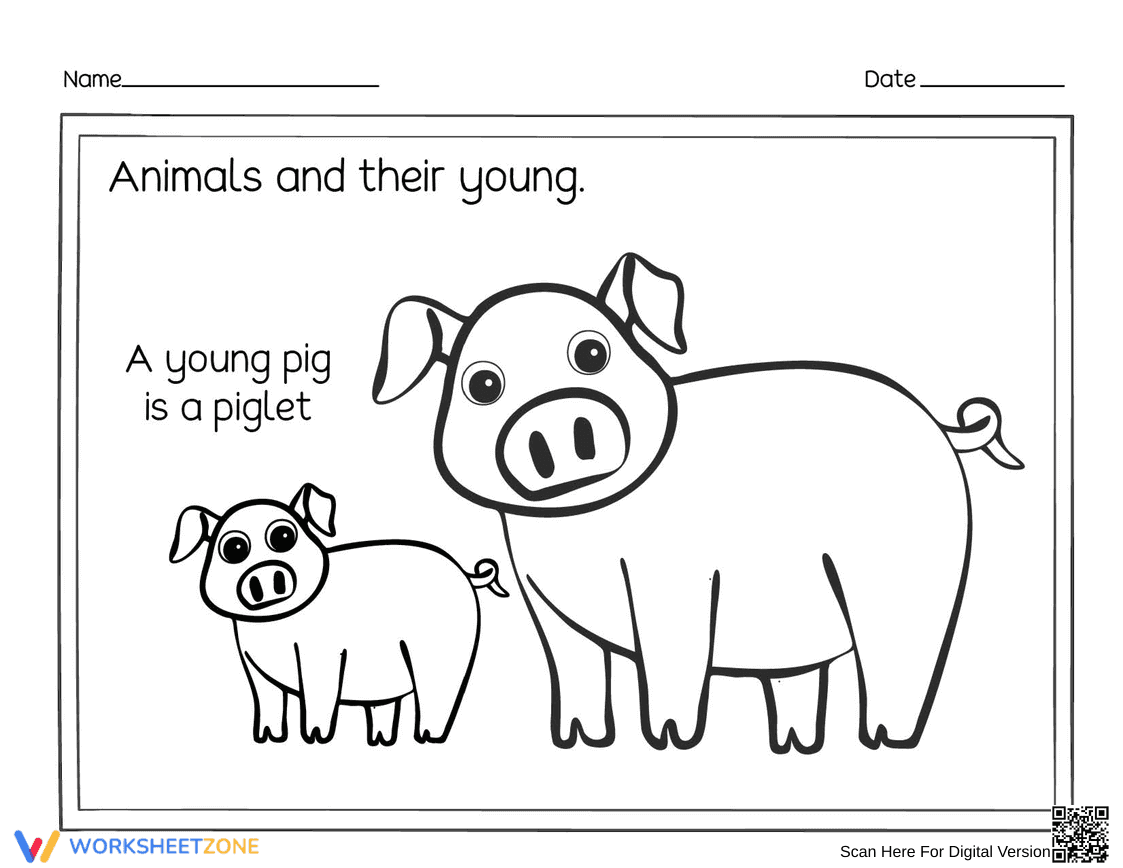
This animals and their young worksheet helps early learners identify the relationship between parent animals and their offspring. By focusing on the specific pairing of a pig and a piglet, students build essential biological vocabulary while practicing observation skills. This printable resource serves as an effective introduction to the life cycles and characteristics of living things.
At a Glance
- Grade: 1 · Subject: Science
- Standard:
1-LS3-1— Make observations that young animals are like, but not exactly like, their parents- Skill Focus: Identifying animal offspring (Pig/Piglet)
- Format: 1 page · 1 task · Answer key included · PDF
- Best For: Early childhood science vocabulary introduction
- Time: 10–15 minutes
Inside this resource, you will find a clean, high-contrast coloring and identification page. It features a large illustration of an adult pig and a young piglet, clearly labeled to reinforce the vocabulary connection. The simple text "A young pig is a piglet" provides a direct literacy link for beginning readers, making it a dual-purpose tool for science and ELA.
The zero-prep workflow for this worksheet is designed for maximum efficiency in a busy classroom. First, print the single-page PDF, which takes less than 30 seconds. Next, distribute the sheets to students for a quick warm-up or transition activity. Finally, review the terminology as a group in under two minutes. This resource is perfect for emergency sub plans or last-minute science centers.
This worksheet is aligned to 1-LS3-1, which requires students to make observations to construct an evidence-based account that young animals are like, but not exactly like, their parents. By visually comparing the pig and piglet, students begin to notice patterns in physical traits. This standard code can be copied directly into lesson plans, IEP goals, or district curriculum mapping tools.
Use this worksheet as a formative assessment during a unit on living things. Before direct instruction, ask students to color the animals and identify differences in size or features. During a center rotation, it serves as a quiet, focused task for independent practice. Observe if students can orally explain the relationship between the two animals to check for conceptual understanding.
This resource is ideal for Preschool, Kindergarten, and Grade 1 students, particularly those developing foundational vocabulary. It provides excellent support for English Language Learners (ELLs) by providing clear visual cues for new terms. It pairs naturally with a classroom read-aloud about farm animals or a digital slideshow showing various animal families in their natural habitats.
Research highlights the importance of visual literacy in early childhood science education. According to Fisher & Frey (2014), the use of intentional scaffolds—such as combining images with direct labeling—significantly improves the retention of technical vocabulary in primary students. This worksheet targets the 1-LS3-1 standard by encouraging children to observe that a piglet is a "young pig," a fundamental concept in biological classification. By engaging with this focused task, students develop the ability to categorize offspring and parents, which serves as a prerequisite for more complex genetics and inheritance topics in later grades. The RAND AIRS 2024 report suggests that high-quality, single-skill worksheets reduce cognitive load for emerging readers, allowing them to focus on the core scientific relationship being presented. This printable guide ensures that the distinction between adult and young animals is clearly mastered through repeated exposure and artistic engagement.


