


























Views
Downloads

Essential Animals and Their Young: Lion Cub — Grade K-2
Paste this activity's link or code into your existing LMS (Google Classroom, Canvas, Teams, Schoology, Moodle, etc.).
Students can open and work on the activity right away, with no student login required.
You'll still be able to track student progress and results from your teacher account.
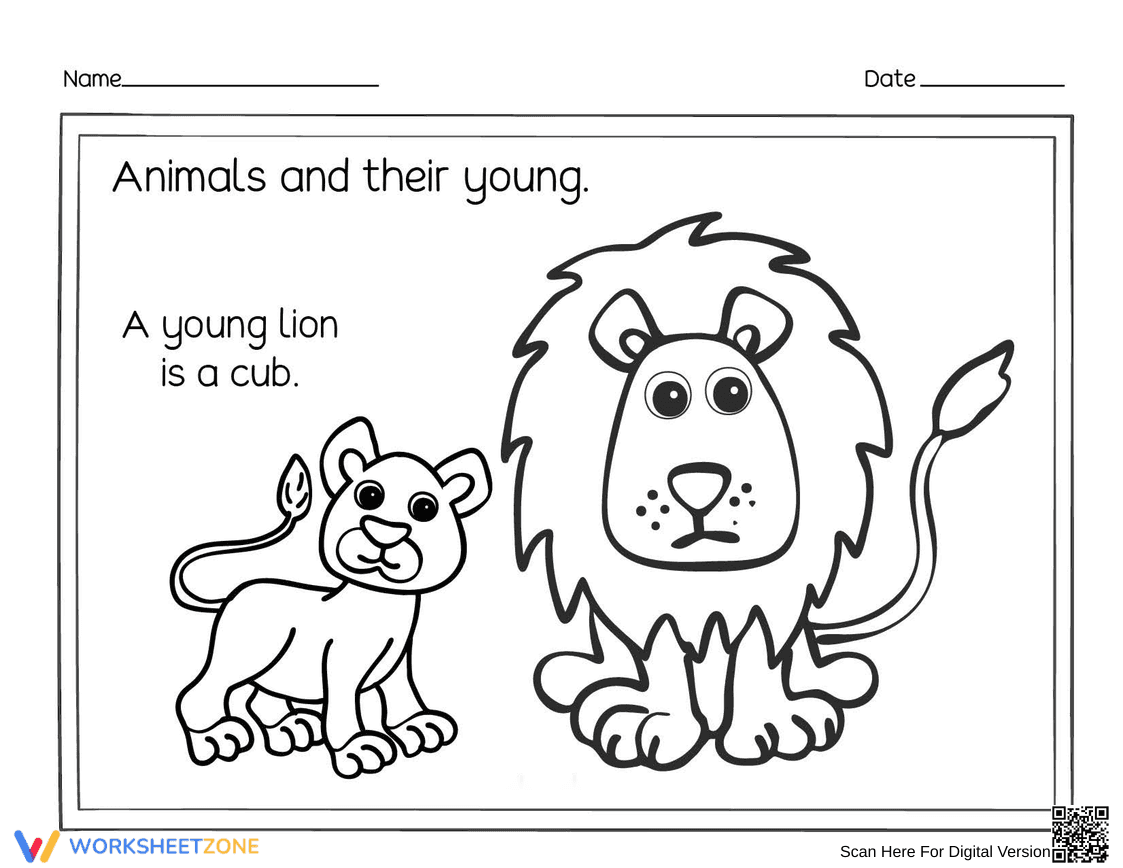
This animals and their young worksheet provides early learners with a clear visual introduction to parent-offspring relationships. By focusing on the lion and its cub, students develop biological vocabulary and observational skills. This resource simplifies life science concepts into an engaging, classroom-ready format for primary students.
At a Glance
- Grade: K-2 · Subject: Science
- Standard:
1-LS3-1— Observe how young animals are like, but not exactly like, their parents- Skill Focus: Animal Offspring Identification
- Format: 1 page · 1 task · Coloring element · PDF
- Best For: Early finishers or science center activity
- Time: 10–15 minutes
What's Inside
This single-page PDF features high-quality line drawings of an adult lion and a cub, perfect for coloring and motor skill development. The worksheet includes bold text stating animal names to reinforce reading and scientific terminology. It is designed with clear headers for names and dates, making it a self-contained lesson supplement with a built-in identification key.
Zero-Prep Workflow
This resource is designed for immediate implementation. First, print the single-page master (30 seconds). Next, distribute to students as they transition to independent practice (1 minute). Finally, review student work during a quick walk-around check (30 seconds). Total preparation time is under two minutes, making it an ideal choice for substitute folders or emergency science lesson plans.
Standards Alignment
The primary focus is 1-LS3-1, which requires students to observe that young animals are like, but not exactly like, their parents. By comparing features of the lion and cub, students notice patterns in inheritance. Additionally, this resource supports SL.1.5 through the use of visual displays to clarify ideas. Both standard codes can be copied directly into lesson plans, IEP goals, or district curriculum mapping tools.
How to Use It
Use this as a quiet morning work activity to reinforce lessons on animal families. Alternatively, assign it as a formative assessment during a science unit to check if students can identify animal offspring. A great tip is to ask students to name one similarity between the parent and the baby as they color.
Who It's For
This activity is suited for preschool through first-grade students developing their understanding of the natural world. It supports English Language Learners by pairing visuals with vocabulary. This resource pairs naturally with an anchor chart showing various animal families or a read-aloud book about savanna wildlife.
Aligned to the 1-LS3-1 standard, this identification worksheet supports the developmental need for concrete visual aids in early childhood science education. According to Fisher & Frey (2014), the use of intentional visual scaffolds like this coloring page helps students bridge the gap between simple observation and the construction of evidence-based accounts of biological patterns. By focusing on the specific relationship between a lion and its cub, the resource encourages students to look for specific traits—such as the presence or absence of a mane—that differentiate parents from their young. This targeted practice builds the foundational schema necessary for later studies in genetics and heredity. The simplified format ensures that cognitive load is managed, allowing students to focus entirely on the core scientific concept of parent-offspring similarity while simultaneously refining fine motor control through coloring. This worksheet serves as a reliable, research-backed tool for primary science instruction.


