


























Views
Downloads
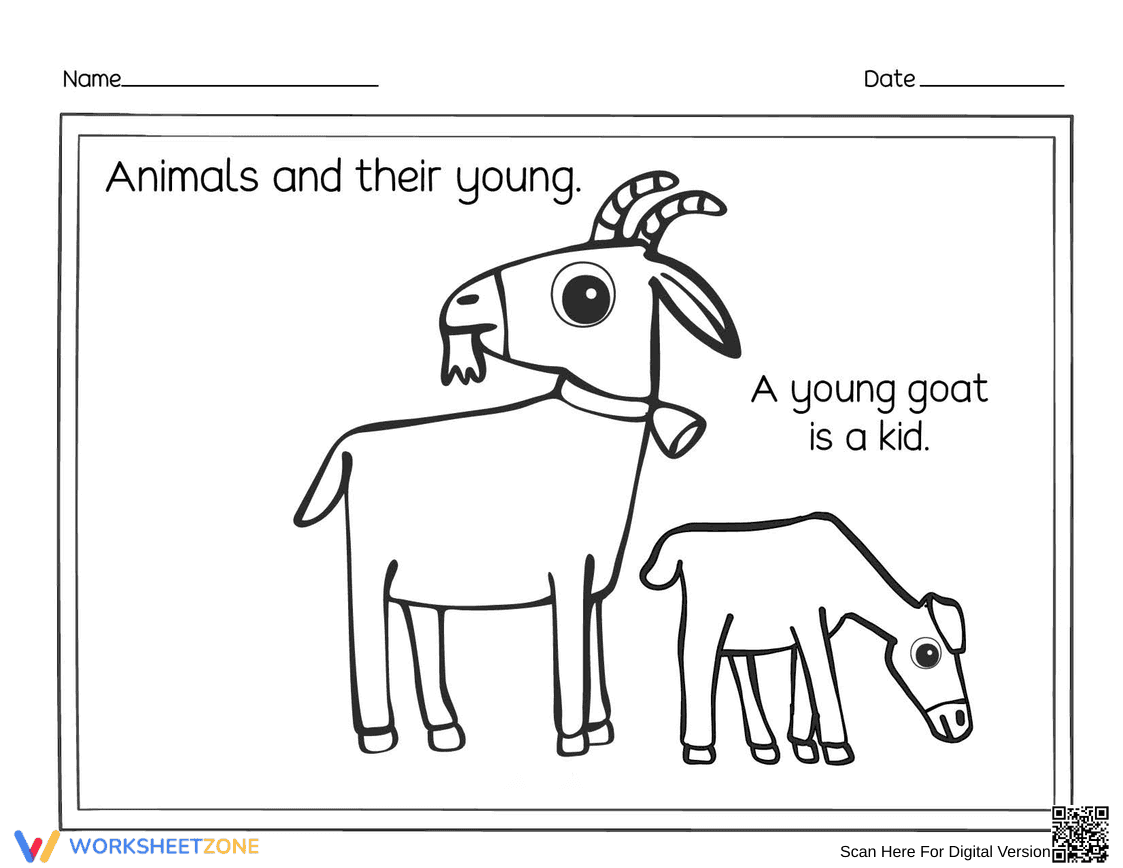

Essential Young Goat Worksheet | Grade K-2 Science
Paste this activity's link or code into your existing LMS (Google Classroom, Canvas, Teams, Schoology, Moodle, etc.).
Students can open and work on the activity right away, with no student login required.
You'll still be able to track student progress and results from your teacher account.
This Young Goat and Kid worksheet introduces early learners to the biological concept of offspring through engaging visual association. By identifying and coloring the parent goat and its baby kid, students solidify their understanding of animal life cycles and specialized vocabulary. This printable resource ensures students grasp the relationship between adult animals and their young ones.
At a Glance
- Grade: K–2 · Subject: Science
- Standard:
1-LS3-1— Observe that young animals are like, but not exactly like, their parents- Skill Focus: Animal Offspring Identification
- Format: 1 page · 1 task · Answer key not required · PDF
- Best For: Early finishers or science center activity
- Time: 10–15 minutes
This focused single-page resource features a clear, high-quality illustration of an adult goat and its kid, designed specifically for coloring and visual recognition. The worksheet includes a concise fact statement—"A young goat is a kid"—to build literacy skills alongside scientific knowledge. The simple layout minimizes distractions, making it ideal for young children developing fine motor skills and basic animal vocabulary.
The zero-prep workflow for this resource is designed for maximum efficiency in the classroom. First, print the single-page PDF, which takes less than 30 seconds for a full class set. Second, distribute the worksheets to students during your science block or as a transition activity. Finally, review the terminology as a group to check for understanding, requiring zero minutes of teacher preparation. This simplicity makes it a perfect addition to any sub plan.
This worksheet is aligned to the Next Generation Science Standard 1-LS3-1, which requires students to make observations to construct an evidence-based account that young plants and animals are like, but not exactly like, their parents. By comparing the adult goat to the kid, students observe patterns in growth and development. This standard code can be copied directly into lesson plans, IEP goals, or district curriculum mapping tools.
Use this worksheet as a quiet morning work activity to settle the class while introducing the day's science theme of living things. Alternatively, it serves as an excellent formative assessment observation tool during a lesson on animal families; teachers can observe if students correctly identify the parent-child relationship. Completion time typically ranges from 10 to 15 minutes depending on the student's coloring detail and fine motor ability.
This resource is designed for Preschool through Grade 2 students, particularly those in inclusive classrooms needing high-interest, low-text materials. It is highly effective for English Language Learners (ELL) who are building basic noun vocabulary related to farm animals. This worksheet pairs naturally with a read-aloud book about farm life or an anchor chart displaying various animal parents and their offspring to reinforce visual literacy.
Scientific literacy in early childhood depends on the integration of visual cues and specialized vocabulary, as emphasized in the 1-LS3-1 standard. This Young Goat worksheet provides the foundational observation skills necessary for students to recognize that young animals are similar to their parents. According to Fisher & Frey (2014), the use of scaffolded visual aids in early science instruction significantly improves the retention of domain-specific vocabulary and conceptual understanding. By focusing on a single animal pair, the resource reduces cognitive load and allows for deeper engagement with the primary fact that a young goat is called a kid. This observation-based learning approach prepares students for more complex biological studies in later grades. The worksheet functions as a standalone evidence-gathering tool that supports the development of patterns and cause-and-effect reasoning in young learners, ensuring they meet core scientific benchmarks early in their academic careers.


