


























Views
Downloads
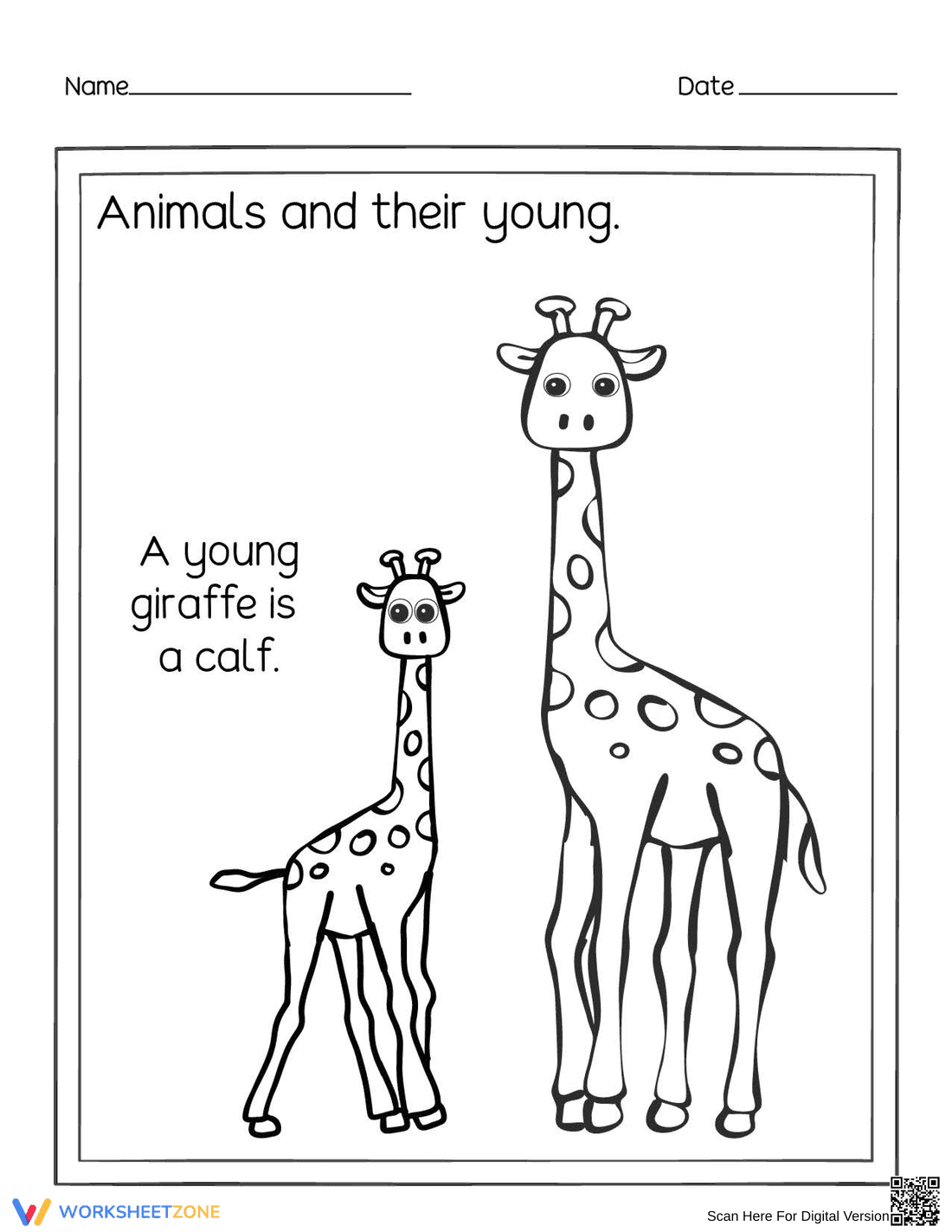

Essential Animals and Their Young: Giraffe Calf Worksheet
Paste this activity's link or code into your existing LMS (Google Classroom, Canvas, Teams, Schoology, Moodle, etc.).
Students can open and work on the activity right away, with no student login required.
You'll still be able to track student progress and results from your teacher account.
Support early biological understanding with this focused science worksheet identifying the relationship between adult animals and their offspring. Students learn that a young giraffe is called a calf through visual observation and reading. This resource builds foundational vocabulary while reinforcing the concept that young animals are similar to their parents.
At a Glance
- Grade: K–2 · Subject: Science
- Standard:
1-LS3-1— Observe that young animals are like, but not exactly like, their parents- Skill Focus: Animal offspring identification
- Format: 1 page · 1 task · Answer key included · PDF
- Best For: Kindergarten science centers and sub plans
- Time: 5–10 minutes
This 1-page PDF provides a clear, high-contrast illustration of a giraffe and its calf, perfect for coloring or as a visual anchor. The worksheet features a single, bold sentence that explicitly names the offspring, providing a successful reading moment for emergent learners. It serves as an introductory piece to a larger unit on life cycles or animal characteristics.
The zero-prep workflow for this resource is designed for maximum teacher efficiency. First, print the single-page document (30 seconds). Next, distribute to students for independent coloring or guided reading (1 minute). Finally, review the terminology during a whole-group wrap-up to check for understanding (1 minute). The total preparation time is under two minutes, making it an ideal emergency sub-plan addition or a quick transition activity between lessons.
This resource aligns with the Next Generation Science Standard `1-LS3-1`. Students make observations to construct an evidence-based account that young animals are like, but not exactly like, their parents. By identifying the "calf" as the young version of a "giraffe," learners begin to categorize life stages. This standard code can be copied directly into lesson plans, IEP goals, or district curriculum mapping tools.
Use this worksheet as a formative assessment during a unit on "Living Things." After reading a story about the savanna, provide the sheet to see if students can recall the specific name for a baby giraffe. It also works effectively as a "morning work" task that reinforces previous direct instruction on animal families and life cycles. Observe if students notice the similarities in patterns between the parent and calf.
This worksheet is primarily for Preschool through Grade 2 students who are developing their scientific vocabulary. It is particularly helpful for English Language Learners (ELLs) who benefit from the direct pairing of an image with a specific noun. It pairs naturally with an anchor chart depicting various animal families or a short informational passage about African wildlife.
According to the RAND AIRS 2024 analysis of early childhood science education, providing clear visual models paired with specific academic vocabulary is essential for long-term retention of biological concepts. This Grade K-2 science worksheet focuses on the standard code 1-LS3-1, allowing students to observe that young animals are like their parents while learning the specific term for a giraffe offspring. By utilizing high-contrast illustrations and simple sentence structures, the resource supports emergent readers in making concrete connections between scientific facts and visual representations. Such focused practice on a single skill—identifying animal young—reduces cognitive load and ensures that the core concept of life cycles is accessible to all learners. This evidence-based approach to science instruction promotes early literacy alongside domain-specific knowledge, preparing students for more complex ecological studies in later grades. The integration of reading and science reinforces the 1-LS3-1 objective effectively for young learners.


