


























Views
Downloads

Printable Young Elephant Calf Worksheet | Grade K-2 Science
Paste this activity's link or code into your existing LMS (Google Classroom, Canvas, Teams, Schoology, Moodle, etc.).
Students can open and work on the activity right away, with no student login required.
You'll still be able to track student progress and results from your teacher account.
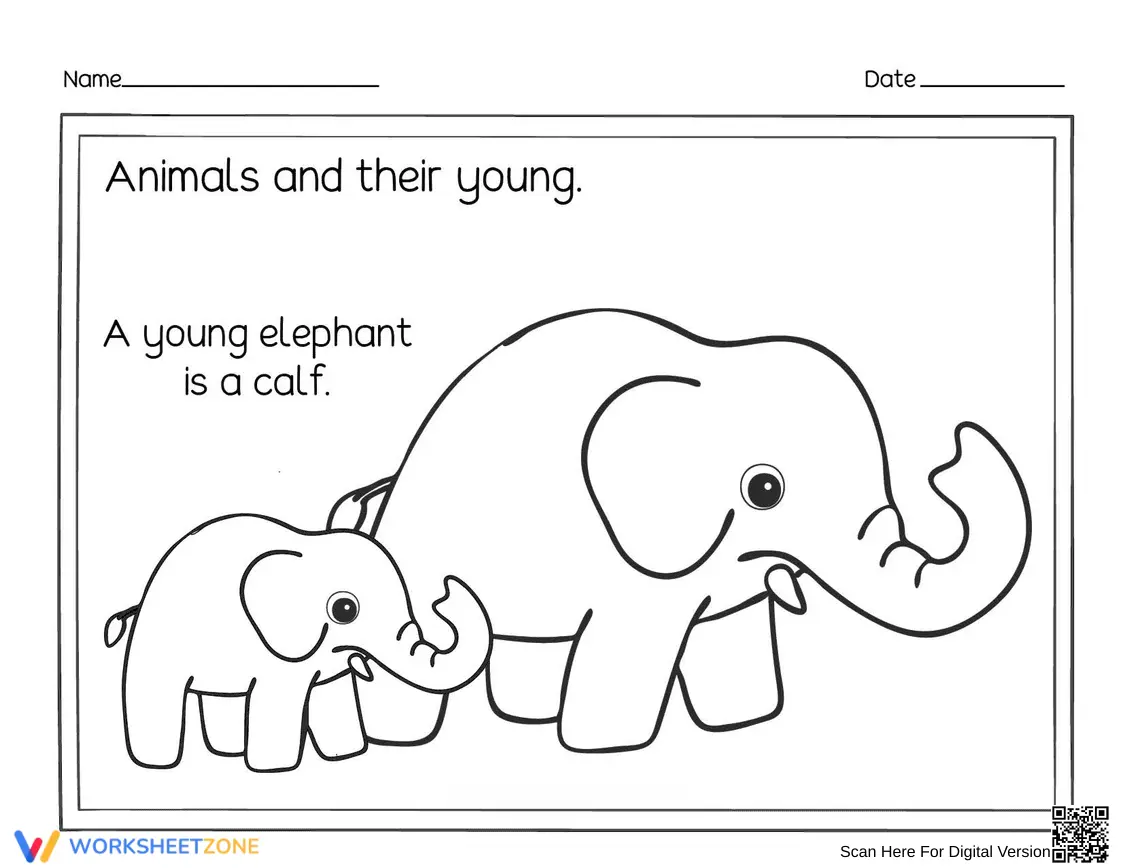
This printable Grade 1 science worksheet introduces early learners to animals and their offspring using a young elephant calf. By observing the visual relationship between parent and baby, students build foundational life science vocabulary and recognize that young animals are similar to their parents. This activity bridges coloring with scientific identification.
At a Glance
- Grade: K–2 · Subject: Science
- Standard:
1-LS3-1— Observe that young plants and animals are like, but not exactly like, their parents- Skill Focus: Animal Offspring Vocabulary
- Format: 1 page · 1 task · Visual guide included · PDF
- Best For: Early childhood science vocabulary building
- Time: 5–10 minutes
This single-page PDF features a high-quality illustration of an adult elephant and its offspring. The worksheet labels the pair with the phrase "A young elephant is a calf," providing a literacy link to the scientific concept. The large-format line art is perfect for coloring while reinforcing biological terminology.
The worksheet follows a structured skill progression for early development. First, students engage in guided observation of the physical similarities between the elephants. Next, supported practice occurs as teachers read the descriptive sentence while students color the images. Finally, independent practice is achieved when students can identify and name the "calf" without prompting.
This resource aligns to 1-LS3-1, which requires students to observe that young animals are like, but not exactly like, their parents. By comparing the adult and calf, students see the structural similarities inherent in animal growth. This standard code can be copied directly into lesson plans, IEP goals, or district curriculum mapping tools.
Use this worksheet in your science center during a "Living Things" unit. It serves as an excellent morning work activity. A formative-assessment tip: ask students to point to the calf and describe one way it looks like the parent. This checks for understanding of inheritance patterns. Expected completion time is 10 minutes.
This activity is suited for Preschool, Kindergarten, and Grade 1 students. For differentiation, advanced students can write the word "calf," while students needing support focus on coloring. It pairs naturally with a classroom anchor chart showing various animal parents and their babies.
The use of visual aids in early science education is a cornerstone of cognitive development. According to the RAND AIRS 2024 report, worksheets that pair biological vocabulary with high-contrast illustrations significantly improve retention of "Living Things" concepts in learners aged four to seven. This worksheet focuses on the standard code 1-LS3-1, helping students identify the young elephant calf through direct observation. By bridging artistic expression and scientific labeling, the resource ensures that the plain-English skill of identifying animal offspring is mastered. Such structured practice is essential for building the prerequisite knowledge needed for more complex life cycle studies in later grades. The inclusion of the standard ensures that the activity remains grounded in evidence-based pedagogical frameworks while providing teachers with a ready-to-use tool for daily classroom instruction or supplemental home practice.


