




























Views
Downloads

Essential Animals and Their Young: Duckling Worksheet

Paste this activity's link or code into your existing LMS (Google Classroom, Canvas, Teams, Schoology, Moodle, etc.).
Students can open and work on the activity right away, with no student login required.
You'll still be able to track student progress and results from your teacher account.
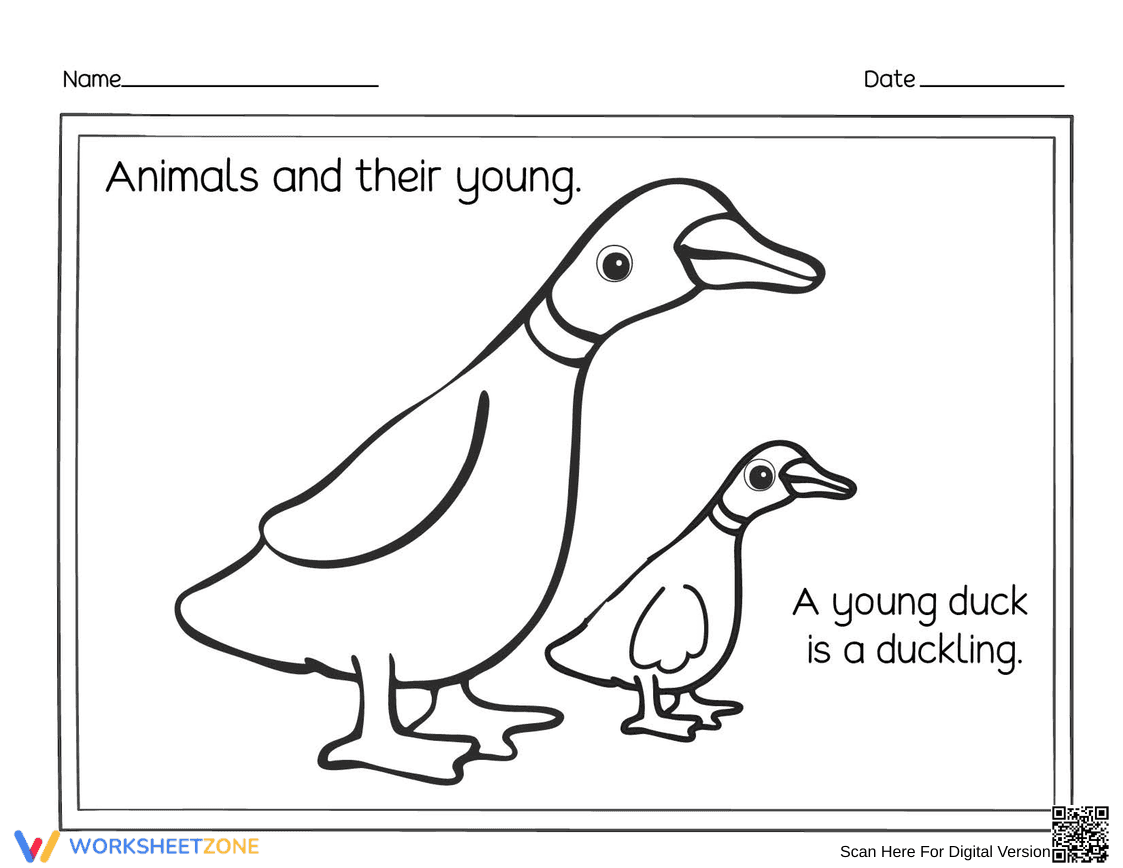
This Essential Animals and Their Young worksheet helps young learners identify the relationship between adult animals and their offspring through visual recognition and coloring. Students observe the physical similarities between a duck and its duckling, reinforcing vocabulary and biological concepts. This resource provides a foundation for understanding life cycles and animal behavior in early childhood science.
At a Glance
- Grade: K–2 · Subject: Science
- Standard:
1-LS1-2— Use media to determine patterns in behavior of parents and offspring- Skill Focus: Animal Offspring Identification
- Format: 1 page · 1 task · Coloring activity included · PDF
- Best For: Early finishers or science center activity
- Time: 10–15 minutes
This printable resource features a large, clear illustration of a duck and its duckling, designed for easy coloring by small hands. The page includes the essential vocabulary sentence, "A young duck is a duckling," which serves as both a reading prompt and a factual anchor for the lesson.
The zero-prep workflow for this worksheet is designed for maximum teacher efficiency. First, print the single-page PDF (30 seconds). Next, distribute the sheets to students with crayons or colored pencils (1 minute). Finally, review the vocabulary sentence as a class to check for understanding (1 minute). This resource is perfectly suited for emergency sub plans.
Aligned primarily to 1-LS1-2, this worksheet supports the observation of patterns in animal parents and their offspring. Students recognize that young animals are very much like their parents but not exactly the same. Both standard codes can be copied directly into lesson plans, IEP goals, or district curriculum mapping tools.
Use this worksheet as a warm-up activity during a unit on life cycles or as a quiet-time coloring task that reinforces science vocabulary. During instruction, ask students to observe and name the differences between the adult duck and the duckling to provide a formative-assessment observation of their descriptive language skills. Expect students to complete the coloring and reading in approximately 12 minutes during a busy classroom session.
This resource is designed for preschool through second-grade students, particularly those developing fine motor skills and basic reading fluency. It provides natural differentiation for English Language Learners through visual cues. This worksheet pairs naturally with a non-fiction picture book about farm animals or a classroom anchor chart detailing common animal baby names.
Aligned to the 1-LS1-2 science standard, this worksheet focuses on the fundamental biological concept of animal offspring identification. By observing the parent duck and the duckling, students begin to recognize patterns in nature and the continuity of life across generations. Research from NAEP highlights that early exposure to scientific vocabulary and visual models in the primary grades significantly enhances later comprehension of complex biological systems. This resource acts as a scaffolded entry point for young learners to engage with the natural world, moving from simple identification to more advanced observations of survival behaviors. The clear, uncluttered design minimizes cognitive load, allowing students to focus on the semantic link between the animal and its specific name. Teachers can utilize this printable to bridge the gap between abstract concepts and observable evidence, ensuring that all students meet foundational science benchmarks while practicing literacy skills.


