




























Views
Downloads
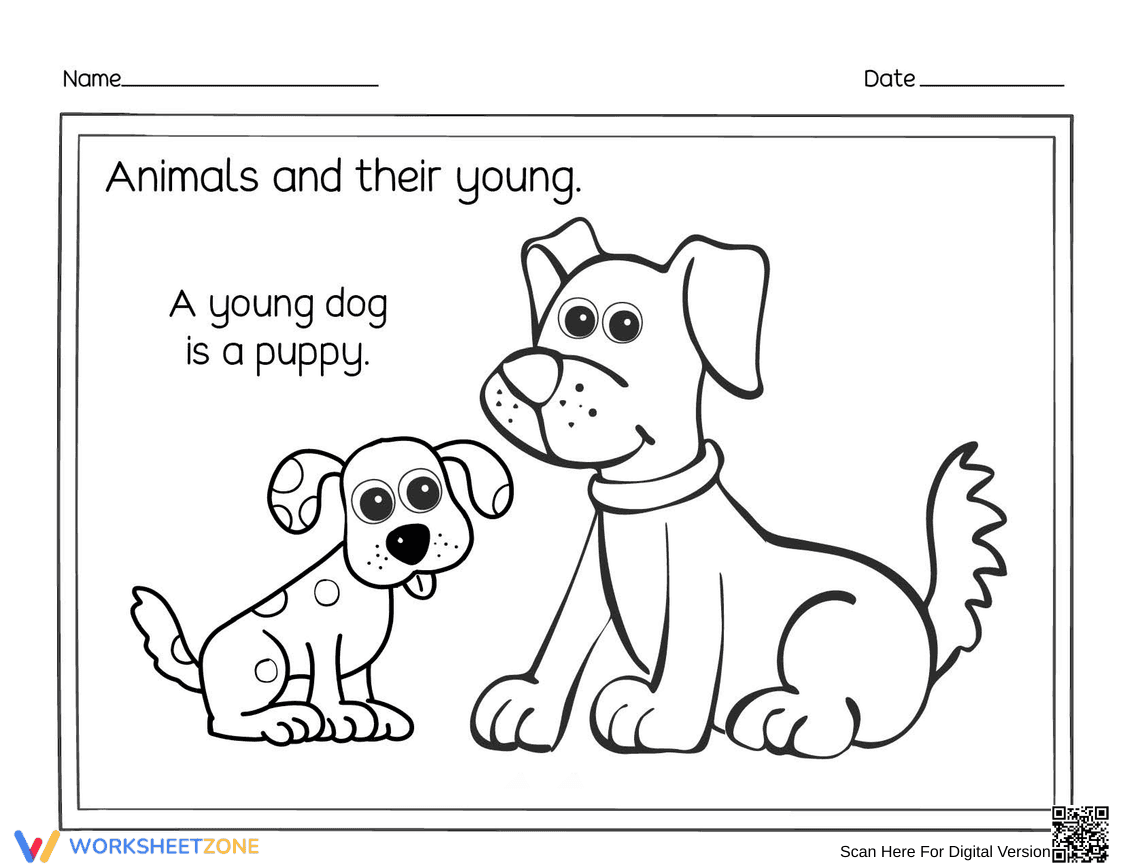

Young Dog & Puppy Essential Science Coloring Worksheet

Paste this activity's link or code into your existing LMS (Google Classroom, Canvas, Teams, Schoology, Moodle, etc.).
Students can open and work on the activity right away, with no student login required.
You'll still be able to track student progress and results from your teacher account.
Introduce early learners to the fascinating world of biology with this "Animals and Their Young" coloring worksheet. Students observe the relationship between a parent dog and its puppy, reinforcing vocabulary and life science concepts through visual engagement. This activity helps children recognize that young animals are similar to their parents while developing fine motor skills.
At a Glance
- Grade: K–2 · Subject: Science
- Standard:
1-LS3-1— Observe how young animals are like, but not exactly like, their parents- Skill Focus: Animal Offspring Identification
- Format: 1 page · 1 task · Coloring activity included · PDF
- Best For: Early finishers or introductory life science lessons
- Time: 10–15 minutes
This single-page PDF features a clear, high-quality line drawing of an adult dog alongside its puppy. The worksheet includes simple, large-print text that explicitly states the relationship: "A young dog is a puppy." This design combines literacy practice with scientific observation, making it an ideal resource for classrooms focusing on living things and life cycles.
Teachers can implement this resource in under two minutes using a three-step workflow. First, print the desired number of copies (30 seconds). Second, distribute the pages along with crayons or colored pencils (1 minute). Finally, facilitate a brief class discussion about the similarities and differences between the two dogs pictured (30 seconds). This zero-prep approach is perfect for substitute folders or morning work.
The primary standard for this resource is 1-LS3-1: "Make observations to construct an evidence-based account that young plants and animals are like, but not exactly like, their parents." By comparing the adult dog and the puppy, students engage in the foundational practice of scientific observation and pattern recognition. This standard code can be copied directly into lesson plans, IEP goals, or district curriculum mapping tools.
Use this worksheet during direct instruction to introduce the concept of animal families and offspring. After students finish coloring, have them circle one feature that is identical between the dogs (like the ears) and one that is different (like the size). This serves as a quick formative-assessment observation tip to gauge their understanding of physical traits. Expected completion time is approximately 15 minutes.
This resource is designed for Preschool through Grade 2 students, particularly those in inclusive classrooms requiring visual scaffolds. It is a natural pairing for a read-aloud session featuring animal non-fiction books or an anchor chart showing various animal babies. The simple text supports emerging readers while the coloring task keeps tactile learners engaged.
Aligned with 1-LS3-1, this worksheet focuses on the scientific skill of identifying parent-offspring relationships in the animal kingdom. Research from NAEP indicates that early exposure to biological patterns through visual and hands-on activities significantly improves long-term retention of life science concepts. By explicitly labeling the "young dog" as a "puppy," the resource builds essential academic vocabulary within a context-rich environment. Studies by Fisher & Frey (2014) emphasize that integrating literacy with science content supports the gradual release of responsibility, allowing students to move from guided observation to independent recognition of biological traits. This resource serves as a foundational tool for meeting early childhood science benchmarks while maintaining high engagement through age-appropriate artistic expression. The clear, uncluttered layout ensures that students can focus on the primary instructional goal of recognizing how young animals resemble their parents, a core competency in primary science education.


