


























Views
Downloads
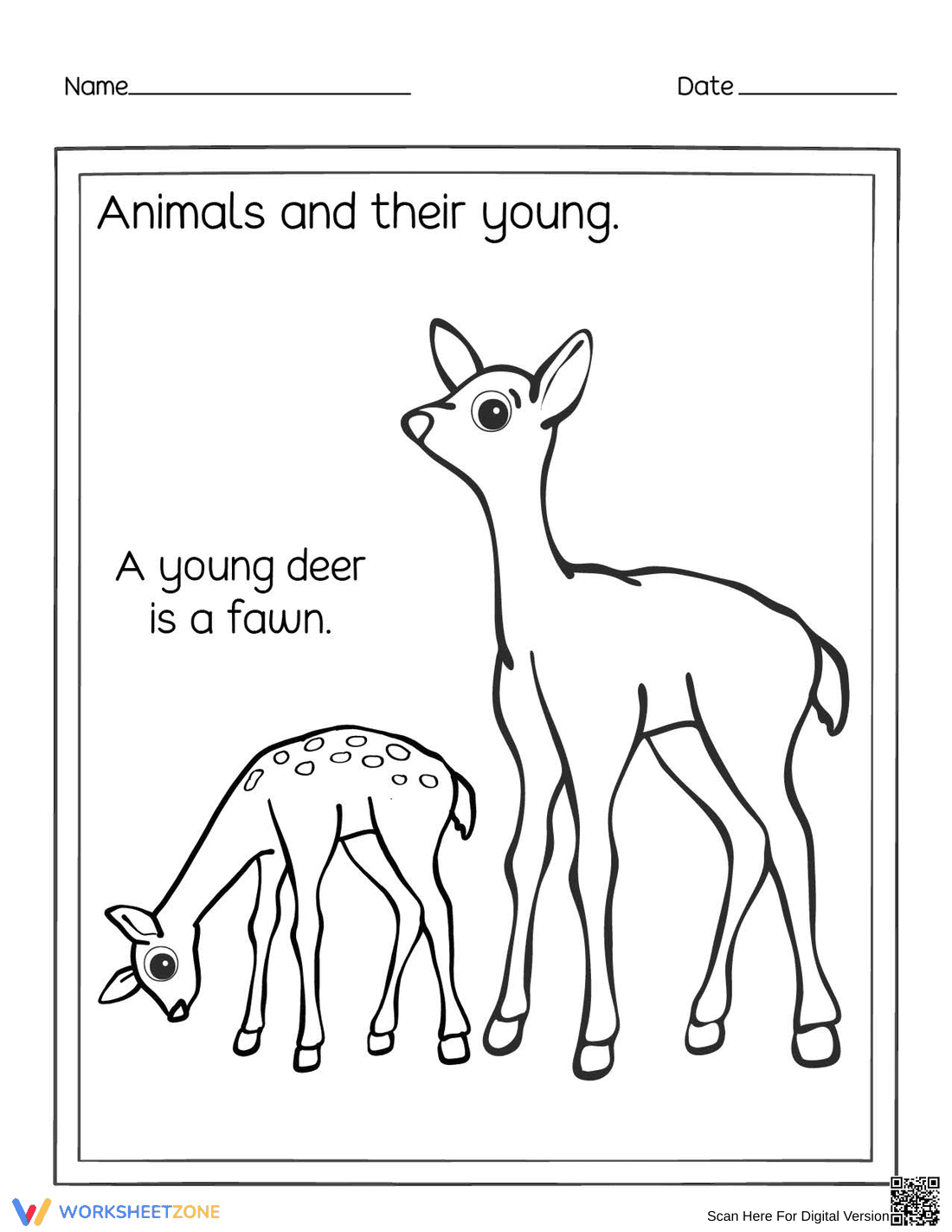

Essential Deer and Fawn Worksheet | Grade 1 Science
Paste this activity's link or code into your existing LMS (Google Classroom, Canvas, Teams, Schoology, Moodle, etc.).
Students can open and work on the activity right away, with no student login required.
You'll still be able to track student progress and results from your teacher account.
Introduce your students to the natural world with this focused science resource. This worksheet centers on identifying the relationship between parent animals and their young. Students learn the specific term "fawn" for a young deer while engaging in a coloring activity. This resource bridges vocabulary development with biological observation, helping early learners recognize patterns in nature.
At a Glance
- Grade: Preschool–Grade 2 · Subject: Science
- Standard:
1-LS3-1— Make observations to construct an evidence-based account that animals are like their parents- Skill Focus: Animal Offspring Identification (Deer/Fawn)
- Format: 1 page · 1 task · Coloring supported · PDF
- Best For: Early finishers or vocabulary introduction
- Time: 10–15 minutes
This single-page printable features a high-quality line-art illustration of an adult deer alongside its offspring, the fawn. The text clearly states the relationship to reinforce vocabulary. Students color the animals, allowing for fine motor skill practice while they internalize the biological concept. The clean layout is perfect for the youngest learners in a primary classroom.
Zero-Prep Workflow
- Print (15 seconds): Open the PDF and print immediately for the whole class.
- Distribute (30 seconds): Hand out the sheets during transitions or as a morning warm-up.
- Review (15 seconds): Confirm the "fawn" label and discuss visible similarities between the animals.
Total teacher preparation is under one minute. This worksheet is an excellent addition to sub plans or emergency folders when you need a high-quality, relevant activity with zero setup required.
Standards Alignment
This worksheet aligns with standard 1-LS3-1: "Make observations to construct an evidence-based account that young plants and animals are like, but not exactly like, their parents." By observing the visual similarities and differences between the adult deer and the fawn, students begin to build the foundations of heredity. This standard code can be copied directly into lesson plans, IEP goals, or district curriculum mapping tools.
How to Use It
Use this as an introductory activity during a unit on life cycles or living things. Teachers can display the image and ask students to point out similarities between the two animals before handing out the individual sheets. It also serves as a great formative-assessment tool; observe if students correctly use the term "fawn" when describing their work. Completion usually takes 10 to 15 minutes depending on coloring depth.
Who It's For
Designed for Preschool through Grade 2 students, this resource is highly accessible for non-readers or beginning readers. The large illustrations provide ample space for coloring, which supports students with developing fine motor skills. It pairs naturally with a read-aloud about forest animals or an anchor chart listing common animal babies and their parent names.
The identification of parent-offspring relationships is a critical component of early life science education, as outlined in the 1-LS3-1 standard. Research from Fisher & Frey (2014) emphasizes the importance of visual literacy and gradual release when introducing new vocabulary to primary students. This worksheet facilitates that process by providing a clear, observable model of a deer and its fawn, allowing students to map specific labels to biological realities. By engaging in the identifying and coloring task, learners reinforce their understanding that young animals resemble their parents, a foundational concept for later studies in genetics and biological adaptation. This self-contained resource is optimized for inclusion in curriculum banks and serves as a reliable tool for achieving early science benchmarks in local and national frameworks, ensuring that students develop a strong grasp of how organisms grow and change over time.


