


























Views
Downloads
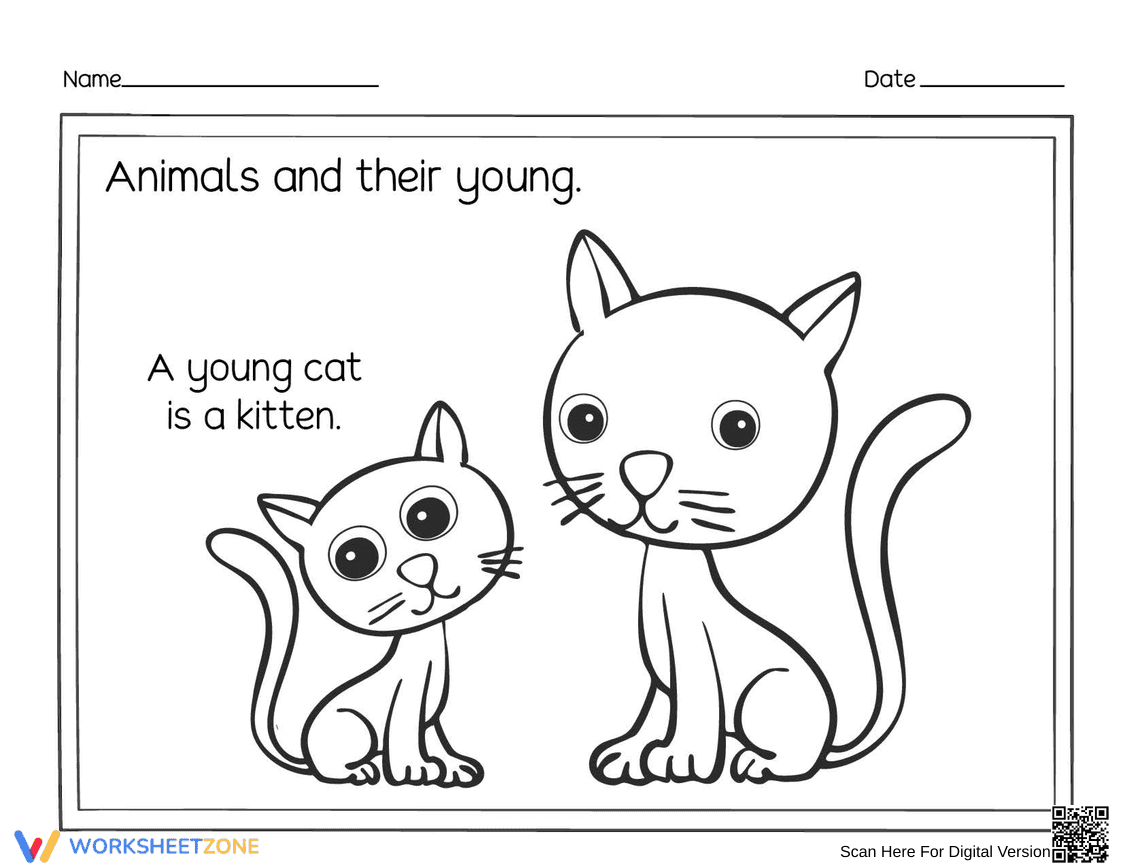

Printable Worksheet: Grade 1 Animals and Their Young
Paste this activity's link or code into your existing LMS (Google Classroom, Canvas, Teams, Schoology, Moodle, etc.).
Students can open and work on the activity right away, with no student login required.
You'll still be able to track student progress and results from your teacher account.
Engaging Life Science Practice for Grade 1
This worksheet helps young learners master the essential science skill of identifying animals and their young. Students will draw a clear connection between a parent cat and its kitten, reinforcing core life science vocabulary and observational skills through a simple, engaging coloring activity. It's a perfect introduction to the concept of life cycles and inherited traits.
At a Glance
- Grade: 1 · Subject: Science
- Standard:
1-LS3-1— Observe young animals are like, but not exactly like, their parents- Skill Focus: Identifying animals and their young
- Format: 1 page · 1 task · Answer key not required · PDF
- Best For: Science warm-up, vocabulary building, or sub plan
- Time: 5–10 minutes
What's Inside
This single-page PDF features a large illustration of a cat and a kitten. It includes a simple sentence: 'A young cat is a kitten,' and has spaces for the student's name and date. As an observational coloring task, no answer key is required, making it a truly independent activity.
Zero-Prep Workflow
Built for efficiency, this worksheet's prep time is under two minutes. The workflow is simple: 1. Print: The PDF prints in seconds. 2. Distribute: Hand out sheets during a transition (approx. 1 minute). 3. Review: Discuss the sentence and allow 5-10 minutes for coloring. Its self-contained design is perfect for substitute plans or an impromptu science center.
Standards Alignment
This activity directly supports NGSS 1-LS3-1, requiring students to observe that young animals are like, but not exactly like, their parents. By comparing the cat and kitten, learners make initial observations about inherited traits. The standard code can be copied directly into lesson plans, curriculum maps, or IEP goals.
How to Use It
Use this as a quick formative assessment during a living things unit. It's an excellent 'do-now' activity to start a science lesson or a calming task after recess. For an observation tip, ask students to point out one similarity and one difference between the two cats. The task should take 5 to 10 minutes to complete.
Who It's For
Ideal for students in Preschool through Grade 2, this resource supports early science vocabulary and fine motor skills. It is especially helpful for English Language Learners (ELLs) with its clear image-text pairing. To extend the lesson, pair this worksheet with a non-fiction read-aloud about animal families or an anchor chart displaying different parent and baby animals.
This worksheet aligns with standard 1-LS3-1, focusing on the observation that young animals resemble their parents. Research from Fisher & Frey (2014) highlights the value of such 'low-stakes' practice, allowing students to engage with new concepts without performance anxiety. By providing a clear visual example—a cat and its kitten—this resource helps students build an evidence-based account of biological traits, a foundational skill in the life sciences. The simple format of reading a sentence and coloring an image reinforces specialized vocabulary effectively, a method supported by the RAND AIRS 2024 report on visual aids in early education. It provides a concrete, accessible entry point for Grade 1 students to explore heredity, ensuring the concept is grounded in a familiar example before moving to more complex life cycle discussions.


