




























Views
Downloads
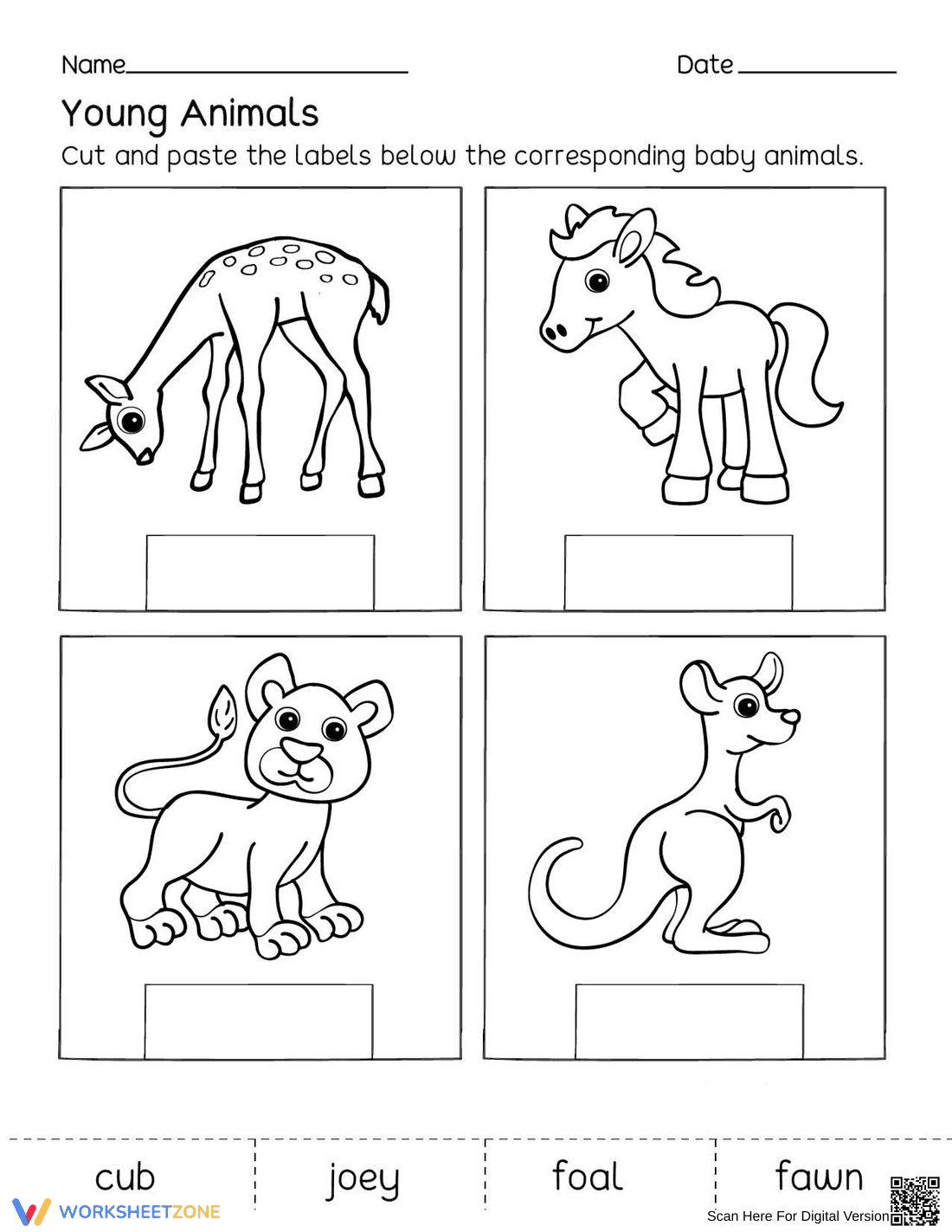

Grade K Young Animals — Printable No-Prep Worksheet

Paste this activity's link or code into your existing LMS (Google Classroom, Canvas, Teams, Schoology, Moodle, etc.).
Students can open and work on the activity right away, with no student login required.
You'll still be able to track student progress and results from your teacher account.
This Young Animals worksheet provides a hands-on introduction to biological vocabulary for early learners. By matching labels to offspring like cubs and foals, students develop foundational observation skills and an understanding of the relationship between parents and their young. It is a complete, ready-to-use resource that transforms a simple vocabulary lesson into an engaging fine motor activity.
At a Glance
- Grade: Kindergarten · Subject: Science
- Standard:
1-LS3-1— Observe how young animals are similar to their parents across species- Skill Focus: Baby animal nomenclature
- Format: 1 page · 4 problems · Answer key included · PDF
- Best For: Independent science centers and morning work
- Time: 10–15 minutes
This single-page PDF features line art of four baby animals: a fawn, a foal, a cub, and a joey. The worksheet is a cut-and-paste activity, featuring a dashed-line section for removal of labels. It includes a clear instruction line and designated spaces for names and dates. A full-color answer key is included for rapid teacher review or student self-correction.
Implementing this activity requires zero teacher preparation. Step 1: Print. Select the page and print copies in under 30 seconds. Step 2: Distribute. Hand out sheets with scissors and glue sticks, taking less than one minute. Step 3: Review. Use the included key to verify matches in seconds. This workflow is ideal for emergency sub plans or quick science transitions.
Aligned primarily to NGSS 1-LS3-1, this resource focuses on constructing an evidence-based account that young animals are recognizable versions of their parent species. By identifying specific names for offspring, students begin to categorize life forms and recognize patterns in nature. This standard code can be copied directly into lesson plans, IEP goals, or district curriculum mapping tools.
Use this worksheet as a formative assessment after a direct instruction lesson on life cycles or animal families. It serves as an excellent check for understanding to see if students can differentiate between various species' young. Alternatively, use it as a station activity during a "Living Things" rotation. Teachers should observe students during the cutting phase to assess fine motor development alongside their scientific knowledge. Completion typically ranges from 10 to 15 minutes.
This worksheet is tailored for Preschool, Kindergarten, and Grade 1 students who are beginning to explore biological concepts. It provides enough visual support for English Language Learners (ELL) through clear, recognizable illustrations. It pairs naturally with a classroom read-aloud about animal babies or a digital slideshow showing parents and offspring together in their natural habitats.
Scientific literacy in early childhood depends on the acquisition of domain-specific vocabulary and the ability to categorize natural phenomena through observation. According to the RAND AIRS 2024 report, hands-on activities that combine tactile manipulation with vocabulary matching significantly improve retention of biological concepts in students aged 4-7. This Young Animals worksheet utilizes a cut-and-paste format to reinforce standard 1-LS3-1, which requires students to observe how offspring resemble their parents. By focusing on specific names for baby animals like cubs and fawns, the resource builds a foundation for later studies in genetics. The clear line art supports visual learners and provides an accessible entry point for students with varying literacy levels. This worksheet is an essential tool for any early elementary science curriculum, providing a measurable way to track student progress in identifying animal characteristics.


