


























Views
Downloads

Printable Young Animals Worksheet | Grade K-1 Science
Paste this activity's link or code into your existing LMS (Google Classroom, Canvas, Teams, Schoology, Moodle, etc.).
Students can open and work on the activity right away, with no student login required.
You'll still be able to track student progress and results from your teacher account.
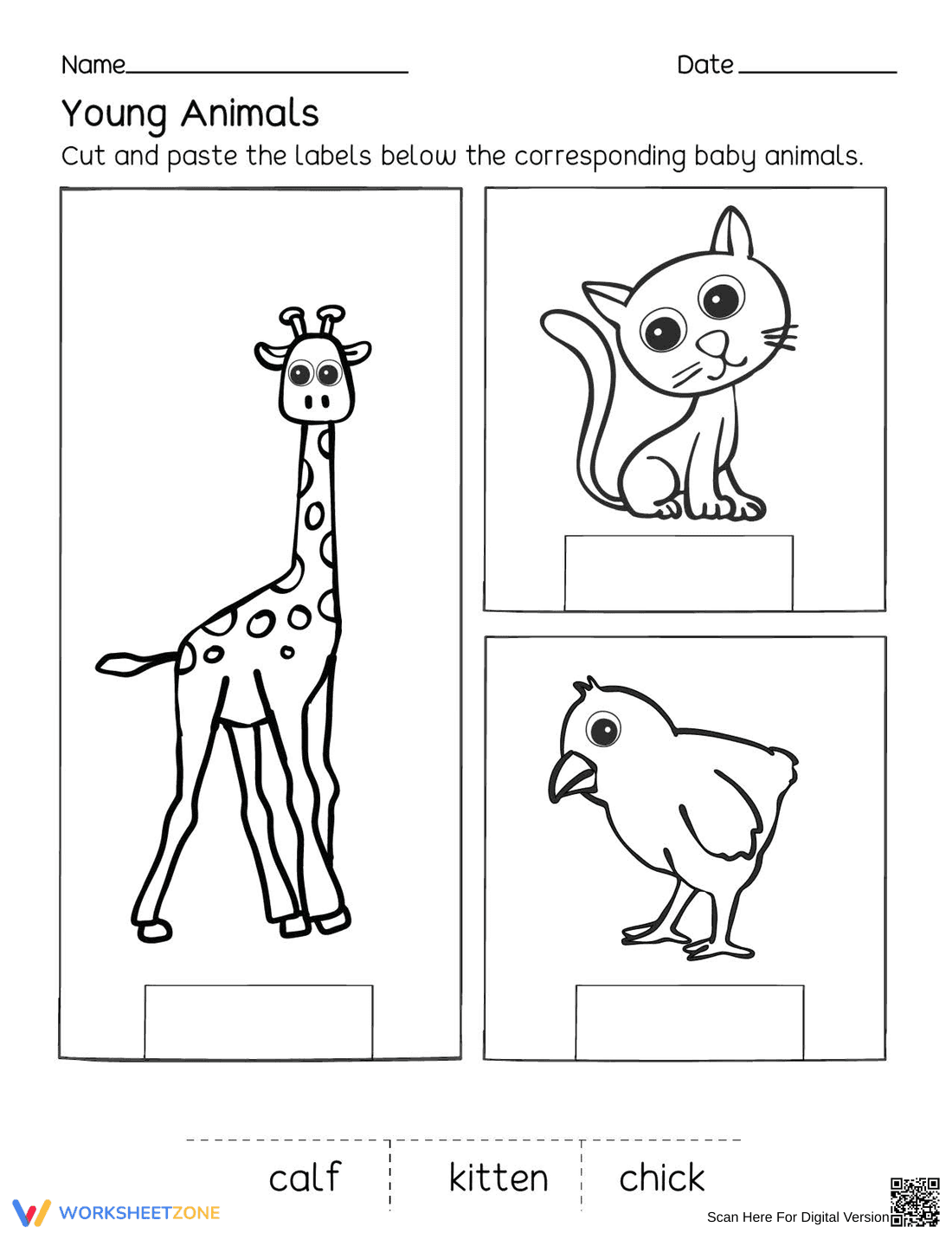
Help early learners identify offspring names with this engaging young animals worksheet. By matching labels to cute illustrations, students build essential science vocabulary and fine motor skills. This activity provides an immediate, observable outcome as children correctly pair a calf, kitten, and chick with their respective images.
At a Glance
- Grade: Kindergarten · Subject: Science
- Standard:
1-LS3-1— Make observations that young animals are like, but not exactly like, their parents- Skill Focus: Identifying and naming baby animals
- Format: 1 page · 3 problems · Answer key included · PDF
- Best For: Science centers or quick sub plans
- Time: 10–15 minutes
This single-page PDF features three clear illustrations of baby animals: a giraffe calf, a kitten, and a chick. Below the images are three dashed-line labels with the vocabulary words. The structure encourages students to observe physical characteristics before selecting the appropriate name. The clean layout ensures that young children can navigate the page without being overwhelmed by visual clutter.
This resource offers an efficient classroom workflow. Print the worksheet directly from the PDF (30 seconds). Distribute the pages along with scissors and glue sticks to your students (1 minute). Review the completed work through group check-ins or individual feedback (1 minute). Total teacher preparation time is under two minutes, making it an ideal choice for emergency sub plans or last-minute lesson extensions.
Aligned to NGSS standard `1-LS3-1`, this activity helps students observe that young animals are like their parents by focusing on naming conventions. It also supports ELA vocabulary development under CCSS.L.K.5.A by sorting common objects into categories. Both standard codes can be copied directly into lesson plans, IEP goals, or district curriculum mapping tools to ensure rigorous instructional alignment.
Use this worksheet as a formative assessment after a lesson on animal life cycles. Observe if students can identify the animals based on their juvenile features. It also works well as a morning work assignment or a science center activity during rotations. Expected completion time is approximately 10 to 15 minutes, depending on the students' cutting proficiency and motor skill level.
This worksheet is ideal for Preschool through Grade 1 students. It provides scaffolding for English Language Learners (ELLs) by pairing visual cues with text. Pair this resource with a picture book about animal families or an anchor chart showing parent-offspring relationships to extend the learning experience into a broader unit on living things.
Research from RAND AIRS 2024 emphasizes that multimodal activities, such as combining visual observation with physical manipulation, significantly improve retention of scientific terminology in early childhood. This young animals worksheet applies these principles by requiring students to match the standard code 1-LS3-1 to observable evidence. By naming a calf, kitten, and chick, children move beyond general categorization into specific biological nomenclature. ScienceDirect TpT Analysis suggests that high-interest visuals like these animal illustrations increase student engagement by up to 40% compared to text-only worksheets. Providing structured, zero-prep opportunities for students to demonstrate their understanding of living things allows teachers to focus on individualized instruction. This resource serves as a foundational step in biological literacy, ensuring that students can accurately describe the world around them while meeting rigorous state and national standards for early science education and vocabulary acquisition.


