




























Views
Downloads
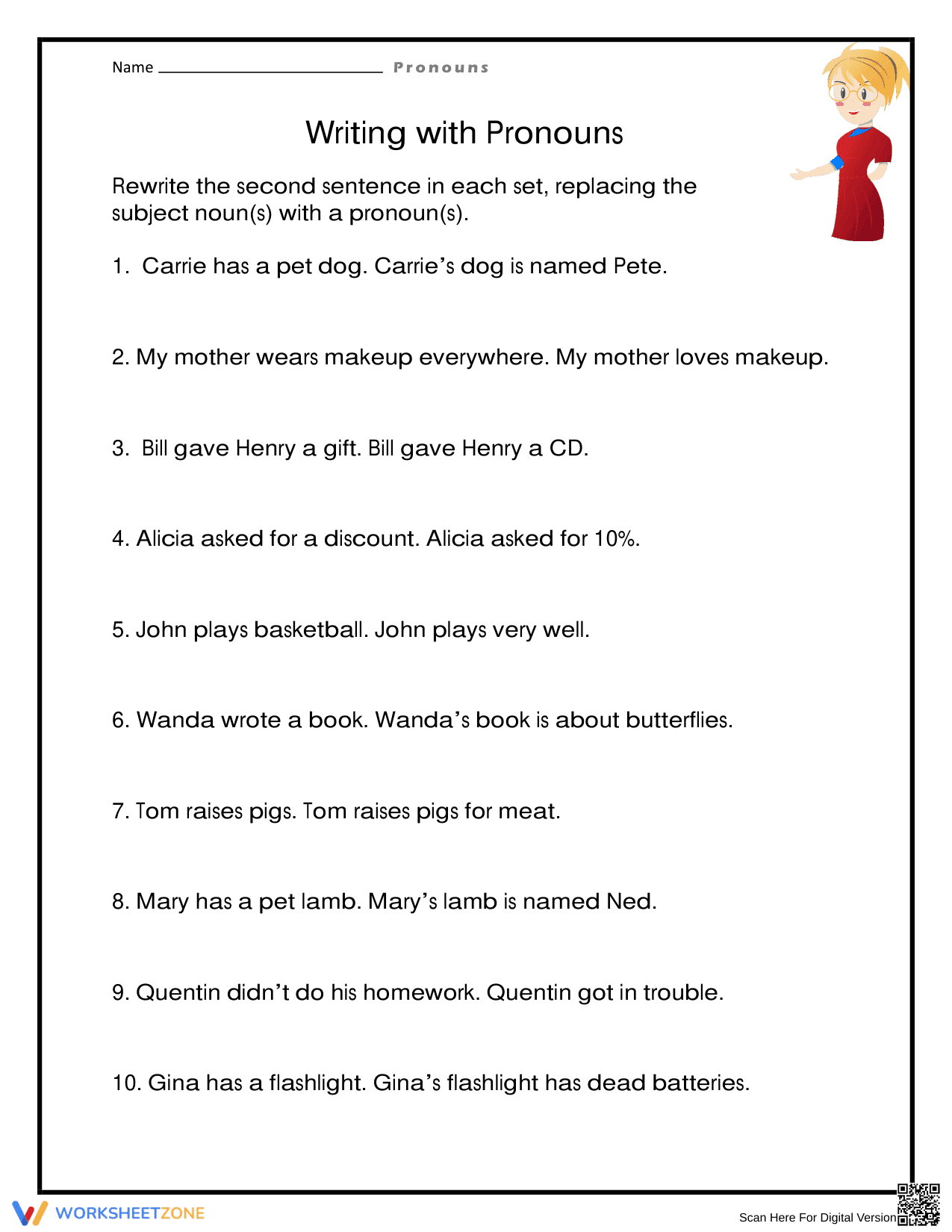

Essential Writing with Pronouns Worksheet | Grade 1-5

Paste this activity's link or code into your existing LMS (Google Classroom, Canvas, Teams, Schoology, Moodle, etc.).
Students can open and work on the activity right away, with no student login required.
You'll still be able to track student progress and results from your teacher account.
Students master sentence cohesion with this focused grammar resource. By replacing repetitive subject nouns with accurate pronouns, learners develop a more sophisticated writing style. This worksheet provides direct practice in identifying antecedents and selecting correct pronouns (he, she, it, they) to maintain clarity and sentence flow across various academic and everyday contexts.
At a Glance
- Grade: 1–5 · Subject: ELA
- Standard:
CCSS.ELA-LITERACY.L.1.1.D— Use personal pronouns to replace subject nouns in sentences- Skill Focus: Pronoun Substitution
- Format: 1 page · 10 problems · Answer key included · PDF
- Best For: Independent grammar practice or sub plans
- Time: 15–20 minutes
This single-page PDF contains 10 exercises designed to build confidence in pronoun usage. Each task presents a sentence pair; students rewrite the second sentence by substituting the repeated subject noun with a pronoun. The layout is clean and spacious, featuring clear instructions and a helpful visual cue to engage elementary learners while maintaining academic rigor.
The zero-prep design follows a simple three-step workflow: Print, Distribute, and Review. Total teacher preparation time is less than two minutes, making it an ideal choice for busy mornings or emergency substitute folders. The self-explanatory nature of the tasks allows students to work independently with minimal guidance, ensuring a productive classroom environment.
Aligned to CCSS.ELA-LITERACY.L.1.1.D, this resource helps students "use personal, possessive, and indefinite pronouns." By focusing on personal pronouns, the worksheet supports literacy goals related to sentence structure. This standard code can be copied directly into lesson plans, IEP goals, or district curriculum mapping tools to ensure consistent tracking of student progress.
Deploy this worksheet during the independent practice phase of a lesson. After demonstrating how to identify a subject noun, have students complete the items to check for accuracy in gender and number agreement. This serves as an effective formative assessment tool or an "exit ticket" to gauge mastery before moving to more complex pronoun-antecedent agreement topics.
Tailored for students in Grades 1 through 5, this resource offers broad applicability for varied skill levels. It is especially beneficial for English Language Learners needing repetitive practice with substitution rules. For differentiation, pair this activity with a short reading passage and ask students to identify all personal pronouns used as subjects within the text.
According to research by Fisher & Frey (2014) on the gradual release of responsibility, structured practice like this pronoun substitution task is vital for moving students from guided instruction to independent mastery. The worksheet focuses on CCSS.ELA-LITERACY.L.1.1.D, a foundational standard that underpins more advanced writing skills. By engaging with 10 distinct sentence sets, students build the necessary cognitive links between nouns and their pronoun counterparts. Research indicates that frequent, short-burst grammar activities are more effective for retention than isolated, long-form units. This resource provides exactly that: a targeted 15-minute intervention that reinforces core linguistic rules. Educators can rely on this evidence-based approach to improve student writing clarity and sentence variety. The inclusion of a full answer key ensures that feedback can be provided promptly, which is a key factor in successful skill acquisition within the NAEP frameworks for writing proficiency.


