


























Views
Downloads

Grade 2 Positive Thinking — Printable No-Prep Worksheet
Paste this activity's link or code into your existing LMS (Google Classroom, Canvas, Teams, Schoology, Moodle, etc.).
Students can open and work on the activity right away, with no student login required.
You'll still be able to track student progress and results from your teacher account.
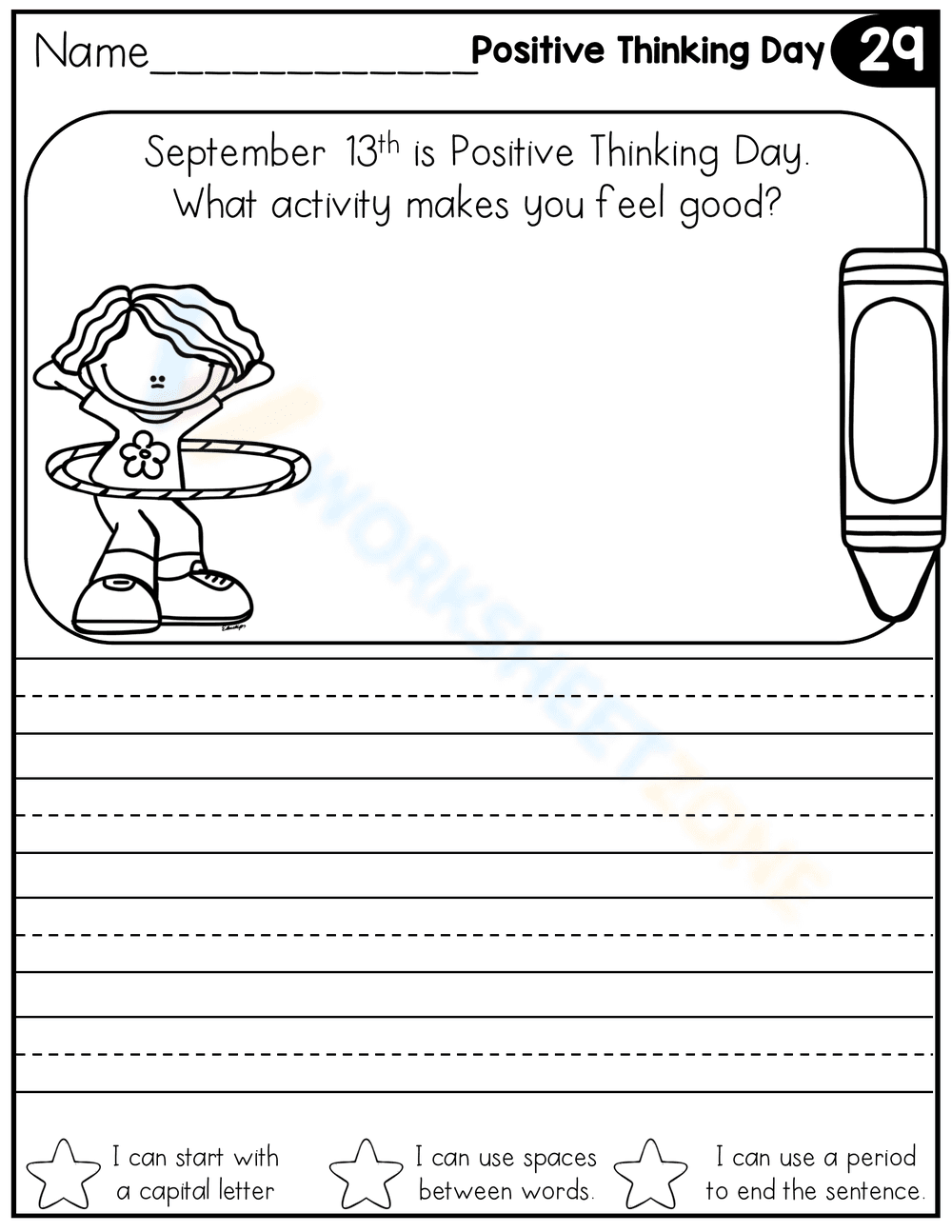
This single-page writing worksheet helps second-grade students practice foundational composition skills while reflecting on healthy habits. Students respond to a Positive Thinking Day prompt by illustrating and writing about an activity that makes them feel good, reinforcing both emotional awareness and core sentence conventions.
At a Glance
- Grade: 2 · Subject: ELA
- Standard:
CCSS.ELA-LITERACY.L.2.2— Apply capitalization, punctuation, and spacing in writing- Skill Focus: Sentence Conventions & Short Composition
- Format: 1 page · 1 prompt · No answer key · PDF
- Best For: Morning work or writing centers
- Time: 15–20 minutes
This printable resource features a combined drawing and writing space tailored for early elementary learners. The top section provides a clear, engaging prompt asking students to identify an activity that brings them joy, alongside a designated illustration box. The bottom half includes primary-ruled dashed lines to support proper letter formation. A built-in, three-star student self-check rubric sits at the footer, prompting writers to verify their use of capital letters, word spacing, and ending punctuation before submitting their work.
Designed for immediate classroom implementation, this resource requires minimal teacher preparation:
- Print (1 minute): Generate copies of the single-page PDF for the entire class. No special materials or cutting required.
- Distribute (1 minute): Hand out the prompt during morning routines, writing blocks, or as a fast-finisher activity.
- Review (3 minutes): Use the built-in self-check stars to quickly assess student adherence to basic writing conventions.
With under two minutes of total teacher prep time, this worksheet serves as an excellent emergency sub-plan or a reliable independent practice station.
This activity aligns directly with CCSS.ELA-LITERACY.L.2.2, requiring students to demonstrate command of the conventions of standard English capitalization, punctuation, and spelling when writing. The explicit self-monitoring rubric at the bottom of the page reinforces these exact convention standards. Both standard codes can be copied directly into lesson plans, IEP goals, or district curriculum mapping tools.
Deploy this worksheet as a focused morning work assignment to settle students into the day with a positive mindset. Alternatively, integrate it into a dedicated writing center where students can independently draft and self-edit their responses. During formative assessment, teachers should observe whether students actively use the three-star rubric at the bottom to check their capitals and periods before turning the paper in. Expected completion time ranges from 15 to 20 minutes depending on the student's illustration detail.
This resource is primarily designed for second-grade students developing their independent writing stamina and convention awareness. The primary-ruled lines provide necessary scaffolding for students who still struggle with letter sizing and placement. It pairs naturally with social-emotional learning (SEL) lessons on mindfulness or a direct instruction mini-lesson on sentence editing and proofreading.
Integrating self-monitoring tools into daily writing tasks significantly improves student mastery of foundational literacy skills. This worksheet targets CCSS.ELA-LITERACY.L.2.2, helping students apply capitalization, punctuation, and spacing in writing through a structured, independent prompt. According to Fisher & Frey (2014), providing students with explicit, visible success criteria—such as the three-star self-check rubric included in this resource—enhances their ability to self-regulate and edit their own compositions before teacher intervention. By combining a high-interest, positive-thinking prompt with immediate convention accountability, educators can foster both expressive fluency and technical accuracy. Regular practice with these embedded checklists reduces careless errors and builds the metacognitive habits necessary for advanced writing tasks in later grades. This approach ensures that students do not just write, but actively evaluate their adherence to standard English conventions.


