


























Views
Downloads
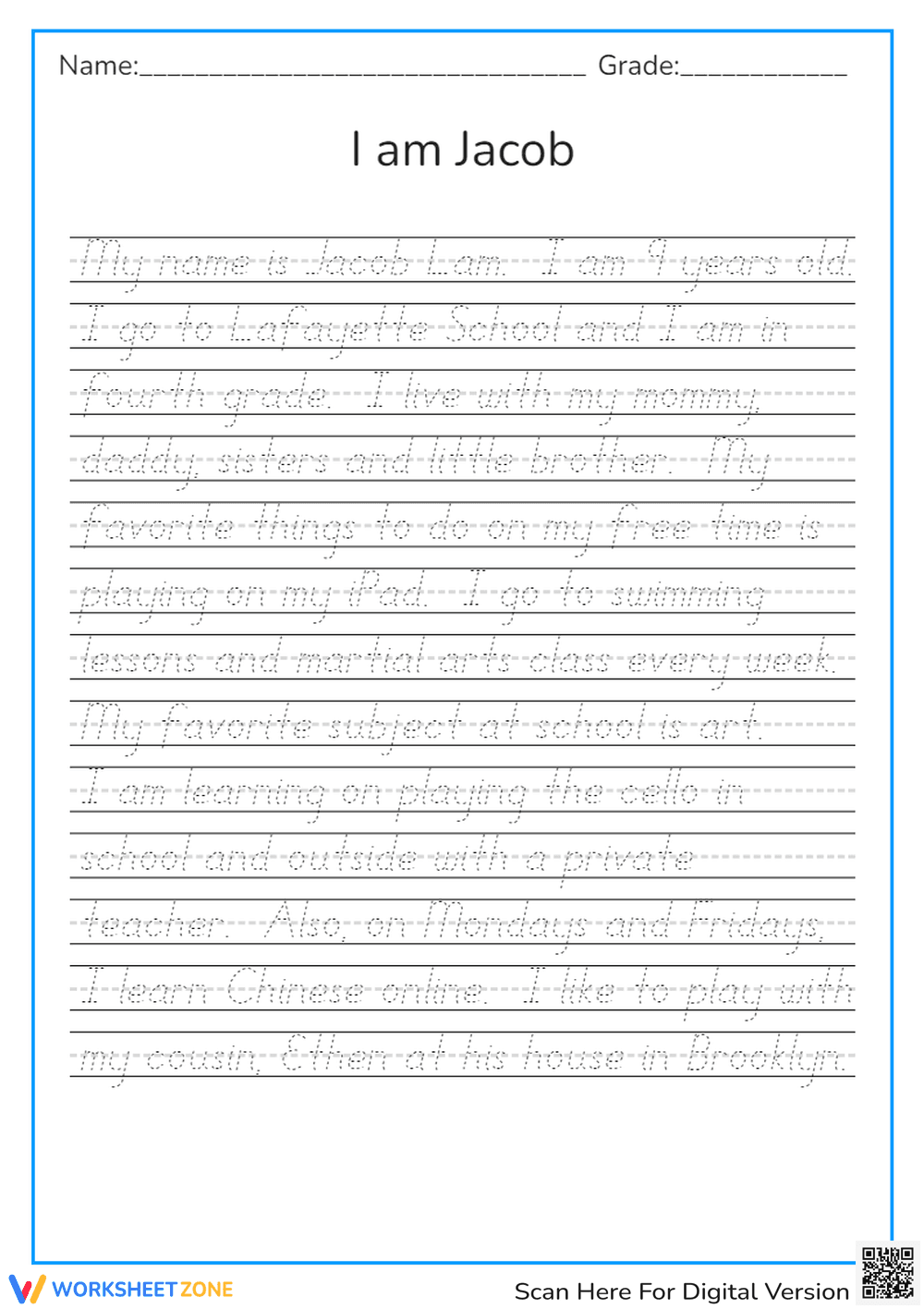

"I Am Jacob" Handwriting Worksheet | Grade 1-2 Essential
Paste this activity's link or code into your existing LMS (Google Classroom, Canvas, Teams, Schoology, Moodle, etc.).
Students can open and work on the activity right away, with no student login required.
You'll still be able to track student progress and results from your teacher account.
This Grade 1-2 handwriting worksheet provides a structured tracing activity to improve letter formation and fine motor control. By tracing a cohesive paragraph about a student named Jacob, learners practice spacing, alignment, and capitalization in a meaningful context. It is an effective tool for developing the muscle memory required for fluent, legible writing.
At a Glance
- Grade: 1-2 · Subject: Handwriting
- Standard:
CCSS.ELA-LITERACY.L.1.1.A— Print all upper- and lowercase letters legibly and accurately- Skill Focus: Paragraph tracing and letter formation
- Format: 1 page · 12 lines · No answer key needed · PDF
- Best For: Daily morning work or handwriting centers
- Time: 10–15 minutes
This single-page PDF features 12 lines of dashed-line text designed for tracing. The content is a first-person narrative that introduces "Jacob," providing students with a model of proper sentence structure and punctuation. The layout includes standard primary ruling with a midline to guide letter height and descender placement, ensuring students maintain consistent sizing throughout the exercise.
The zero-prep workflow for this resource is designed for maximum efficiency. First, print the single-page PDF (30 seconds). Next, distribute the sheets to students during your morning transition or literacy block (1 minute). Finally, conduct a quick visual review of letter slant and line adherence as students work (ongoing). Total teacher preparation time is under 2 minutes, making it an ideal sub plan addition.
The primary focus is `CCSS.ELA-LITERACY.L.1.1.A`, which requires students to print all upper- and lowercase letters. This worksheet also supports `CCSS.ELA-LITERACY.W.1.2` by modeling how to write informative texts about a person. Both standard codes can be copied directly into lesson plans, IEP goals, or district curriculum mapping tools.
Use this worksheet during the independent practice phase of a handwriting lesson. It is particularly effective after a brief teacher demonstration of tricky letter connections. For formative assessment, observe the student's pencil grip and the directionality of their strokes. Completion typically takes 10 to 15 minutes depending on the student's fine motor proficiency.
This resource is designed for first and second-grade students who are transitioning from individual letter practice to full-sentence writing. It is also suitable for older students requiring occupational therapy support or English Language Learners (ELLs) who benefit from seeing high-frequency vocabulary in a narrative context. Pair this with a personal narrative writing prompt.
According to the RAND AIRS 2024 report, consistent handwriting practice is a foundational component of literacy development that directly impacts a student's ability to compose complex texts later in their academic career. This worksheet targets CCSS.ELA-LITERACY.L.1.1.A by providing 12 lines of high-quality tracing practice. Research from Fisher & Frey (2014) emphasizes the importance of modeling through instructional frameworks; this worksheet serves as the independent phase where students internalize the mechanics of writing. By focusing on a cohesive paragraph rather than isolated letters, students learn to manage spatial constraints and punctuation simultaneously. This integrated approach to fine motor development ensures that handwriting becomes an automated skill, freeing up cognitive resources for higher-order composition tasks. This resource provides a reliable, evidence-based method for improving legibility and writing stamina in early elementary classrooms.


