


























Views
Downloads

Grade 2 Would You Rather — Printable No-Prep Worksheet
Paste this activity's link or code into your existing LMS (Google Classroom, Canvas, Teams, Schoology, Moodle, etc.).
Students can open and work on the activity right away, with no student login required.
You'll still be able to track student progress and results from your teacher account.
This engaging Grade 2 and Grade 3 opinion writing worksheet gives students a fun, structured way to express their preferences and support them with clear reasoning. By answering high-interest "Would You Rather" questions, learners practice articulating their thoughts, building foundational writing skills, and preparing for lively classroom discussions.
At a Glance
- Grade: 2 & 3 · Subject: ELA
- Standard:
CCSS.ELA-LITERACY.W.2.1— Write opinion pieces supplying reasons that support the opinion.- Skill Focus: Opinion writing and reasoning
- Format: 5 pages · 12 problems · No answer key needed · PDF
- Best For: Morning work and icebreakers
- Time: 15–20 minutes
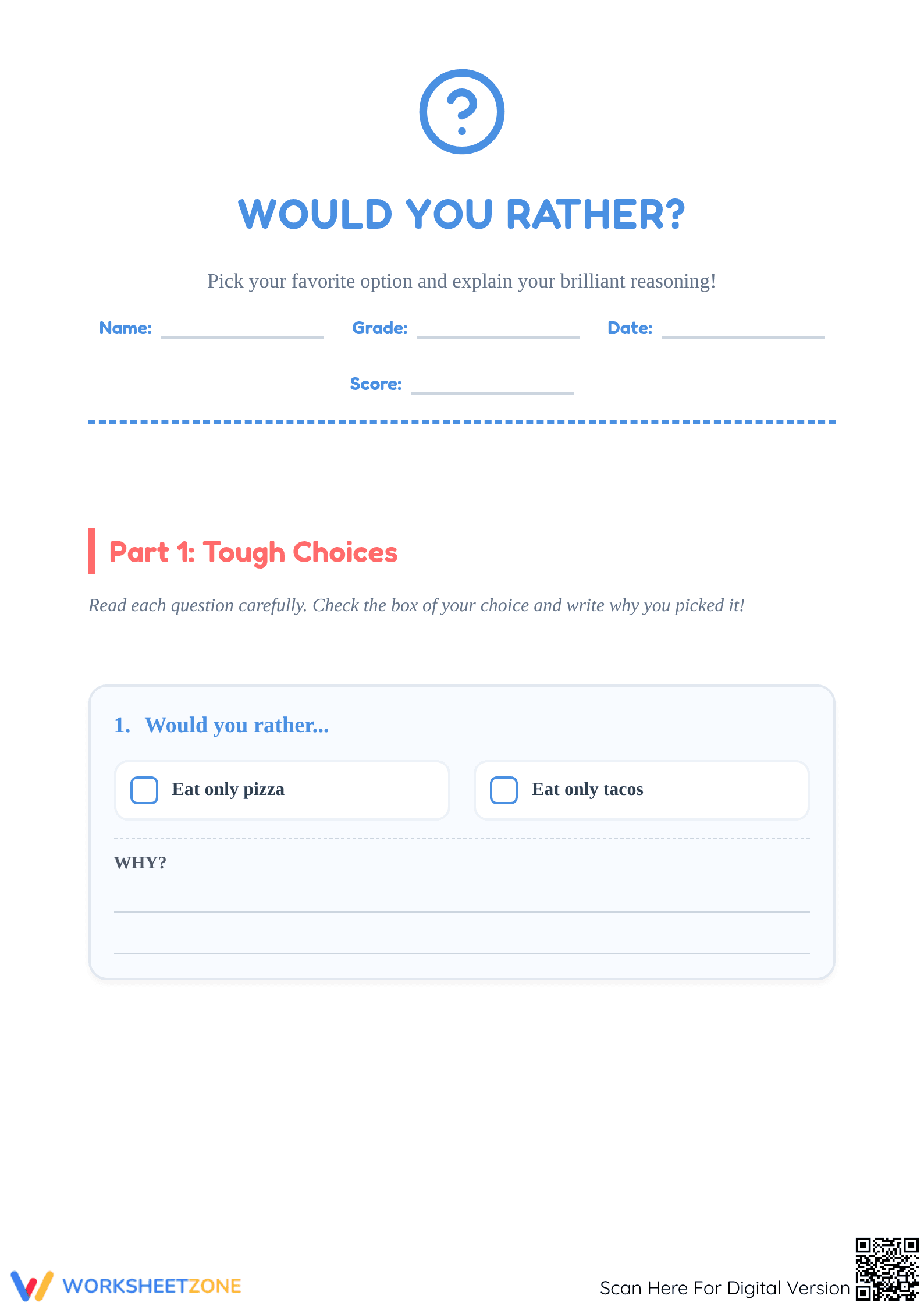
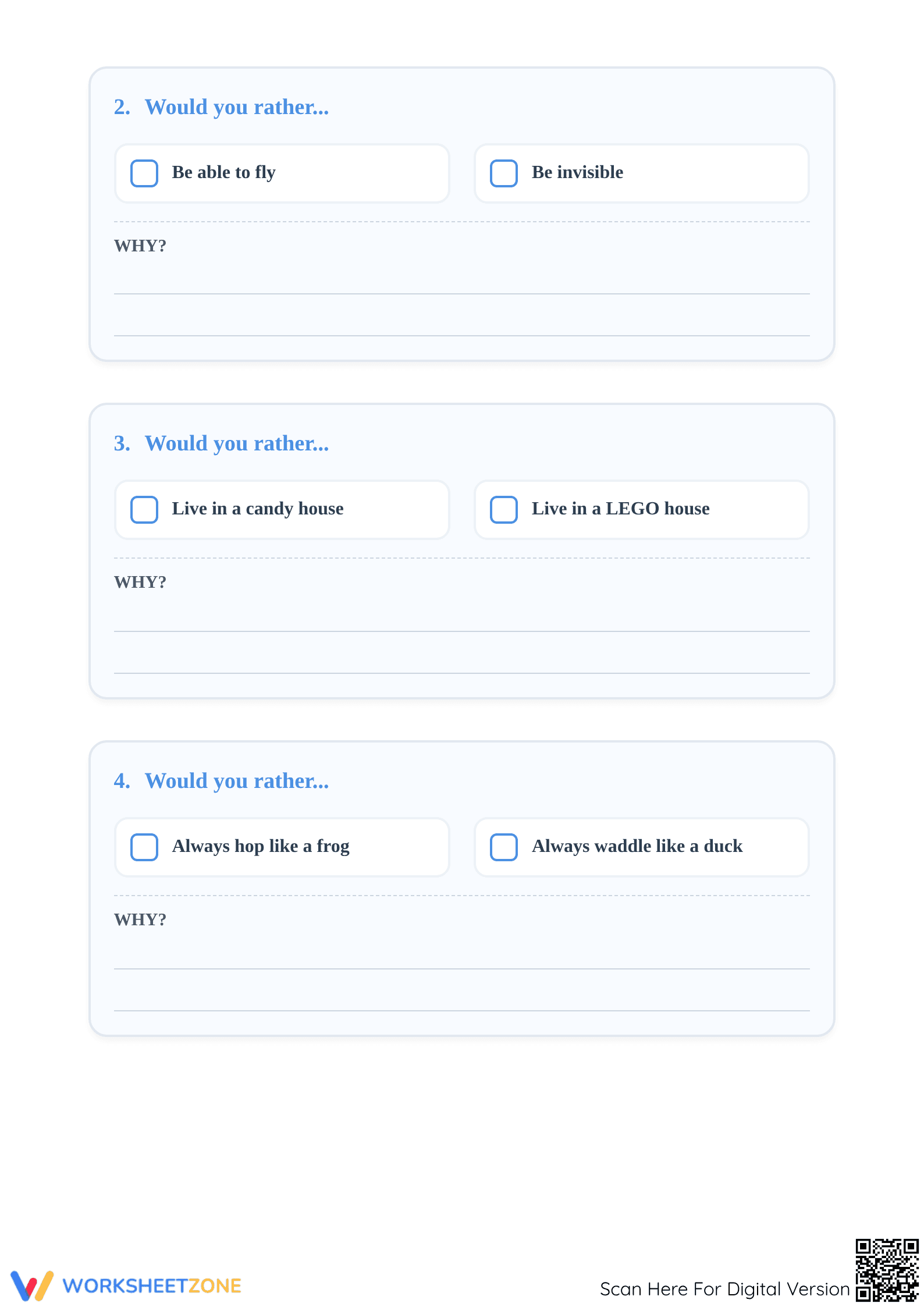
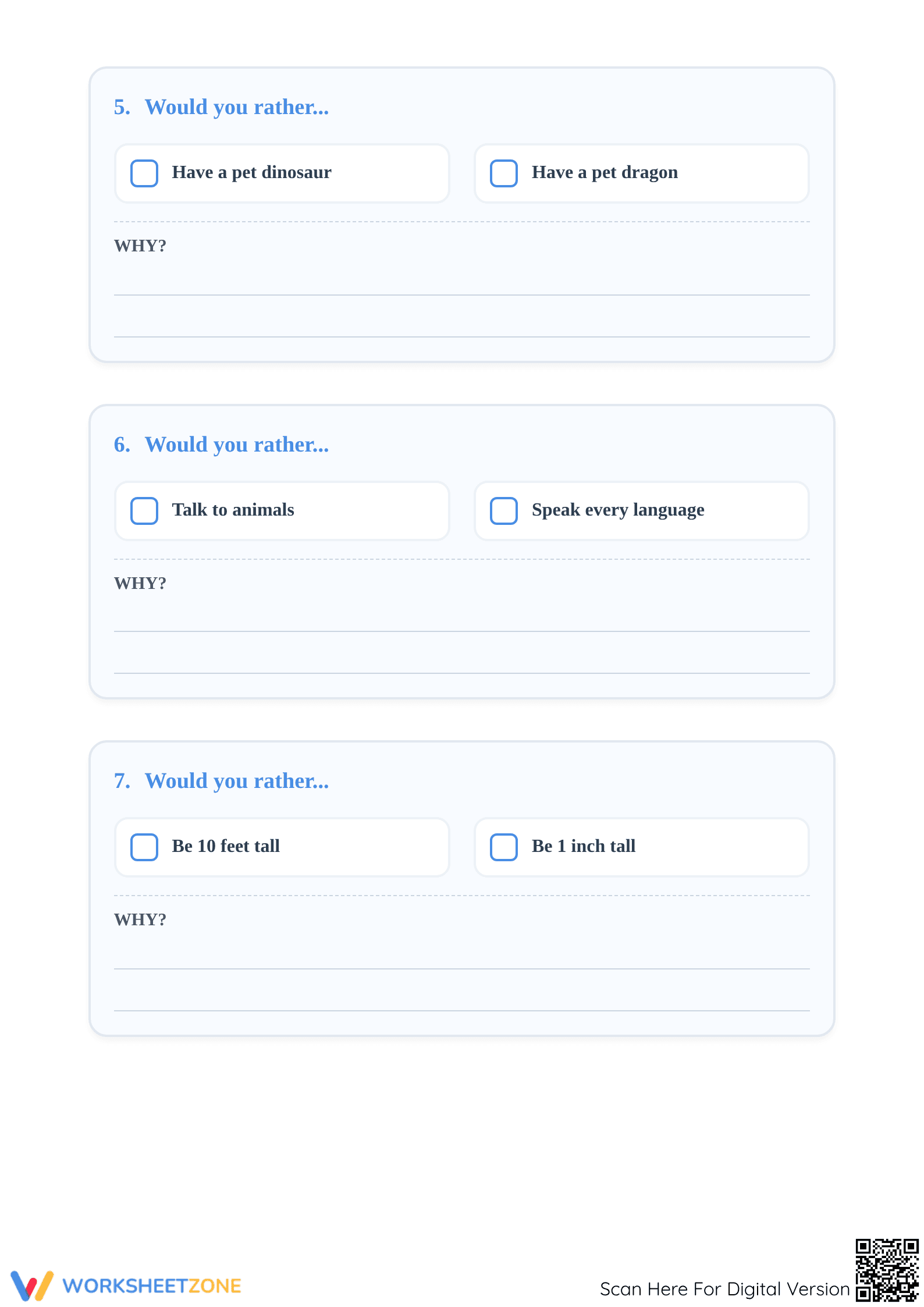
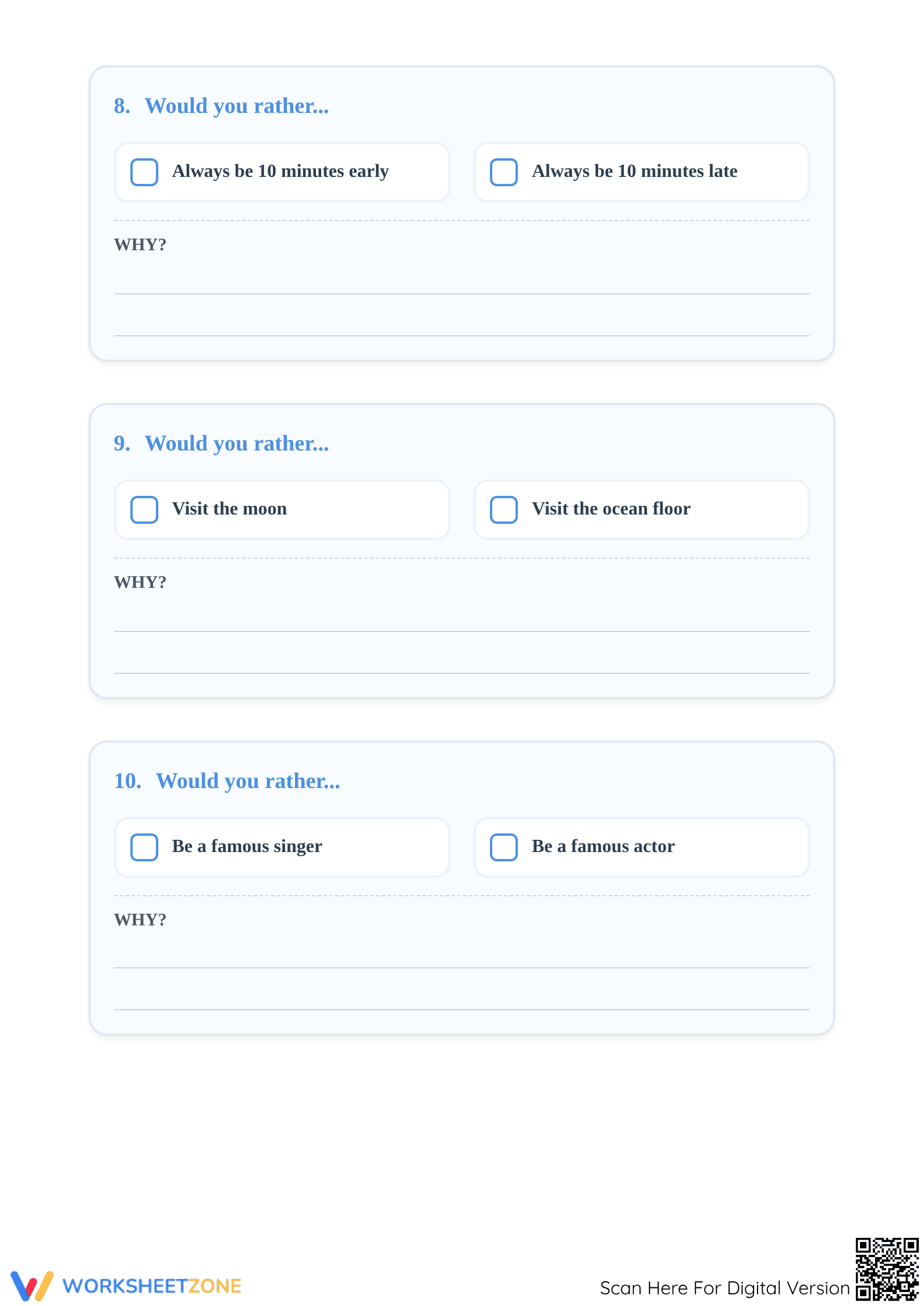
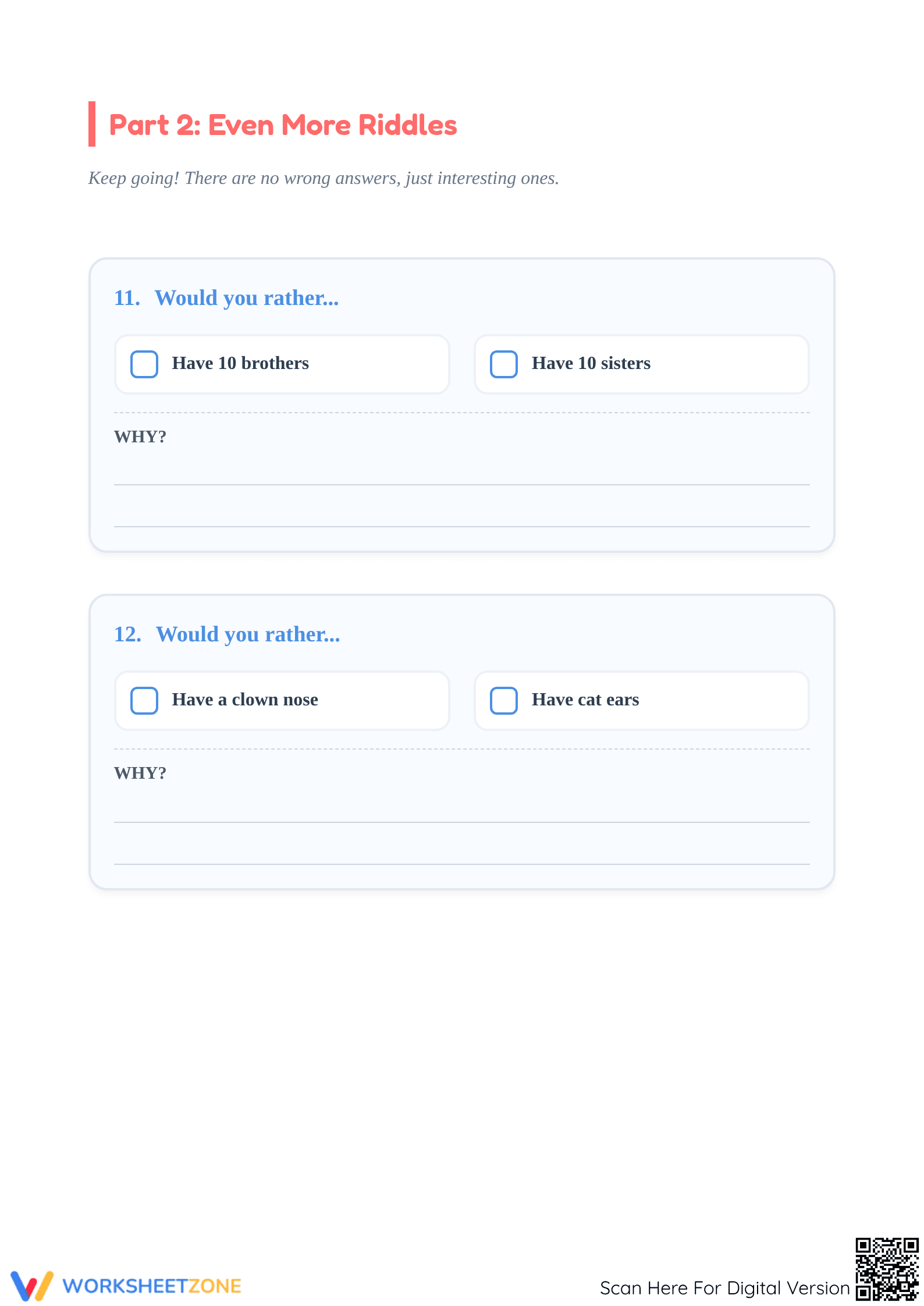
This five-page packet features 12 distinct "Would You Rather" scenarios divided into two parts. Each prompt presents two engaging options—like choosing between eating only pizza or tacos. Below the checkboxes, a dedicated "WHY?" section provides handwriting lines for students to draft their reasoning. Because these are opinion-based prompts, there are no wrong answers, making an answer key unnecessary.
Designed for immediate use, this resource requires virtually zero teacher setup.
- Print (1 minute): Print the five-page PDF packet. The clean design ensures quick copying.
- Distribute (1 minute): Hand out during morning meeting or writing block.
- Review (0 minutes): Prompts are self-explanatory, so students can begin independently right away. Total teacher prep time is under two minutes, making this an excellent sub plan.
This activity is directly aligned to CCSS.ELA-LITERACY.W.2.1, requiring students to write opinion pieces in which they state an opinion and supply reasons that support it. It also supports third-grade expectations under CCSS.ELA-LITERACY.W.3.1 for supporting a point of view with reasons. Both standard codes can be copied directly into lesson plans, IEP goals, or district curriculum mapping tools.
Morning Work: Use one page a day as a warm-up to get students writing immediately.
Speaking Prep: Have students complete the worksheet, then pair up to debate their choices.
Formative Assessment Tip: Circulate to observe if students use linking words like "because" to connect their choice to their reasoning. Expect completion in 15–20 minutes.
Ideal for second and third-grade students, as well as ESL learners who benefit from low-stakes writing prompts. For students who struggle, differentiate by providing sentence starter frames on the board. It pairs perfectly with an anchor chart on opinion writing.
Developing strong opinion writing skills early in elementary school is critical for later academic success across all subject areas. By practicing with CCSS.ELA-LITERACY.W.2.1, students learn to write opinion pieces supplying reasons that support the opinion in a structured format. According to Fisher & Frey (2014), providing students with high-interest, low-stakes writing prompts significantly increases their willingness to engage in the writing process and helps build essential cognitive stamina. When young learners are asked to justify their choices in fun, imaginative scenarios—such as choosing between having a pet dinosaur or a pet dragon—they naturally begin to construct logical arguments without the cognitive overload of complex academic topics. This foundational practice effectively bridges the gap between casual classroom conversation and structured academic writing. Regular exposure to these types of reasoning tasks ensures that students are better prepared for the rigorous analytical writing demands they will face in upper elementary grades and beyond.


