Worksheets
Lesson Plans
Coloring Pages
Home
Activity:
Topic:
CCSS:
Master poetic devices! Learn techniques like allusion, anaphora, metaphor, and rhyme scheme. Enhance your poetry analysis skills with this guide!
When an animal or thing acts like a person: personification. When we see the story through a particular character's view: perspective. when and where a story takes place: setting. conversation between 2 people or characters in a story: dialogue. "My plants are begging for water."This is an example of..: personification. When one person see the number it is a 6. When the other person looks at the number, they see a 9. Each sees the number in their own way.This is an example of..: perspective. This is an example of ______ between Joy and Elle: dialogue. What is the setting of this story: Andy's home. “The sun smiled down on us.” is an example of...: personification. This is an example of..: perspective. What literary device is used: Personification. The morning sun cast a soft glow over the opening in the forest. Martha rested on a tree stump and breathed in the fresh air. It was full of the scent of pine needles and flower blossoms. She heard two mockingbirds singing together and saw a butterfly flutter past. Martha wished every morning could be exactly like this one. What best describes the mood of the passage: peaceful. Lisa gets on the bus. Mrs. Cantu says hi to her. Lisa sees Jill and Ken.Who says hi to Lisa: Mrs. Cantu. Jack and Dad walk from their house to the front gates and pay admission. The first thing they see as they enter is the house of mirrors. Cautiously, they make their way through its winding halls full of different types of mirrors. The twisted and stretched images in the mirrors make Jack laugh at his appearance. Jack and Dad agree this is a fun way to end the day! Which describes the setting of the paragraph: At the carnival near Jack’s house in the evening. Emma saw May, the new girl, eating lunch by herself. She didn’t want May to have to sit by herself. So Emma invited May to sit with her and her friends. Emma thinks it is important to _______: help new people feel welcome. Thunder rolled across the sky, shaking the house as if it were made of cards. The wind howled and moaned. The children tiptoed down the stairs holding tightly to the railing. The sounds of the storm had made it impossible for them to stay upstairs. They decided they wanted to be downstairs with their parents.Which describes the mood of the passage: alarming. One day, a kitten finds a small, white bell. It sits on a chair and rings the bell. Poof! The kitten is now a little girl.Where would you find this story: in a fairy tale book. The real path to getting and staying fit is to exercise you heart, lungs, muscles, and joints every day. Choose exercise that is fun for you. Ride a bike or take a walk. If you prefer the encouragement of a group, then why not start some sort of ball game? Many fun exercise options cost little or nothing. A rubber ball, a pair of sneakers and a jump rope can keep you moving for hours.What is the purpose of this article: To persuade people that exercise can be easy and fun. There was a lion who liked scaring mice. The lion scared them all the time. But one day the lion was caught in a net. The mice felt sorry for him and chewed through the net. They set the lion free, and so the lion never scared the mice again.What did the lion learn: To be nicer to the mice
What is the strategy for the following question:How is Lucy’s behavior in paragraph 23 important to the resolution of her conflict: Conflict. What is the strategy for the following question:: STAR. What is the strategy for the following question:Why are the events in paragraphs 1 and 2 important to the plot? : Plot. What is the strategy for the following question:A major turning point occurs in the selection when Lucy — : . What is the strategy for the following question:Based on Lucy’s interactions with her classmates, which statement best expresses the major theme explored in this selection: . What is the strategy for the following question:What inference can the reader make based on the events that take place in scene 4? : . What is the strategy for the following question:What lesson is referred to in the title of the story: Making connections. What is the strategy for the following question:Which sentence best expresses a theme in the story: . What is the strategy for the following question:The author uses a simile in this sentence to illustrate —: . What is the strategy for the following question: What does the sensory language in paragraph 7 help the reader understand: SSHTT. What is the strategy for the following question:Paragraphs 8 and 9 are mainly a description of —: PMI. What is the strategy for the following question:Paragraphs 1 through 3 are important to the story because they establish that Anthony —: PLOT. What can the reader conclude about Grandpa from his actions in the story: . Teresa’s comments influence the theme of the story because they show that she —: . Which event in the story causes Teresa to reevaluate her talent as a long jumper: . The dialogue between Teresa and her mother after the tryout indicates that her mother —: . Which sentence of from the passage best illustrates the conflict of the story: . What events initiate the rising action in the story:
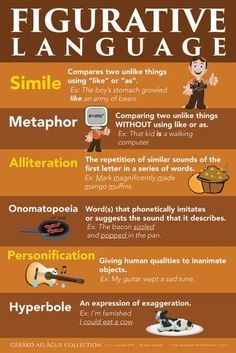
A Comparison Using like or as : Similie. Compares to things not using like or as : Metaphor. An exaggerated way of saying something: hyperbole. The life lesson of a story: Theme. When you have to infer to find out what a Character is like: Indirect Characterization. When the reader knows something the Character in the story dose not: Dramatic Irony. When a Character says something but means the opposite: Verbal Irony. When an inanimate object is given human characteristics : Personification. When two contradicting words are combined: oxymoron. When something happens that is the opposite of what we expect: Situational Irony. When the story goes back to previous events: Flashback. When something hints to a later event in the story: Foreshadowing. When I or me is used in the story: 1st person point of view. When the character is speaking to you in the piece of literature: 2nd person point of view. When an outside narrator is telling the story: 3rd Person Point of view. When the story tells us the way a character is: Direct Characterization. When a character has a conflict with someone else: man vs man . When a character has a conflict with them selves: man vs self. When a character has a conflict with something in the world ex; sickness: man vs nature. The occurrence of the same sound in a piece of literature: alliteration
a widely known basic truth: adage. a story that can reveal a hidden truth: allegory. repetition of the same sounds of the first syllable: alliteration. casual reference to a historical figure or event: allusion. how the author reveals the personality of the character: characterization. overused idea or expression: cliche. pivotal moment where the story takes a turn: climax. problem or struggle the main characters are facing: conflict. clues that hint at what’s to come: foreshadowing. figure of speech that is exaggerated: hyperbole. when certain words together mean something unique: idiom. visually descriptive figurative language: imagery. words that imitate actions or sounds: onomatopeia. two contradictory words put together: oxymoron. when parts of a sentence are the same or flipped: parallelism. a seemingly contradictory statement: paradox. a humorous play on words: pun. something that repeats over and over: repetition. time and place of a story’s action: setting. when two things are compared using like or as: simile
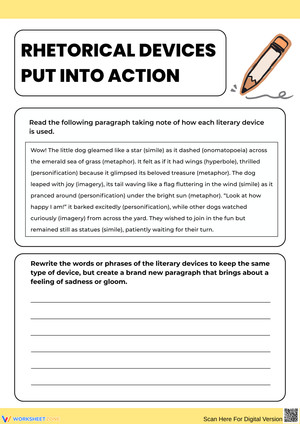
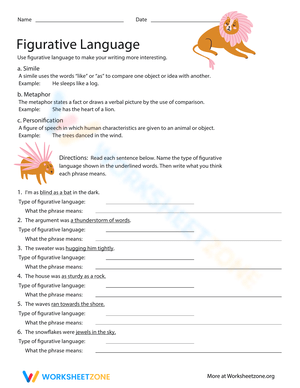
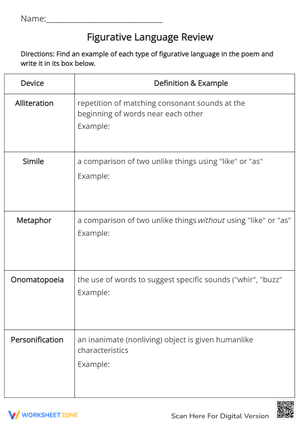
Identify simile, metaphor, and personification with this fun worksheet! Improve understanding of figurative language and enhance literary analysis skills now.
Identify literary devices with this helpful worksheet! Learn about metaphors, similes, and personification. Boost your writing skills today!
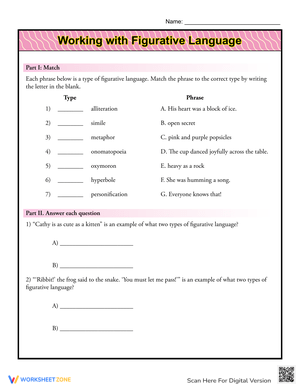
Boost your ELA skills with this printable figurative language quiz. Practice identifying similes, metaphors, hyperbole, onomatopoeia, and imagery.
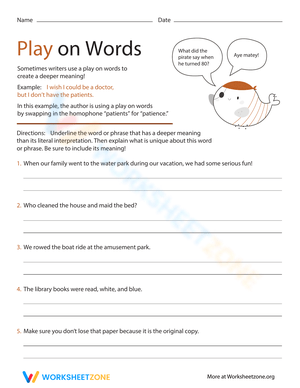
Unleash Language Play with this fun Pun worksheet! Improve understanding of language nuances and creative thinking. Download to explore more Puns!
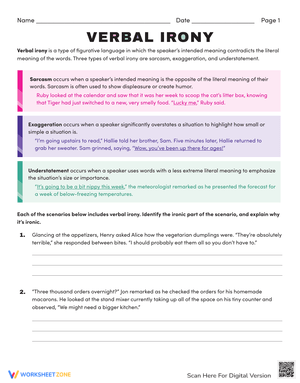
Explore irony and sarcasm in this language skills worksheet! Improve comprehension and differentiate between literal and intended meanings. #Irony
Learn about personification with our detailed chart! Understand how to use this literary device to enrich writing and add creativity. Check it out today!
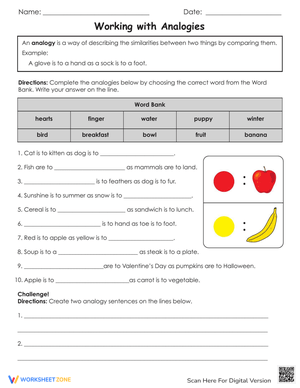
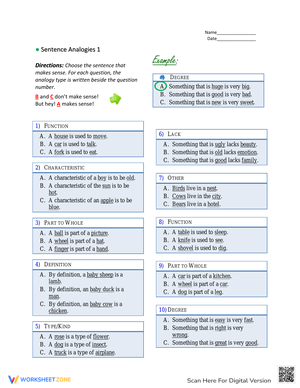
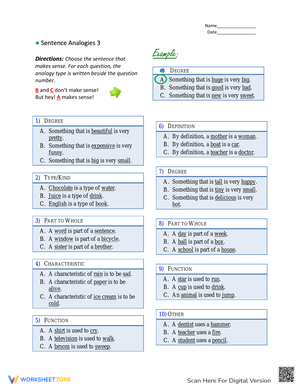
Enhance vocabulary and critical thinking with our analogies worksheet! Learn to solve analogies and expand your word knowledge. Try it today!
Have fun with silly alliteration in this language worksheet! Enhance creativity and language skills. Download for a fun practice session!
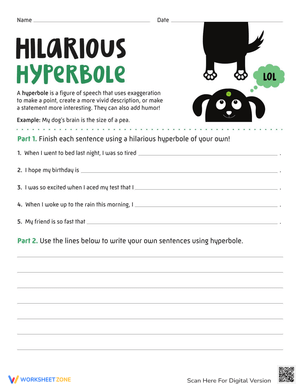
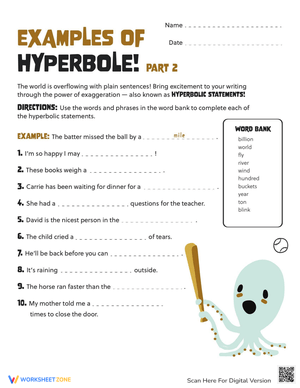
Identify and understand hyperbole with our engaging worksheet! Enhance literary device recognition skills and improve reading comprehension. #Hyperbole #ReadingSkills
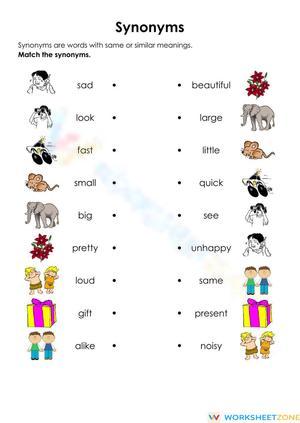
Synonyms online worksheet for kindergarten. You can do the exercises online or download the worksheet as pdf.
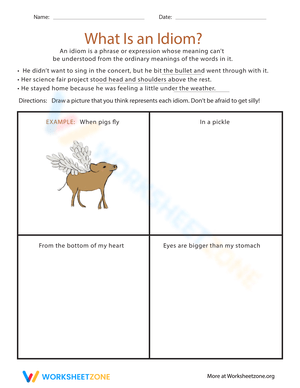
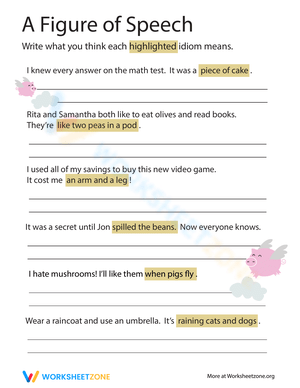
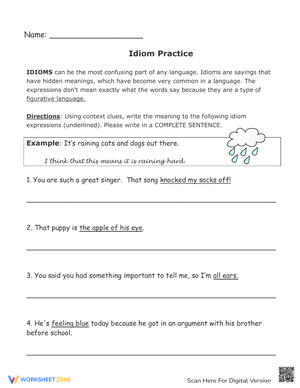
Discover common idioms and their meanings with this engaging worksheet. Improve your vocabulary and comprehension skills. Start learning Idioms today!
Complete sentence analogies and expand your vocabulary! Enhance logical reasoning with this challenging worksheet. Download now! #Analogies
Identify hyperbole examples with this worksheet! Enhance reading skills and learn literary devices. Click here to discover the power of hyperbole!
A figurative-language worksheet where students identify metaphors and similes in a passage and create their own examples. Ideal for grades 3–6.
Which of the following sets of words deal mostly with the sense of SIGHT: rocky, hairy, drenched. Which of the following sets of words deal mostly with the sense of SOUND: quiet, jangling, barking. Which of the following sets of words deal mostly with the sense of TOUCH: rough, sharp, slippery. What is "sensory language": . What type of imagery is this?The thunder clapped loudly shaking the house: Sound. It was too dark to see in the cave, but I tasted the tang of salt on my lips. I must be near the ocean! Excited, I moved toward the salty spray. What sense did the writer describe: taste. Although he was blind, Gino's nose told him that he had to find shelter. The scent of rain filled the air.What sense did the writer describe: smell. Read the sentence from the selection, "Without warning, huge cold drops fell on the marching ants."This sentence best appeals to the reader's sense of __________: . Which sentence from the story best appeals to the reader's sense of touch: "It seemed to them that every second the temperature was rising.". In the selection, which words help the reader imagine the ants' experience: "The ants could feel the wind's force bending their delicate antennae.". Which sentence from the selection best appeals to the reader's sense of sight: "Long shadows stretched over the entrance to the ant kingdom.". The sun gleamed as bright as a lamp: see. The aroma of freshly baked Indian bread filled the air. : smell. Barefoot, The warm mud molds my feet: touch. She spoke of fruit so sugary: taste. My brush strolled across the old woman's dry brittle hair: touch. I headed directly for the flower department, where I spotted yellow tulips: see. By mistake, I grabbed a pink sticky mound of gum from under the table. : touch. Mrs. Olander's heels clicked and clattered as she headed toward our classroom. : hear. Mrs. Crab's sweet perfume lingered in the room after her exit. : smell. The mouthwatering aroma of cheesy pizza drifted across the room. : smell. Which of the five senses are used in sensory writing: Sight, hearing, feeling, tasting, smelling . Which one of the five senses is used in this sentence?The warm juicy burger was like heaven on my tongue: Taste
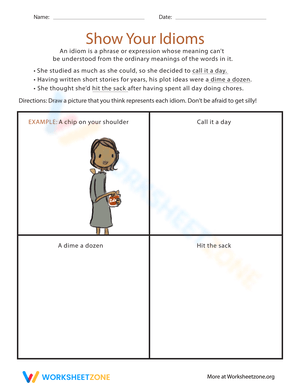
Practice using idioms and enhance your communication skills with this worksheet. Learn to incorporate idioms. Show Your Idioms knowledge now!
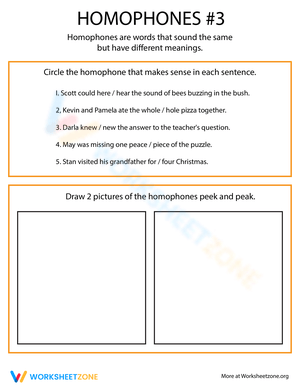
Master homophones and enhance your language skills with this targeted practice worksheet. Ideal for vocabulary building! Try Homophone Practice now.
Master non-fiction writing! Learn about grammar, parts of speech, and literary devices. Improve your non-fiction writing skills today!
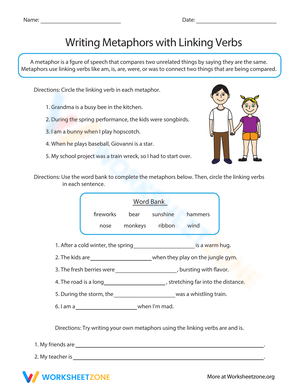
Write metaphors with linking verbs using this helpful worksheet! Enhance writing and creative thinking skills. Perfect for students learning figurative language. Try it now!
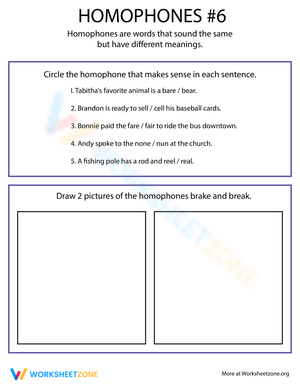
Enhance language skills with this comprehensive homophone practice worksheet. Perfect for students of all levels! Try Homophone Practice now.
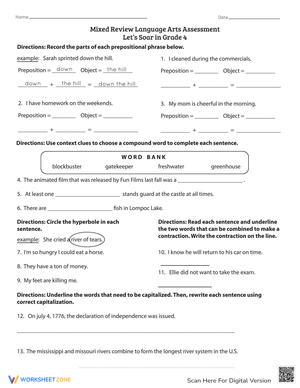
Eric ran home the rest of the way because he knew he was in trouble: Compound. Since we had only gone a mile from camp, we could turn back before dark: Complex. Dr. Matthews did what could be done, but it simply was not enough to save his life: Compound. A simple sentence that stands alone is called ___________: Independent Clause. Although he searched everywhere, Mr. Brooks could not find the keys to the computer lab: complex. Dad went hunting but Mama decided to stay home: compound. Mara planned to return to Canada. : simple. Although I drank a lot of coffee, I'm getting sleepy, and I don't think I'll make it through the movie: . Even though the the classroom is big, the students don't like the room because it is not suitable for a classroom: . While I was doing my homework, my father cooked the dinner and my mother was asleep in front of the television: . Do you want to go swimming tomorrow, or would you prefer to play tennis: compound. He told me that he is returning to London next summer: simple. She runs every day, so she is very fit: compound
Spot Verbal Irony and sarcasm! This worksheet helps you understand and identify it. Improve your comprehension of Verbal Irony with fun activities!
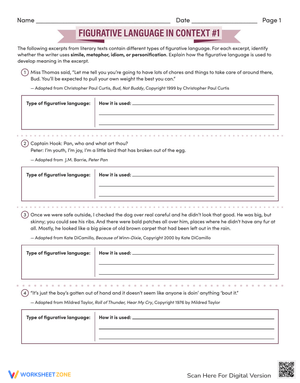
Master figurative language with this context-focused worksheet! Learn about metaphors, similes, and more. Enhance reading and writing skills. Try it out today!
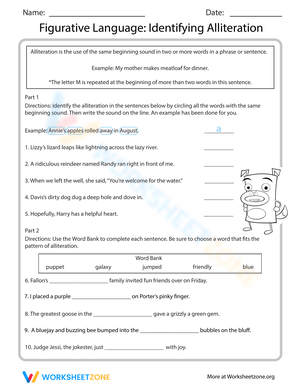
Identify alliteration in sentences with this educational worksheet. Learn about figurative language. Download and improve your language skills!
Find perfect worksheets
Grade + Topic search
Select your Grade level, Topic and Subject to find worksheets instantly or you can use keyword below to search what you need.
Make your own worksheets