




























Views
Downloads


Idiom Practice Worksheet | Grade 4-6 Essential

Paste this activity's link or code into your existing LMS (Google Classroom, Canvas, Teams, Schoology, Moodle, etc.).
Students can open and work on the activity right away, with no student login required.
You'll still be able to track student progress and results from your teacher account.
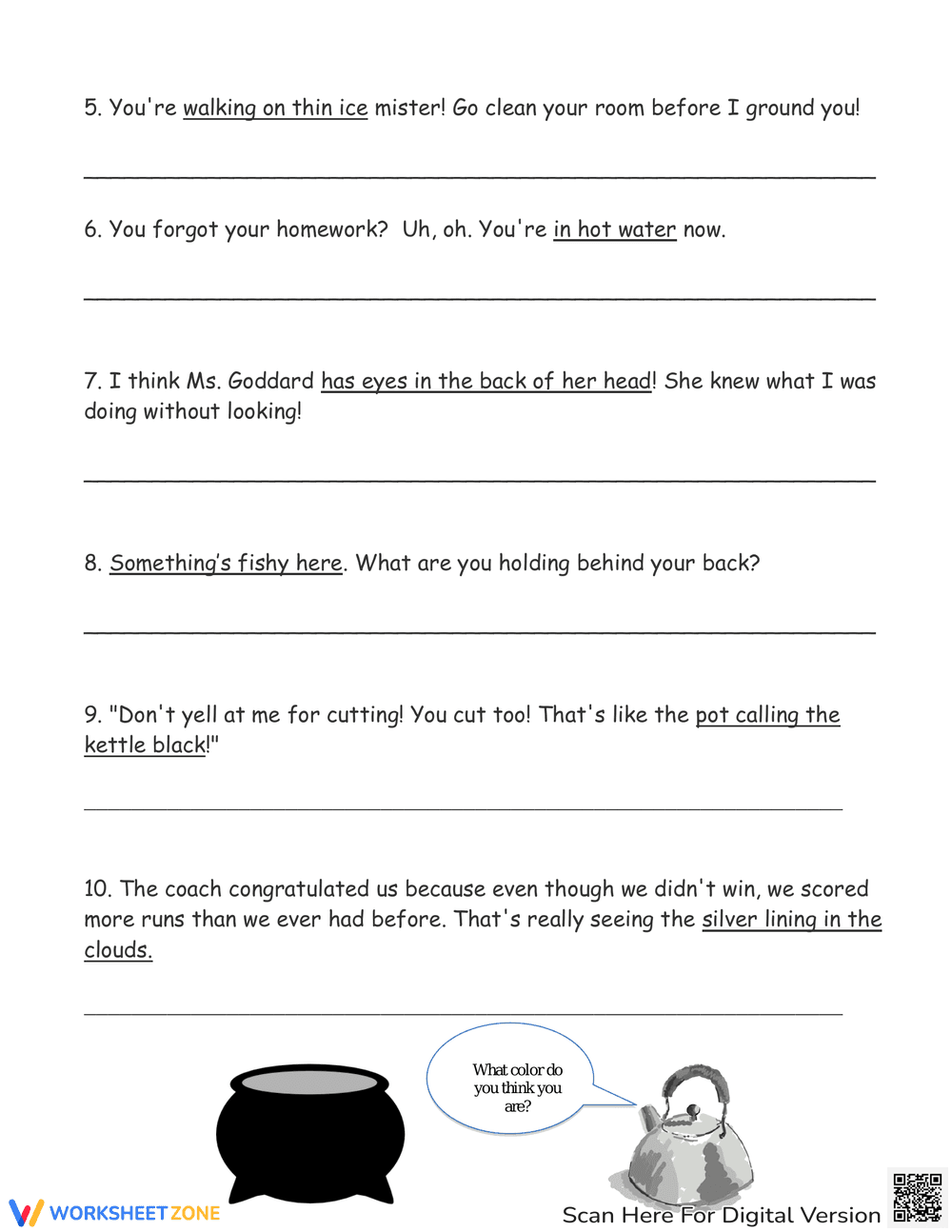
This Grade 4-6 idiom practice worksheet helps students decode figurative language by using context clues to determine the meaning of common expressions. By analyzing 10 unique sentences, learners move beyond literal interpretations to understand the nuances of English idioms. This resource ensures students can explain complex phrases in their own complete sentences.
At a Glance
- Grade: 3-6 · Subject: ELA
- Standard:
CCSS.ELA-LITERACY.L.4.5.B— Recognize and explain the meaning of common idioms, adages, and proverbs- Skill Focus: Figurative Language & Context Clues
- Format: 2 pages · 10 problems · Answer key included · PDF
- Best For: Independent practice or sub plans
- Time: 20–30 minutes
What's Inside
The packet contains two pages of focused practice. It begins with a clear definition of idioms and a worked example ("raining cats and dogs") to model the expected response format. Students encounter 10 underlined idiomatic expressions embedded in descriptive sentences. Each task provides ample writing space for students to draft a complete sentence explaining the hidden meaning without relying on literal definitions.
Zero-Prep Workflow
- Print: Generate the two-page PDF for your class in roughly 60 seconds.
- Distribute: Hand out the sheets and read the introductory definition aloud to set the stage for the activity.
- Review: Go over the answers as a whole group or use the included key for rapid grading in under 2 minutes.
This workflow makes the resource an ideal option for literacy centers or emergency sub plans.
Standards Alignment
This resource aligns directly with `CCSS.ELA-LITERACY.L.4.5.B`, which requires students to recognize and explain the meaning of common idioms, adages, and proverbs. It also supports vocabulary acquisition through the use of context clues. Both standard codes can be copied directly into lesson plans, IEP goals, or district curriculum mapping tools.
How to Use It
Use this worksheet during the independent practice phase of a figurative language unit. It works best after students have been introduced to the concept of non-literal meanings. For a formative assessment, observe students as they work on item number 9 ("pot calling the kettle black") to see if they can identify the irony in the context. Completion typically takes 25 minutes.
Who It's For
This is designed for general education students in grades 3 through 6, as well as English Language Learners (ELL) who often struggle with non-literal phrasing. It pairs perfectly with an anchor chart displaying common idioms or a mentor text rich in figurative language. The clear layout supports students who need structured writing lines to organize their thoughts.
According to the RAND AIRS 2024 report, explicit instruction in figurative language is a critical component of reading comprehension for upper elementary students. This worksheet addresses the specific challenge of idiomatic expressions, which often act as barriers for students transitioning from literal to inferential reading. By requiring students to explain meanings in complete sentences, the resource reinforces the CCSS.ELA-LITERACY.L.4.5.B standard through active production rather than passive identification. Research from Fisher & Frey (2014) suggests that using context clues to decode idioms helps bridge the gap between Tier 1 and Tier 2 vocabulary. This 10-problem set provides the necessary repetition for students to internalize the process of analyzing non-literal text. It serves as a reliable tool for measuring student progress in understanding the cultural and linguistic nuances of the English language while providing teachers with clear evidence of student mastery.


