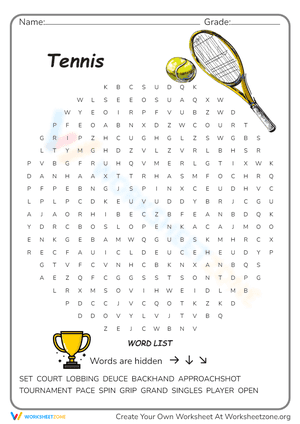
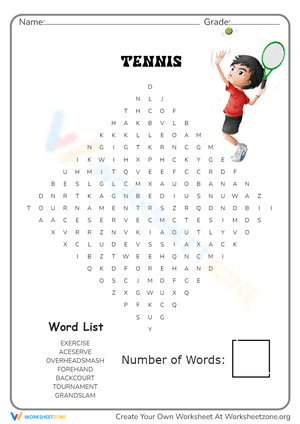
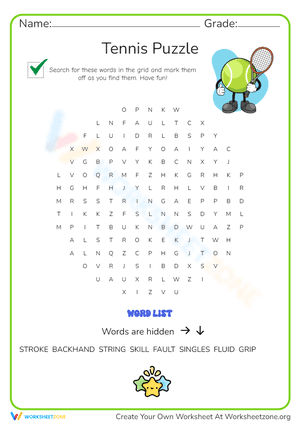
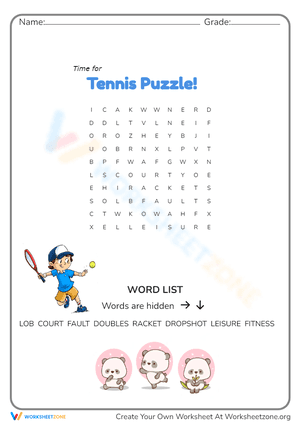
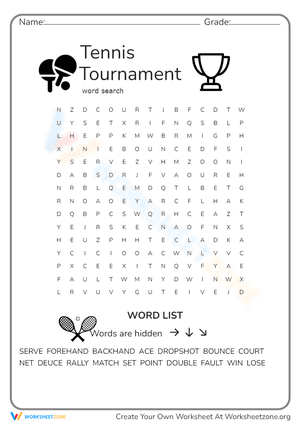
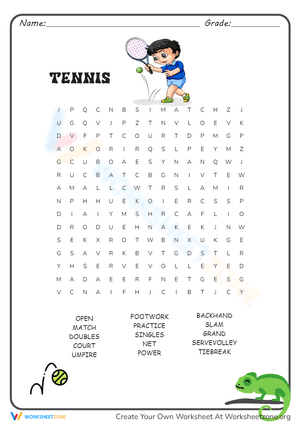
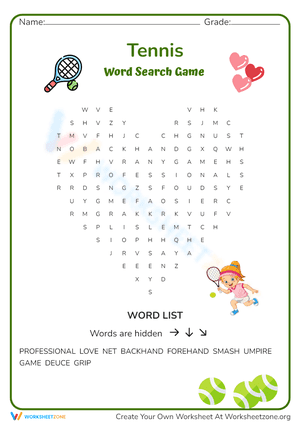
When you are planning a tennis unit, the first ten minutes on the court often decide how much vocabulary actually sticks. Students who cannot tell a backhand from a baseline struggle to follow verbal cues once rallies start moving. An all about tennis word search gives you a quiet, structured way to front-load that vocabulary before racquets ever come out, so your on-court instructions land faster and with less re-teaching.
This kind of puzzle works well as a five-to-ten minute warm-up at the start of a PE block, a homeroom bell-ringer on a tennis-unit day, or a quick station during indoor recess. Because it requires no equipment beyond a printed sheet and a pencil, it fits almost any scheduling gap without extra prep.
Core Tennis Vocabulary to Include
For elementary and middle school PE units, keep the word list focused on terms students will actually hear during play rather than advanced strategy language. A strong beginner list includes:
- Ace
- Baseline
- Backhand
- Deuce
- Drop shot
- Lob
- Love
- Net
- Rally
- Return
These ten terms cover equipment positioning, basic scoring, and common shot types, which means students who master this list can follow most beginner-level tennis instruction without extra clarification.
Classroom Implementation
To get the most out of this worksheet, introduce the word list before handing out the puzzle rather than after. Read each term aloud, ask students to repeat it, and briefly demonstrate the motion or position if it applies, such as showing what a backhand looks like. Then distribute the word search and give students a set time limit, around five to seven minutes for most elementary groups.
Once students finish, do a quick verbal check: call out a term and ask students to point to where they play it on an imaginary court, or ask a volunteer to define it in one sentence. This closes the loop between passive word recognition and active vocabulary use, which is the gap a word search alone cannot fully close.
Keep a few completed copies on hand as an early-finisher option during other PE activities, and reuse the same puzzle two or three days into the unit as a quick formative check to see which terms have moved from the word wall into long-term memory.
Frequently Asked Questions
1. What grade levels is a tennis word search appropriate for?
This format works well for grades 2 through 8. Younger students benefit most from the shorter ten-word list, while older students can handle an expanded list with additional scoring and strategy terms.
2. How can teachers use a tennis word search alongside PE instruction rather than just as busywork?
Introduce the vocabulary verbally first, use the puzzle as active recall practice, then follow up with a quick verbal check once students finish. Pairing it with a word wall or glossary card also keeps the activity connected to actual court instruction.
3. What tennis vocabulary words should be included for beginner students?
Start with ace, baseline, backhand, deuce, drop shot, lob, love, net, rally, and return. These ten terms cover the equipment, scoring, and shot vocabulary students need for beginner-level play.
4. How does a word search help English language learners with sports vocabulary?
It offers a low-stakes way to build word recognition without requiring spoken output, which reduces pressure while still reinforcing new terminology. Gains reported in gamified vocabulary research suggest this format also supports engagement for ELL learners specifically.
5. Can this worksheet be used for indoor recess or as a sub-day activity?
Yes. It requires no equipment beyond the printed sheet, so it works well for indoor recess, rainy-day PE, or as a self-directed task for a substitute teacher to distribute with minimal setup.















 Interactive Worksheet Maker
 Quiz Maker
 Word Search Maker
 Crossword Puzzle Maker
 Word Scramble Generator
 Sentence Scramble Generator
 Handwriting Worksheet Generator
 Name Tracing Generator
 Fill In The Blank Generator