


























Views
Downloads
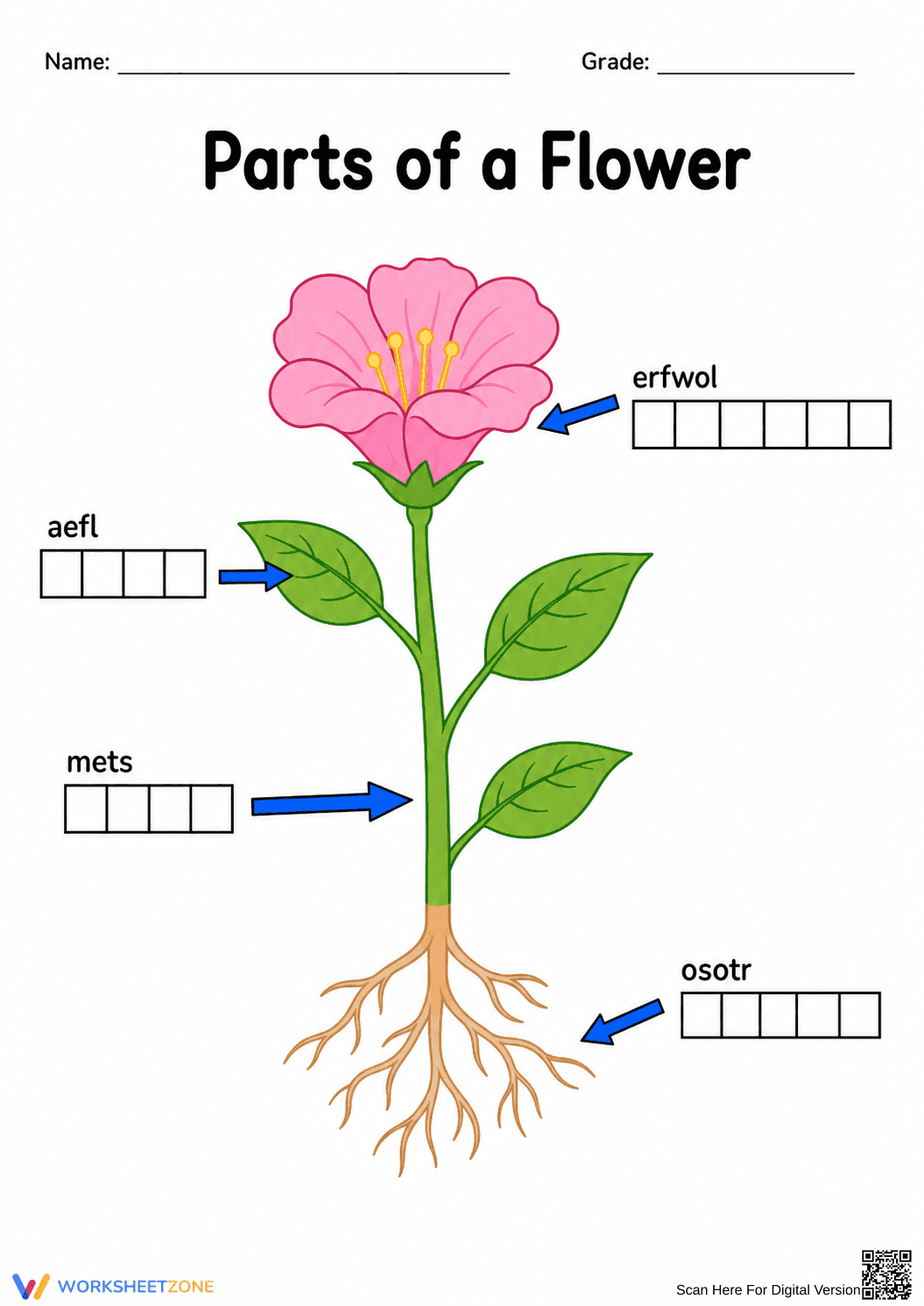

Grade 1 Parts of a Flower — Printable No-Prep Worksheet
Paste this activity's link or code into your existing LMS (Google Classroom, Canvas, Teams, Schoology, Moodle, etc.).
Students can open and work on the activity right away, with no student login required.
You'll still be able to track student progress and results from your teacher account.
This Grade 1 science worksheet provides a clear, visual approach to learning plant anatomy. By unscrambling the names of key structures, students develop both biological knowledge and literacy skills. This resource ensures learners can accurately identify and name the external parts of a flowering plant.
At a Glance
- Grade: 1 · Subject: Science
- Standard:
1-LS1-1— Identify and describe the external parts of plants and animals- Skill Focus: Flower anatomy and spelling
- Format: 1 page · 4 problems · Answer key included · PDF
- Best For: Independent practice or quick formative assessment
- Time: 10–15 minutes
What's Inside
The worksheet features an illustration of a flowering plant, including the blossom, foliage, main support structure, and underground system. Next to each arrow, students find a word scramble and a corresponding set of letter boxes. This dual-task design requires students to recognize the physical part and then apply phonics or memory to correctly spell the term. A comprehensive answer key is provided.
Zero-Prep Workflow
- Print: Select the single-page PDF and print enough copies for your class in under 30 seconds.
- Distribute: Hand out the sheets as a bell-ringer; the visual cues make instructions unnecessary.
- Review: Use the included answer key to check student work in less than 1 minute, or display it on a screen for self-correction.
Standards Alignment
This resource is aligned with 1-LS1-1, which asks students to observe how the external parts of plants help them survive and grow. By identifying the roots, stem, leaves, and flower, students begin to categorize the specific functions of these structures. Both standard codes can be copied directly into lesson plans, IEP goals, or district curriculum mapping tools.
How to Use It
Use this worksheet during the Explain phase of a 5E lesson cycle. After observing real plants in the classroom or school garden, students can use this page to formalize their observations. It also serves as an excellent formative assessment tool; teachers can quickly scan the letter boxes to identify students struggling with scientific vocabulary. Completion typically takes 10 to 15 minutes.
Who It's For
While designed for Grade 1, this worksheet is highly effective for Kindergarten enrichment or Grade 2 review. The heavy reliance on visual diagrams makes it particularly supportive for English Language Learners (ELL) who are building their academic science vocabulary. It pairs perfectly with a classroom anchor chart showing the life cycle of a plant or a hands-on seed-planting activity.
According to the RAND AIRS 2024 report on elementary science instruction, visual scaffolding combined with active retrieval tasks—such as unscrambling terms—significantly improves long-term retention of domain-specific vocabulary in early childhood learners. This worksheet utilizes a label-the-diagram model, which is a foundational literacy strategy in the life sciences. By requiring students to process the scrambled letters while looking at the physical structure, the resource reinforces the connection between the object and its symbolic name. This alignment with 1-LS1-1 ensures that students are not just memorizing words but are associating them with the functional parts of a living organism. Such structured practice is essential for meeting NAEP science standards, which emphasize the ability to describe the characteristics of living things. This printable resource provides the necessary repetition for mastery without overwhelming young students with dense text.


