


























Views
Downloads
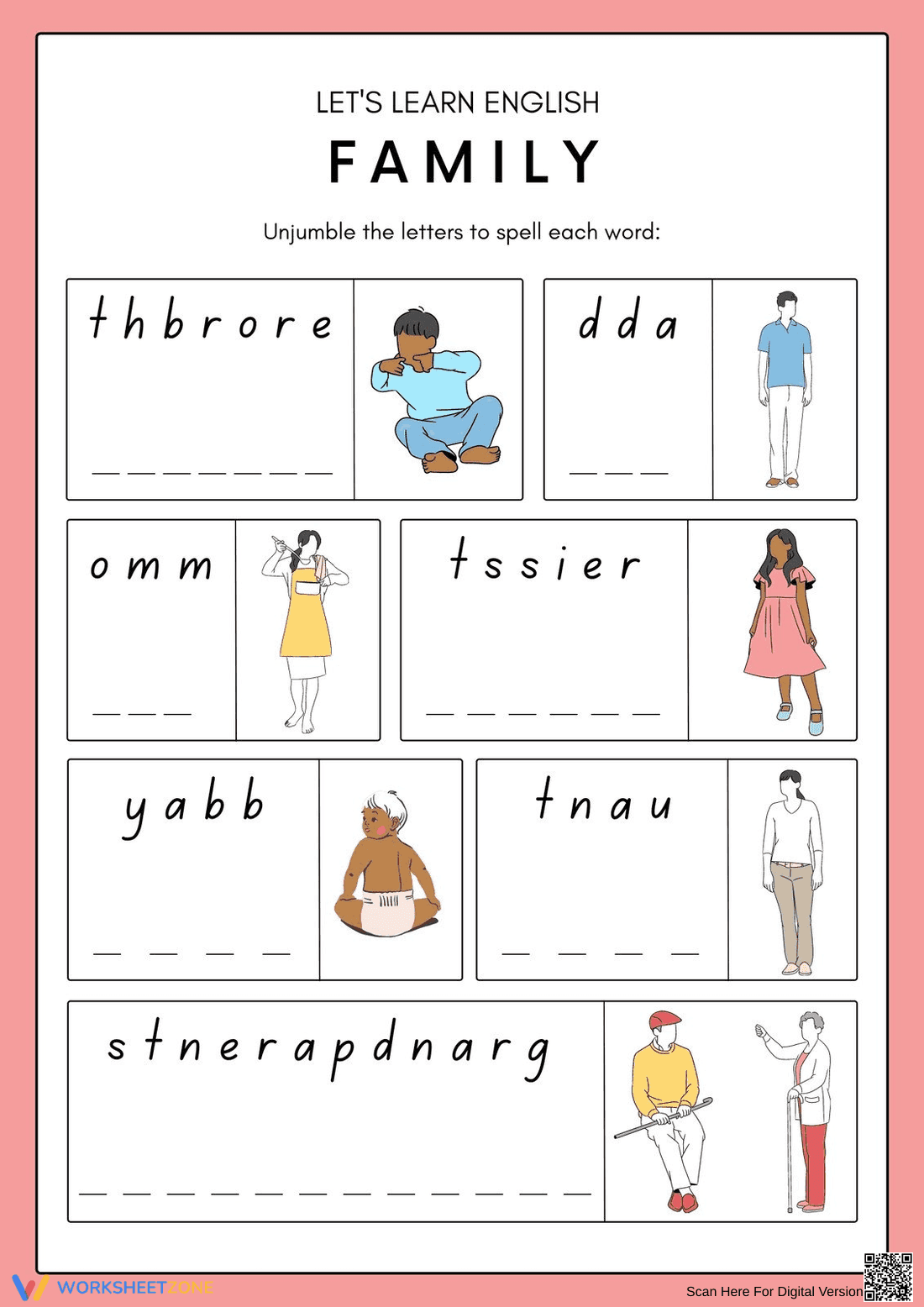

ESL Family Spelling Worksheet | Grade 1 Printable
Paste this activity's link or code into your existing LMS (Google Classroom, Canvas, Teams, Schoology, Moodle, etc.).
Students can open and work on the activity right away, with no student login required.
You'll still be able to track student progress and results from your teacher account.
This Grade 1 ESL spelling worksheet helps early learners and English language beginners master essential family vocabulary. By unscrambling letters to form common words like "brother" and "sister," students build foundational phonics skills and improve their spelling accuracy in a highly visual, engaging format.
At a Glance
- Grade: 1 · Subject: ELA
- Standard:
CCSS.ELA-LITERACY.L.1.2.D— Spell common words using conventional spelling patterns- Skill Focus: Spelling family vocabulary
- Format: 1 page · 7 problems · Answer key included · PDF
- Best For: Independent practice and ESL centers
- Time: 10–15 minutes
This single-page resource features seven word-building tasks centered around family members. Each problem presents an illustration alongside jumbled letters and blank lines. Students decode the scrambled letters to spell words like mom, dad, aunt, and grandparents. An answer key is provided for quick grading.
Zero-Prep Workflow
- Print (1 minute): Simply download the PDF and print the required number of copies. The clear layout prints beautifully in both color and grayscale.
- Distribute (1 minute): Hand out the worksheets during morning work, literacy centers, or as a quick transition activity.
- Review (3 minutes): Use the included answer key to quickly check student work or project it on the board for self-correction.
With a total teacher prep time of under two minutes, this activity is highly suitable for emergency sub plans or last-minute schedule changes.
Standards Alignment
This activity is directly aligned to CCSS.ELA-LITERACY.L.1.2.D, which requires students to use conventional spelling for words with common spelling patterns and for frequently occurring irregular words. By practicing these high-frequency family terms, students reinforce their understanding of letter-sound correspondence and word structures. This standard code can be copied directly into lesson plans, IEP goals, or district curriculum mapping tools.
How to Use It
Use this worksheet during independent literacy centers after direct instruction on family vocabulary. It also serves as an excellent morning work assignment to activate prior knowledge as students settle into the classroom. As a formative assessment observation tip, watch how students approach the longer words like "grandparents"—this will reveal their ability to chunk syllables and apply phonetic rules. Expected completion time ranges from 10 to 15 minutes depending on the student's language proficiency.
Who It's For
This resource is primarily designed for Grade 1 students and beginner ESL/ELL learners who are building their foundational English vocabulary. The visual supports make it highly accessible for students who require visual scaffolding to connect words with meanings. For a complete lesson experience, pair this worksheet with a read-aloud book about diverse families or a classroom anchor chart featuring family tree terminology.
Mastering high-frequency vocabulary is a critical step in early language acquisition, particularly for English language learners. This resource targets CCSS.ELA-LITERACY.L.1.2.D, helping students spell common words using conventional spelling patterns. According to EdReports 2024, integrating visual cues with spelling practice significantly accelerates vocabulary retention for early readers and ESL students. When learners actively manipulate jumbled letters to form meaningful words, they engage in orthographic mapping, a process essential for fluent reading and writing. This targeted practice ensures that foundational terms become permanently stored in the student's sight-word memory. By providing clear visual context alongside the spelling task, educators can effectively reduce the cognitive load, allowing students to focus entirely on letter sequencing and phonetic application. This evidence-based approach builds lasting linguistic competence.


