


























Views
Downloads

Printable Spelling Bee Word Puzzle | Grade 4 ELA
Paste this activity's link or code into your existing LMS (Google Classroom, Canvas, Teams, Schoology, Moodle, etc.).
Students can open and work on the activity right away, with no student login required.
You'll still be able to track student progress and results from your teacher account.
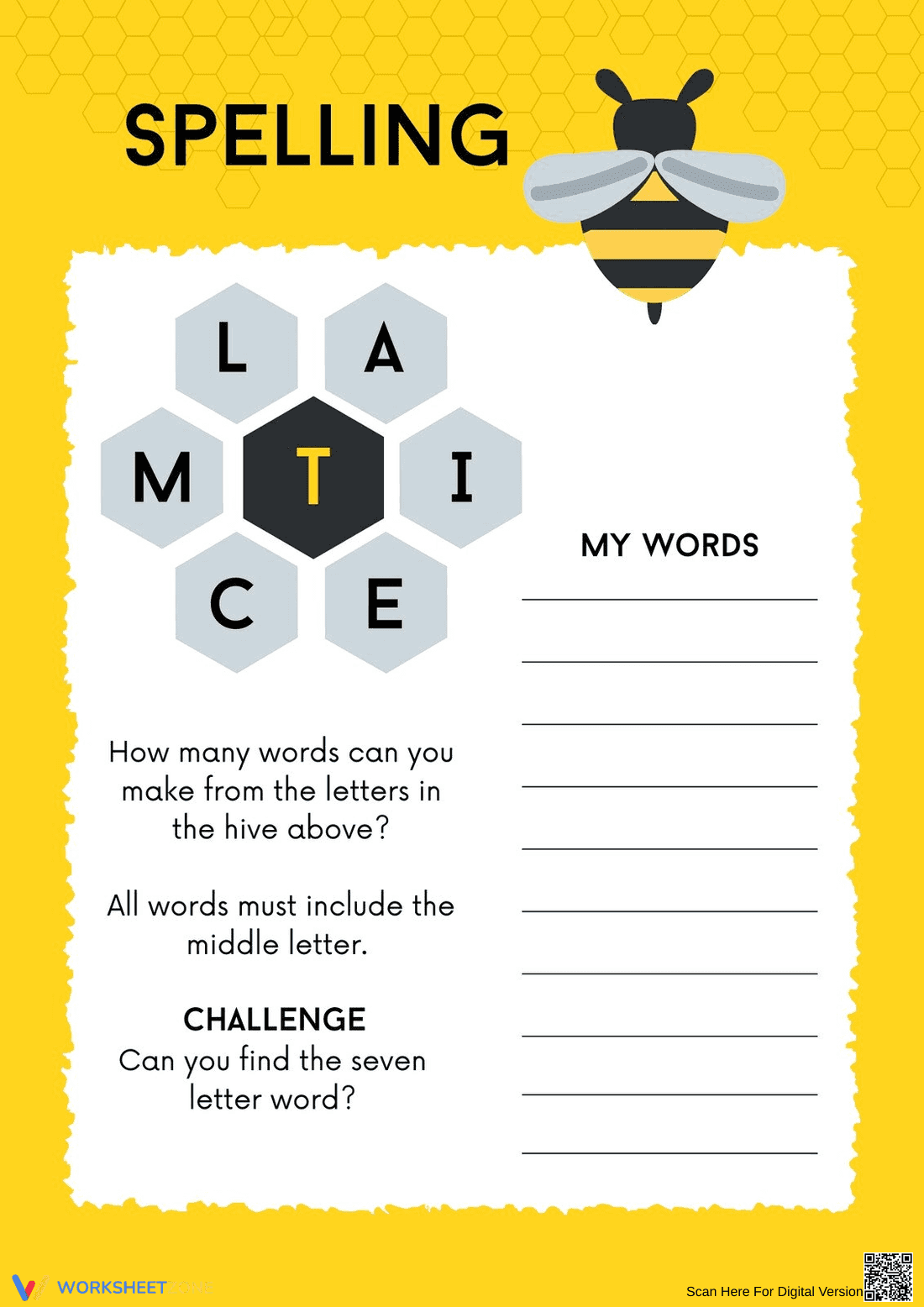
This engaging word generation worksheet challenges students to build vocabulary and practice spelling patterns by creating words from a given set of letters. Featuring a fun, hive-themed puzzle, learners must use the central letter in every word they form, culminating in a challenge to find the hidden seven-letter word.
At a Glance
- Grade: 4 · Subject: ELA
- Standard:
CCSS.ELA-LITERACY.L.4.2— Spell grade-appropriate words correctly- Skill Focus: Word building and spelling
- Format: 1 page · 8 word slots · No answer key · PDF
- Best For: Morning work or early finishers
- Time: 10–15 minutes
Inside this single-page resource, educators will find a visually appealing spelling bee puzzle featuring seven letters arranged in a honeycomb pattern. Students are provided with eight blank lines to record the words they generate. The activity includes specific constraints, requiring the central letter 'T' to be used in every word, and features a special challenge prompt to find the master seven-letter word.
This resource is designed for immediate classroom implementation:
- Print (1 minute): Simply download the PDF and print a class set. The high-contrast design ensures clear copies every time.
- Distribute (1 minute): Hand out the puzzle as students enter the room or transition between subjects. The instructions are completely self-explanatory.
- Review (3 minutes): Have students share their generated words aloud, writing them on the board to celebrate creative vocabulary choices and reveal the challenge word.
Total teacher preparation time is under two minutes, making this an ideal, stress-free addition to any emergency sub plan or busy morning routine.
This activity aligns directly with CCSS.ELA-LITERACY.L.4.2, requiring students to "Demonstrate command of the conventions of standard English capitalization, punctuation, and spelling when writing." By actively constructing words from isolated letters, learners reinforce their understanding of phonics, syllable patterns, and conventional spelling rules. Both standard codes can be copied directly into lesson plans, IEP goals, or district curriculum mapping tools.
This versatile puzzle serves as an excellent bell-ringer activity to settle students at the start of the ELA block. Teachers can also utilize it as an engaging anchor activity for early finishers. As a formative assessment observation tip, educators should note which learners rely on simple words and which attempt complex constructions. Expected completion time ranges from ten to fifteen minutes.
This worksheet is primarily designed for fourth-grade students developing their spelling and vocabulary skills. It naturally differentiates itself; students requiring support can focus on finding smaller three-letter words, while advanced learners can push themselves to fill all eight lines and solve the seven-letter challenge. It pairs perfectly with a direct instruction lesson on anagrams, prefixes, or root words, providing a playful application of those concepts.
Effective vocabulary and spelling instruction requires active cognitive engagement rather than passive memorization. This resource targets CCSS.ELA-LITERACY.L.4.2 by prompting students to spell grade-appropriate words correctly through an interactive puzzle format. According to Fisher & Frey (2014), providing students with constrained, puzzle-based vocabulary tasks significantly increases their motivation and willingness to experiment with language structures. By requiring learners to manipulate a fixed set of letters to generate multiple words, this activity strengthens orthographic mapping and phonemic awareness. The embedded challenge to find a seven-letter word further stimulates higher-order thinking and persistence in problem-solving. Teachers can rely on this structured, independent practice to reinforce foundational literacy skills while maintaining high levels of student interest and participation during independent work periods.


