


























1 / 2
0
Views
0
Downloads

Save
0 Likes
Share
Succession & Equilibrium in Ecosystems
0 Views
0 Downloads
Paste this activity's link or code into your existing LMS (Google Classroom, Canvas, Teams, Schoology, Moodle, etc.).
Students can open and work on the activity right away, with no student login required.
You'll still be able to track student progress and results from your teacher account.
Information
Description
What It Is:
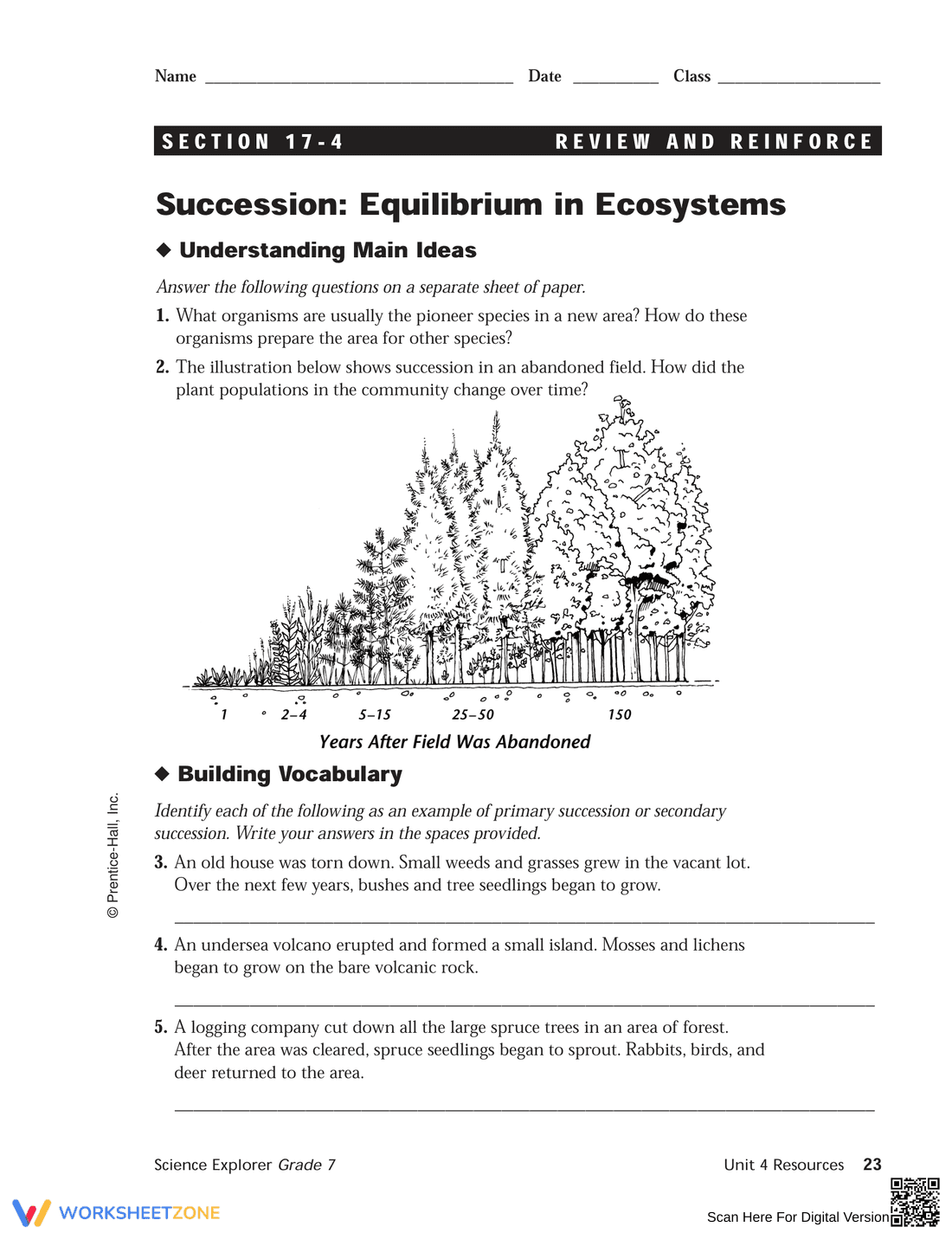
This is an educational worksheet focusing on ecological succession and equilibrium in ecosystems. It includes questions about pioneer species and how organisms prepare new areas. It also features an illustration depicting succession in an abandoned field, showing plant populations changing over time. The worksheet includes vocabulary building exercises where students identify examples of primary or secondary succession based on provided scenarios.
Grade Level Suitability:
The worksheet is suitable for Grade 7, as indicated at the bottom. The content and complexity of the questions and vocabulary exercises align with a middle school science curriculum. The concepts of primary and secondary succession are introduced, along with related vocabulary.
Why Use It:
This worksheet reinforces the understanding of ecological succession and equilibrium. It helps students identify and describe the roles of pioneer species, analyze changes in plant populations over time, and differentiate between primary and secondary succession. The exercises encourage critical thinking and vocabulary development in the context of ecology.
How to Use It:
Students should first read the introductory material on ecological succession. Then, they can answer the questions in the 'Understanding Main Ideas' section on a separate sheet of paper. For the 'Building Vocabulary' section, students should read each scenario and determine if it represents primary or secondary succession, writing their answers in the provided spaces. The illustration can be used to visualize the stages of succession.
Target Users:
This worksheet is designed for 7th-grade science students studying ecology and ecosystems. It is suitable for classroom use as a review activity, homework assignment, or assessment tool. Teachers can use it to gauge student understanding of ecological succession and related concepts.
This is an educational worksheet focusing on ecological succession and equilibrium in ecosystems. It includes questions about pioneer species and how organisms prepare new areas. It also features an illustration depicting succession in an abandoned field, showing plant populations changing over time. The worksheet includes vocabulary building exercises where students identify examples of primary or secondary succession based on provided scenarios.
Grade Level Suitability:
The worksheet is suitable for Grade 7, as indicated at the bottom. The content and complexity of the questions and vocabulary exercises align with a middle school science curriculum. The concepts of primary and secondary succession are introduced, along with related vocabulary.
Why Use It:
This worksheet reinforces the understanding of ecological succession and equilibrium. It helps students identify and describe the roles of pioneer species, analyze changes in plant populations over time, and differentiate between primary and secondary succession. The exercises encourage critical thinking and vocabulary development in the context of ecology.
How to Use It:
Students should first read the introductory material on ecological succession. Then, they can answer the questions in the 'Understanding Main Ideas' section on a separate sheet of paper. For the 'Building Vocabulary' section, students should read each scenario and determine if it represents primary or secondary succession, writing their answers in the provided spaces. The illustration can be used to visualize the stages of succession.
Target Users:
This worksheet is designed for 7th-grade science students studying ecology and ecosystems. It is suitable for classroom use as a review activity, homework assignment, or assessment tool. Teachers can use it to gauge student understanding of ecological succession and related concepts.


