


























1 / 4
0
Views
0
Downloads



0.0
0
Save
0 Likes
Share
Population Ecology Worksheet
0 Views
0 Downloads
Paste this activity's link or code into your existing LMS (Google Classroom, Canvas, Teams, Schoology, Moodle, etc.).
Students can open and work on the activity right away, with no student login required.
You'll still be able to track student progress and results from your teacher account.
Information
Description
What It Is:
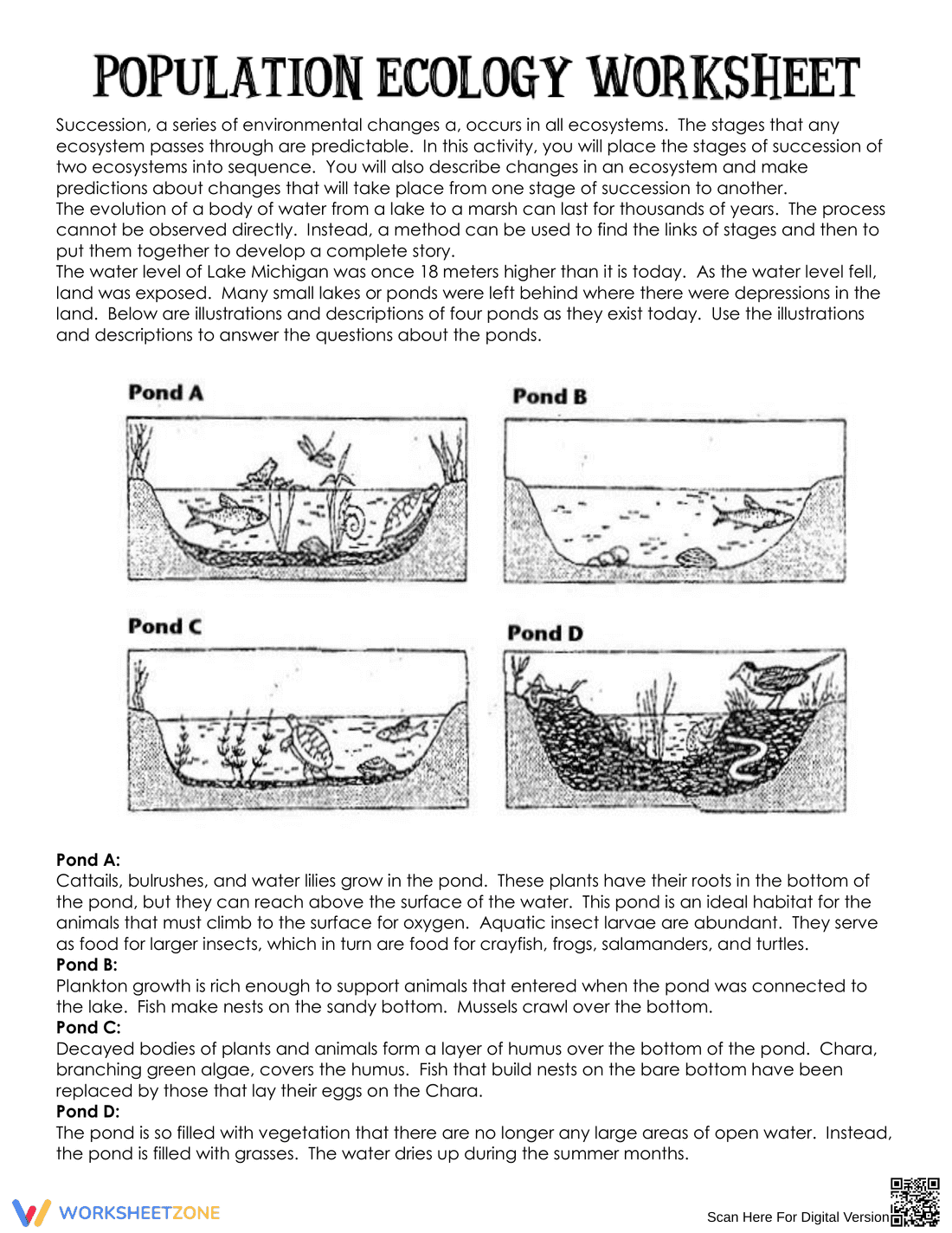
This is a population ecology worksheet focusing on ecological succession in ponds. The worksheet presents descriptions and illustrations of four different ponds (A, B, C, and D) representing different stages of succession. Students are asked to analyze the illustrations and descriptions to understand and predict the changes that occur as an ecosystem evolves over time. The text describes the succession process and how it applies to bodies of water, referencing the changing water level of Lake Michigan. The descriptions detail the plant and animal life found in each pond, showing the progression of vegetation and the changing habitat.
Grade Level Suitability:
This worksheet is suitable for grades 9-12 (high school) biology or environmental science classes. The concepts of ecological succession and ecosystem dynamics require a level of understanding of biological processes and scientific reasoning typically developed in high school. The text and descriptions are complex enough to challenge high school students.
Why Use It:
This worksheet helps students understand the concept of ecological succession through visual representations and detailed descriptions. It promotes critical thinking skills by requiring students to analyze data and make predictions about ecosystem changes. It also teaches about the interconnectedness of organisms and their environment and the long-term processes that shape ecosystems.
How to Use It:
Students should read the introductory text on ecological succession. Then, they should carefully examine the illustrations and descriptions of each pond (A, B, C, and D). They can then use this information to sequence the ponds in order of ecological succession, explain the changes occurring in each stage, and predict future changes in each pond ecosystem. They can answer questions related to the illustrations and descriptions.
Target Users:
This worksheet is designed for high school students studying biology, ecology, or environmental science. It is also useful for teachers looking for resources to teach ecological succession and ecosystem dynamics. It can also be used for homeschooling purposes.
This is a population ecology worksheet focusing on ecological succession in ponds. The worksheet presents descriptions and illustrations of four different ponds (A, B, C, and D) representing different stages of succession. Students are asked to analyze the illustrations and descriptions to understand and predict the changes that occur as an ecosystem evolves over time. The text describes the succession process and how it applies to bodies of water, referencing the changing water level of Lake Michigan. The descriptions detail the plant and animal life found in each pond, showing the progression of vegetation and the changing habitat.
Grade Level Suitability:
This worksheet is suitable for grades 9-12 (high school) biology or environmental science classes. The concepts of ecological succession and ecosystem dynamics require a level of understanding of biological processes and scientific reasoning typically developed in high school. The text and descriptions are complex enough to challenge high school students.
Why Use It:
This worksheet helps students understand the concept of ecological succession through visual representations and detailed descriptions. It promotes critical thinking skills by requiring students to analyze data and make predictions about ecosystem changes. It also teaches about the interconnectedness of organisms and their environment and the long-term processes that shape ecosystems.
How to Use It:
Students should read the introductory text on ecological succession. Then, they should carefully examine the illustrations and descriptions of each pond (A, B, C, and D). They can then use this information to sequence the ponds in order of ecological succession, explain the changes occurring in each stage, and predict future changes in each pond ecosystem. They can answer questions related to the illustrations and descriptions.
Target Users:
This worksheet is designed for high school students studying biology, ecology, or environmental science. It is also useful for teachers looking for resources to teach ecological succession and ecosystem dynamics. It can also be used for homeschooling purposes.


