


























1 / 2
0
Views
0
Downloads

0.0
0
Save
0 Likes
Share
Ecological Succession Practice
0 Views
0 Downloads
Paste this activity's link or code into your existing LMS (Google Classroom, Canvas, Teams, Schoology, Moodle, etc.).
Students can open and work on the activity right away, with no student login required.
You'll still be able to track student progress and results from your teacher account.
Information
Description
What It Is:
This worksheet provides multiple-choice practice to help students understand ecological succession, including pioneer species, soil formation, trophic roles, and climax communities.
Why Use It:
It reinforces key ecology concepts through critical thinking questions that assess students’ understanding of ecosystem development, biodiversity changes, and succession processes.
How to Use It:
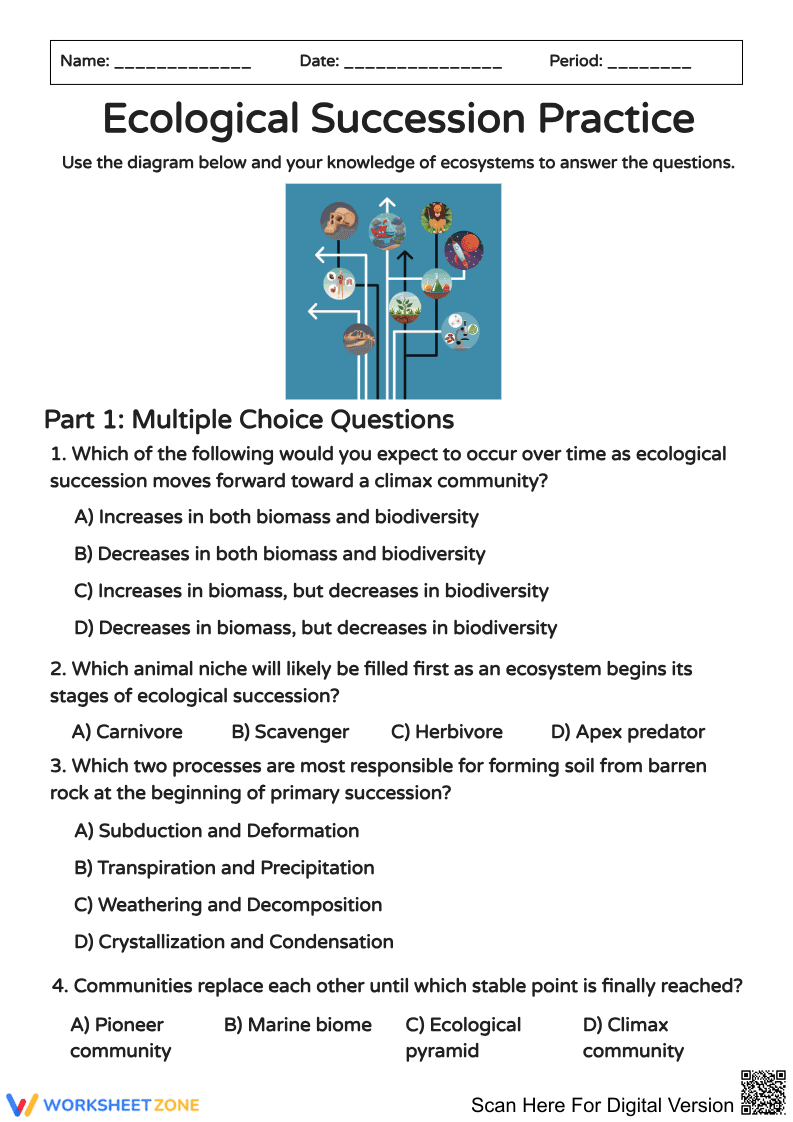
• Analyze a succession diagram to answer conceptual questions.
• Identify trends in biomass and biodiversity over time.
• Apply knowledge of primary succession, soil formation, and community stability.
• Use as independent practice, review, or assessment.
Grade Suitability:
Best suited for Grades 6–8.
• Grade 6: Introductory practice with ecosystem change concepts.
• Grade 7: Strengthen understanding of succession stages and roles.
• Grade 8: Apply ecological reasoning and scientific vocabulary.
Target Users:
Middle school science teachers, homeschool educators, and students studying ecosystems, ecology, and environmental science.
This worksheet provides multiple-choice practice to help students understand ecological succession, including pioneer species, soil formation, trophic roles, and climax communities.
Why Use It:
It reinforces key ecology concepts through critical thinking questions that assess students’ understanding of ecosystem development, biodiversity changes, and succession processes.
How to Use It:
• Analyze a succession diagram to answer conceptual questions.
• Identify trends in biomass and biodiversity over time.
• Apply knowledge of primary succession, soil formation, and community stability.
• Use as independent practice, review, or assessment.
Grade Suitability:
Best suited for Grades 6–8.
• Grade 6: Introductory practice with ecosystem change concepts.
• Grade 7: Strengthen understanding of succession stages and roles.
• Grade 8: Apply ecological reasoning and scientific vocabulary.
Target Users:
Middle school science teachers, homeschool educators, and students studying ecosystems, ecology, and environmental science.


