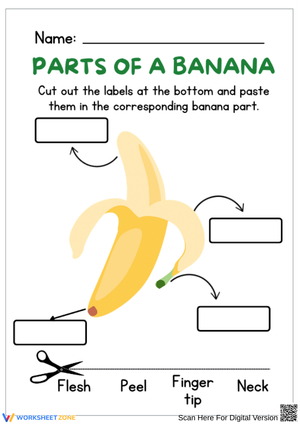
Parts of a Banana worksheets: Botany for the Classroom
These parts of a banana worksheets give students a labeled diagram of a fruit they have eaten hundreds of times but never actually examined — and that gap between casual familiarity and botanical ignorance is precisely what makes the lesson land. Each worksheet in the set targets a distinct anatomical structure or classification concept, moving students from surface-level recognition toward precise vocabulary and an understanding of how those structures function inside a living plant.
Anatomical Structures Covered Across the Set
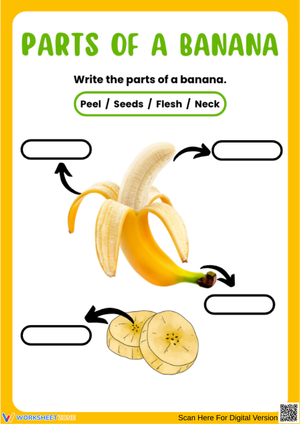
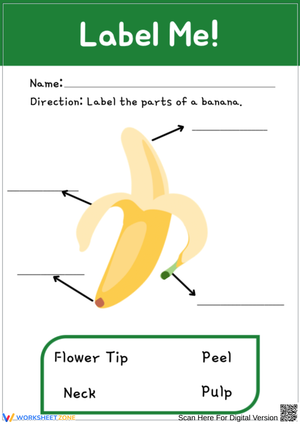
The worksheets build vocabulary around six core structures, each introduced with a reference diagram and reinforced through a blank-label exercise students complete independently:
- Pedicel — the short stem connecting the individual fruit to the plant cluster, which students routinely confuse with a generic "stem" until they learn the term applies specifically to the fruit's own attachment point
- Exocarp — the outer peel, which students almost always call "the skin," and which this vocabulary forces them to rename with scientific precision
- Mesocarp and endocarp — the two distinct layers of edible flesh, which students resist treating as separate structures because they look identical to the naked eye
- Phloem bundles — the stringy vascular fibers running between the peel and the flesh, distributing water and sugars throughout the developing fruit
- Apex — the dark, dried tip at the bottom of the fruit, the remnant of the banana flower, which most students have simply assumed was a manufacturing defect
- Vestigial seeds — the tiny black dots embedded in the pulp, present in Cavendish bananas but sterile because these plants develop without fertilization and reproduce through rhizome cuttings instead
One worksheet focuses entirely on fruit classification, asking students to evaluate whether a banana meets the botanical definition of a berry — a fleshy fruit produced from a single flower with a single ovary. It does. Working through the reasoning on paper, rather than just hearing it announced, cements the distinction between common usage and scientific classification in a way that carries into the next unit.
Frequent Student Errors Worth Anticipating Before the Lab
The most consistent mislabeling error involves the phloem bundles. Students peel the banana, see the strings attached to the inner surface of the peel, and classify them as peel tissue. The worksheets address this by asking students to trace a phloem bundle from the pedicel to the apex — following the fiber the full length of the fruit clarifies that it runs through the fruit as a vascular channel rather than along the peel's edge.
The vestigial seeds produce a subtler error. Students who notice the black dots in the pulp write that bananas "do have seeds, they're just small," which is accurate in form but incomplete in meaning. The worksheets prompt students to write a sentence explaining why those structures cannot germinate — directing attention toward parthenocarpy without requiring the term at the elementary level. At middle school, the same prompt opens a productive discussion about triploidy and commercial propagation.
The fruit classification misconception is the most persistent of the three. Students who correctly call a tomato a fruit will still write "banana is not a berry" even after reading the botanical definition, because the word berry carries such strong everyday connotations. A comparison column — strawberry (not a botanical berry), grape (yes), banana (yes) — converts the abstract definition into a concrete sorting task, and one worksheet in the set uses exactly that format rather than a written explanation alone.
Fitting These Worksheets Into the Instructional Week
The most effective sequence pairs each worksheet with a dissection lab running on the same day. Before students touch the fruit, they color-code a labeled diagram — exocarp in yellow, phloem bundles in green, mesocarp in white. Then they peel the banana and physically lay the fibers they pull free onto the colored lines they just drew. That four-minute tactile matching step converts an abstract diagram into something students have held in their hands, and retention is measurably stronger than when the worksheet and the lab run on separate days with a gap between them.
For middle school teachers, the parts of a banana worksheets work well at the opening of a Structure and Function unit as a low-stakes entry point before moving to more complex plant specimens. The vocabulary is manageable, the dissection tools are plastic knives and paper plates, and the cost per student is under a dollar. Teachers who run the lab on a Tuesday and return to the worksheets Thursday for retrieval practice see the strongest vocabulary retention — that two-day gap gives students time to consolidate before they are asked to recall terms without a reference diagram in front of them.
In elementary settings, these worksheets function well as a Monday morning anchor activity at the opening of a plants unit, especially when a real banana sits at the front of the room for reference. Students who spend fifteen minutes labeling a diagram arrive at the whole-class discussion with specific questions rather than passive attention.
Standard Alignment
These worksheets align directly with NGSS LS1.A: Structure and Function, which asks students to demonstrate that plants have internal and external structures serving specific functions in growth, survival, and reproduction. The banana provides concrete, handleable evidence for that standard at both the macroscopic and cellular level. The phloem bundles demonstrate vascular transport; the exocarp demonstrates protective function; the vestigial seeds demonstrate reproductive structure even when reproduction has been interrupted by selective cultivation. At the middle school level, LS1.A calls for students to construct written arguments using evidence — the dissection provides that evidence, and the worksheet provides the argument frame.
Differentiating the Set Across Ability Levels
For younger students or those who need additional support, reduce the diagram to three labeled structures — peel, flesh, and strings — using plain English before introducing the scientific terms. A word bank printed directly on the worksheet removes the recall load and lets students focus on matching the label to the correct location, which is the transferable skill that shows up on assessments.
Advanced learners benefit from a side-by-side comparison of banana anatomy with a second fruit — a grape or tomato works well. They identify structural parallels (all three have an exocarp and mesocarp) and structural differences (phloem bundles appear in banana and a small number of related monocots). The same parts of a banana worksheets serve as the starting diagram for this comparative task, extending into more demanding analytical work without requiring a separate resource.
For students who are strong readers but struggle with diagrams, pairing the blank-label worksheet with a short written passage about each structure — three to four sentences per term, organized outside-to-inside — gives them a reading comprehension entry point before transferring vocabulary to the image. That outside-to-inside order mirrors the sequence students encounter each part during dissection, so the reading and the lab reinforce each other rather than competing for attention.
Frequently Asked Questions
What are the stringy fibers on a banana called, and do students need to learn the scientific term?
Those fibers are phloem bundles — vascular tissue that transports water and nutrients through the developing fruit. Whether students need the precise term depends on grade level. Elementary standards typically accept "vascular fibers" or "plant veins." Middle school LS1.A work benefits from the exact terminology because it connects directly to broader instruction on vascular tissue across plant types. The worksheets label them as phloem bundles with a parenthetical "vascular fibers" for classrooms that want to introduce the concept before the vocabulary is required.
Why use a banana rather than a more traditional plant specimen for anatomy instruction?
Cost, accessibility, and the surprise factor. A banana costs under a dollar, requires no lab equipment beyond a plastic knife, and immediately produces the cognitive dissonance of being botanically classified as a berry — which students debate actively, which means they are thinking. Pressed flowers and bean seedlings address overlapping standards but rarely generate that level of argument in the first five minutes of a lesson.
Can these worksheets work without a live dissection?
Yes, though the depth is reduced. The diagram exercises and classification worksheets stand alone as vocabulary practice. If a dissection is not feasible — time, budget, food allergies — displaying a peeled banana under a document camera while students label their diagrams in real time covers most of the same conceptual ground. The tactile matching step is lost, but the vocabulary and classification objectives remain fully accessible. The parts of a banana worksheets are designed to be useful under realistic classroom constraints, not just ideal lab conditions.
What is the tip at the bottom of a banana called, and is it worth teaching?
That dark tip is the apex — the dried remnant of the banana flower. It is worth teaching because it connects the fruit back to its origin as a flower, reinforcing the botanical definition of a fruit as the ripened ovary of a flower. Students who label the apex and understand what it was are far better equipped to work through the berry classification question than students who have only seen the fruit in cross-section.
Clear All