What "Count to 10" Actually Means in PreK
When a 4-year-old recites "one, two, three" up to ten, it looks like counting is done. But teachers know the recitation is only the surface. Meaningful counting to 10 rests on three principles preschoolers must hold at the same time, and these worksheets are built to develop each one deliberately rather than rewarding memorized chants.
- Stable order: saying number words in the same fixed sequence every time.
- One-to-one correspondence: tagging exactly one object per number word, with no skips or double-counts.
- Cardinality: understanding that the last number said names the total quantity, so "how many?" has an answer.
Most children solidify these principles across the PreK years, and a worksheet set that isolates each skill lets you see which principle a child has and which one is still shaky. A student who counts seven stickers correctly but answers "how many?" with "one, two, three..." again has stable order and one-to-one correspondence but has not yet grasped cardinality.
Why Counting to 10 Predicts Later Math Success
Counting to 10 is not a cute milestone you check off and move past. It is the floor that later arithmetic stands on, which is why early childhood teams treat it as a priority skill rather than a warm-up.
According to the study Early Math Matters: Kindergarten Number Competence and Later Mathematics Outcomes (PMC), children's number competence at kindergarten entry is the strongest single predictor of math achievement years later, outweighing many other early measures. That finding reframes a counting worksheet from busywork into one of the highest-leverage tasks in a PreK day.
The Fresno County Office of Education Early Math Initiative Brief on Counting reinforces the same instructional point: counting is a set of learnable principles, not a talent, and structured practice moves children through them. When you frame counting this way for families and aides, the daily worksheet routine gets the attention it deserves.
How These Counting 1-10 Worksheets Target Each Sub-Skill
The Worksheetzone count-to-10 set is organized so each page leans on one sub-skill, which makes it easy to assign by need instead of handing out the same sheet to everyone.
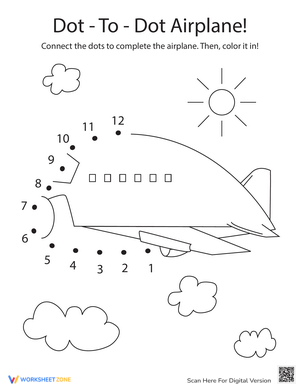
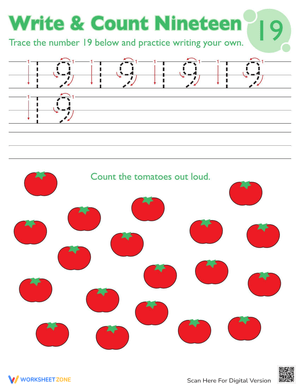
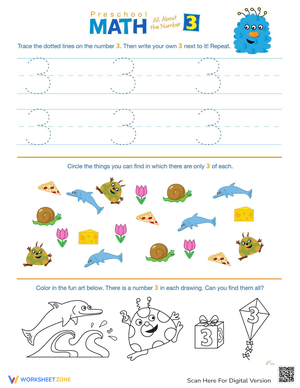
- Numeral tracing: children trace 0-10 to connect the spoken word, the written symbol, and correct formation.
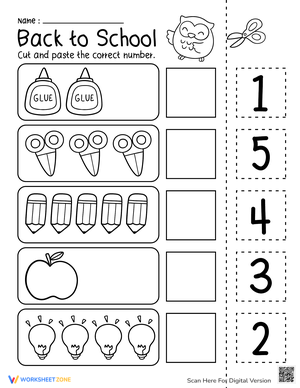
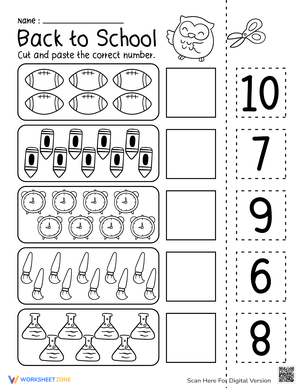
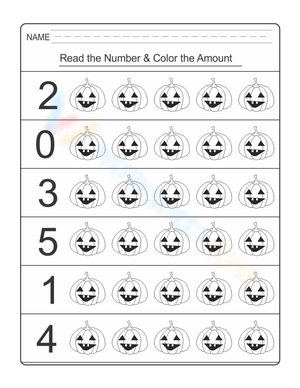
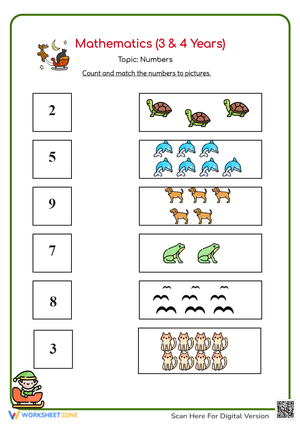
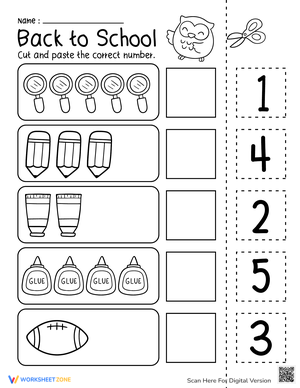
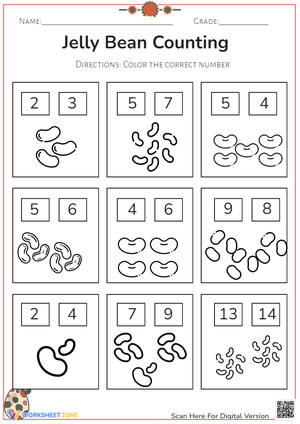
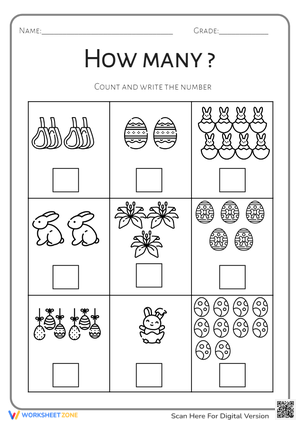
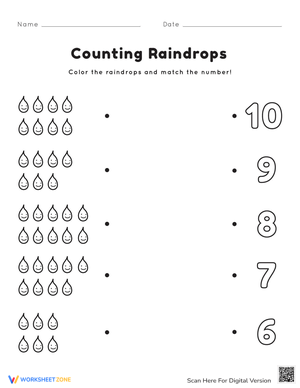
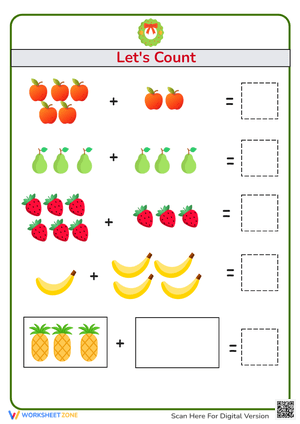
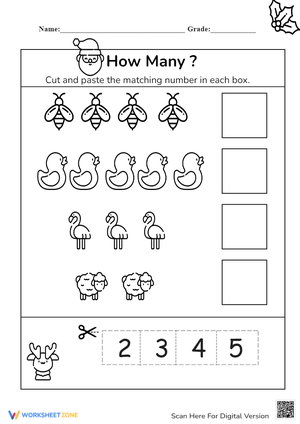
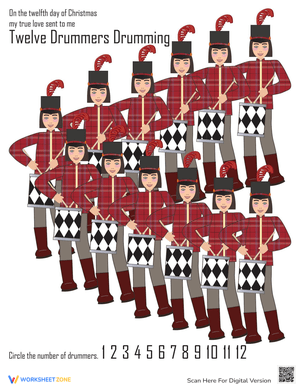
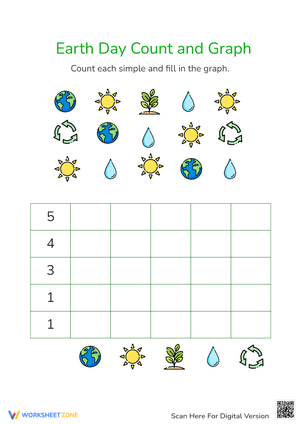
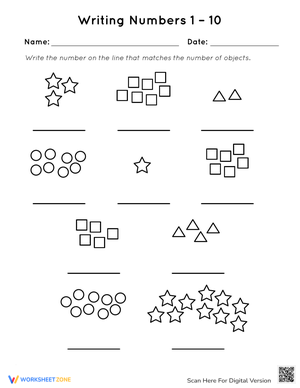
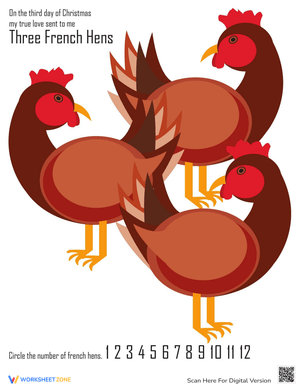
- Object counting: count a pictured group and circle or write the matching numeral to practice one-to-one correspondence and cardinality together.
- Ten-frame fill-ins: color or mark a ten frame to a target number, building a visual sense of quantity and "how many more to ten."
Ten frames deserve a callout. They are a research-supported visual model for representing every number from 1 to 10, and the same frame supports later skills like subitizing, part-part-whole, and early addition. Introducing the frame now means the tool is already familiar when kindergarten work arrives.
Classroom Implementation
A worksheet alone does not teach counting; the routine around it does. Pair every printable with something children can touch and something that gets them moving so the abstract symbol connects to real quantity.
- Manipulatives first: have children count physical counters, blocks, or small toys onto the page before they write a numeral. The object count makes one-to-one correspondence concrete.
- Whole-group routine: open with a 3-5 minute shared count, touching each item on a displayed page or counting classmates, before the independent sheet.
- Movement: hop-count along a floor number line or clap to ten, then return to the page so the body reinforces stable order.
- Narrate the cardinal: after each count, ask "so how many?" and expect the single total, not a re-count, to lock in cardinality.
The University of Nevada Extension resource Math in the Preschool Classroom makes the case that embedding math into hands-on, everyday activity is what gives preschoolers durable number understanding, so treat the worksheet as the record of play, not a replacement for it.
Common Counting Errors and How to Fix Them
Structured worksheet practice is most useful when you read the specific error, because each mistake points to a different missing principle.
- Skipping or double-tagging objects: a one-to-one correspondence gap. Have the child slide each counted object to the side so counted and uncounted stay separate.
- Recounting when asked "how many?": a cardinality gap. Model answering with just the last number and praise the single-number answer.
- Losing the sequence past six or seven: a stable-order gap. Drop back to 1-5, secure it, then extend.
- Reversed or mirrored numerals: normal in PreK; tracing pages and verbal formation cues resolve most of it over time.
Logging which error you see on each sheet turns a stack of worksheets into a simple progress map for the year.
Frequently Asked Questions
1. At what age should preschoolers be able to count to 10?
Many children count to 10 meaningfully — with one-to-one correspondence and cardinality, not just recitation — during the PreK years, roughly ages 3 to 5. Counting objects to 10 and answering "how many?" is a benchmark commonly expected before kindergarten entry, though the exact timing varies by child.
2. What is the difference between rote counting and meaningful counting, and how do these worksheets address both?
Rote counting is reciting number words in order; meaningful counting adds one-to-one correspondence and cardinality. Tracing and chant routines build the rote sequence, while object-counting and ten-frame pages force children to match words to objects and name a total.
3. How many minutes a day should preschoolers practice counting?
Short and frequent beats long and rare. A focused 5-minute whole-group count plus a brief independent or small-group page most days keeps young attention spans engaged and builds the stable-order and cardinality principles through repetition.
4. How can teachers use these worksheets for small-group intervention or RTI support?
Assign the 1-5 pages first, slow the pace, and pair every page with physical counters so the child experiences one-to-one correspondence directly. Use the quick object-counting sheets as repeated formative checks and move up to 10 only once cardinality is reliable.
5. What manipulatives pair best with count-to-10 worksheets in a PreK classroom?
Counters, linking cubes, and small toys work well for object counting, and a ten-frame mat with markers mirrors the worksheet's ten-frame pages. A floor number line adds movement, helping children connect hop-counting to the written numerals on the page.













 Interactive Worksheet Maker
 Quiz Maker
 Word Search Maker
 Crossword Puzzle Maker
 Word Scramble Generator
 Sentence Scramble Generator
 Handwriting Worksheet Generator
 Name Tracing Generator
 Fill In The Blank Generator