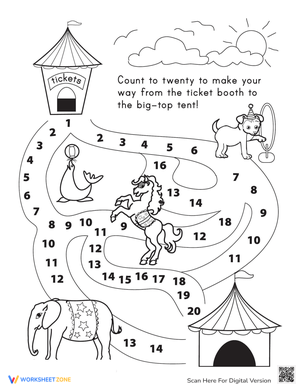
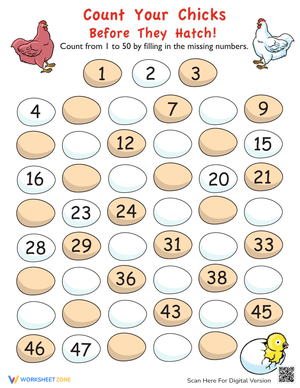
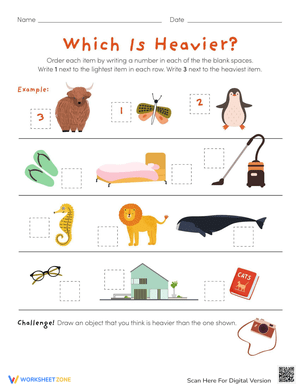
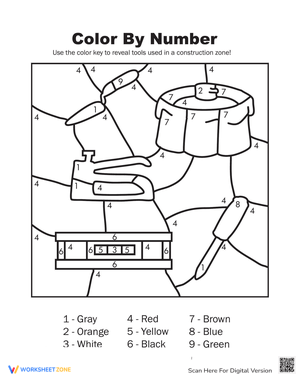
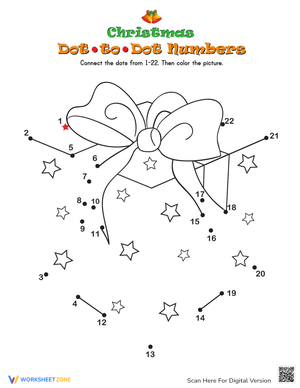
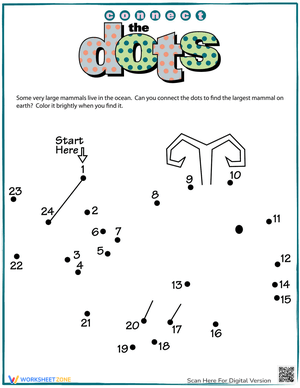
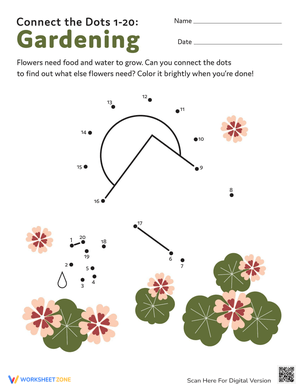
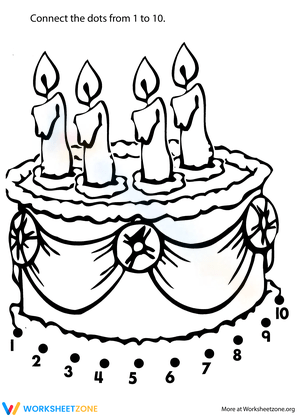
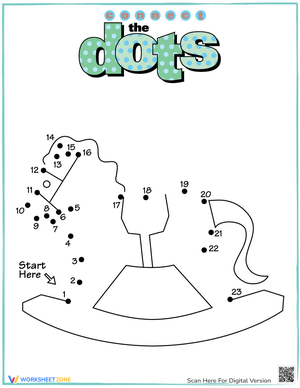
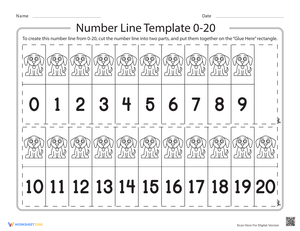
These preschool ordering numbers 0-10 pdf worksheets address a gap that shows up reliably in pre-K classrooms: a child who counts to ten aloud without hesitation but stares at a printed 7 and doesn't recognize it. Rote counting is an auditory memory task; ordering written numerals is a visual-spatial one, and that distinction matters when you're planning what to put in front of a four-year-old. Each worksheet in this set builds the connection between the number name a child already knows and the symbol it represents, moving from recognition to sequencing at a pace that reflects how children at this stage actually develop number sense.
The Specific Skills Each Worksheet Builds
The set targets four distinct areas that early numeracy research consistently identifies as prerequisites for kindergarten readiness. Rather than rushing toward arithmetic, these worksheets develop the underlying structure that addition and subtraction require.
- Numeral recognition: Children distinguish each numeral as a unique symbol — not just a mark on a page. Clean, consistent fonts help students separate visually similar pairs like 2 and 5, or 1 and 7.
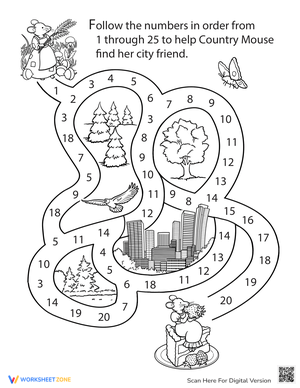
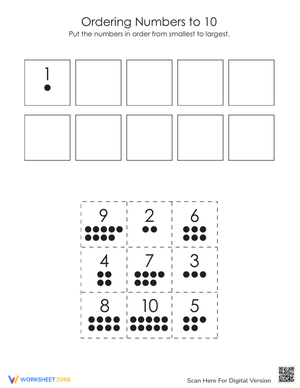
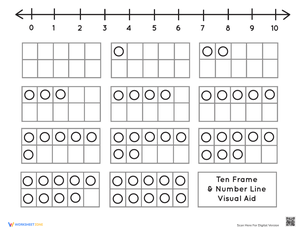
- Ordinal placement: Students arrange numerals in forward sequence, 0 through 10, first with a visible number-line reference and later without one.
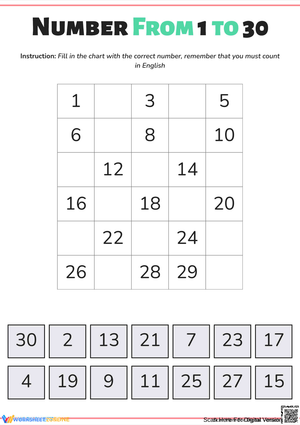
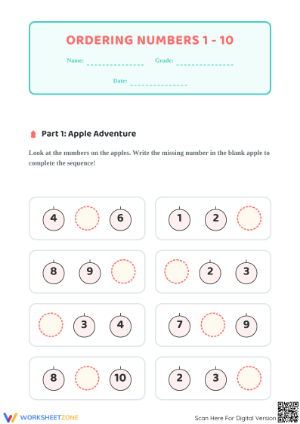
- Missing-number identification: Partial sequences — for example, 4, __, 6 — require students to name the absent term rather than simply copying a complete order. This format surfaces weak spots more quickly than any other.
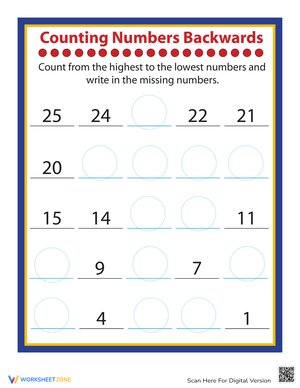
- Backward sequencing: Counting down from 10 to 0 appears after the forward sequence is solid. Reversing the direction forces students to reason about the sequence rather than retrieve it as a memorized string.
The inclusion of zero deserves a direct note. Many preschool number activities quietly skip zero or treat it as optional, but children who have no experience placing zero at the start of a sequence arrive in kindergarten with a conceptual gap that surfaces the moment place value instruction begins. Zero is not the absence of math — it is a numeral with a fixed position, and placing it correctly is one of the first abstract reasoning tasks this set requires.
Student Mistakes Worth Catching Early
The error I see most reliably at this age is not a numeral mix-up — it is a sequence-start error. When a sequence begins with 0, a significant share of preschoolers place 1 first and drop 0 somewhere in the middle or skip it entirely. They have internalized one as the counting starting point because that is where most rote-counting practice begins. A quick intervention: before students touch pencil to paper, point to the leftmost blank and ask, "What lives here?" and wait. That deliberate pause corrects the error before it is committed rather than after.
The 6-and-9 reversal is the second most common issue, and a concrete anchor works far better than repeated correction. Tell students that 6 has its belly pointing up, like it is sitting in a chair, while 9 has its belly pointing down, like it is hanging from a hook. Underlining the base of each numeral on distributed copies — a thirty-second task with a pen before photocopying — gives students a physical orientation cue they can use independently. Children who confuse 6 and 9 will do so on every worksheet until they have a reliable self-check strategy, so build this into the introduction rather than waiting for the error to appear.
Where These Worksheets Fit in the Preschool Day
Three moments in the day work especially well. During morning meeting transitions — that eight-to-ten-minute window while attendance is taken and the day's jobs are assigned — a sequencing worksheet gives students a self-directed task that does not require a teacher stationed at their elbow. During small-group instruction, watching how students move their hands across the worksheet tells you more than the finished product does: a child who traces a numeral several times before writing it is still consolidating recognition, while a child who fills in blanks quickly and scans the line to double-check is ready for a missing-two-terms extension. The third spot is the Friday review block, when a completed worksheet functions as quick formative data — a one-minute scan of the room tells you who is ready to move forward and who needs another week at the same sequence range.
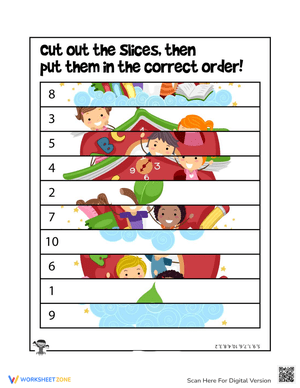
For the cut-and-paste worksheets specifically, build one step into the routine before glue appears: have students lay all number tiles in the correct sequence on their desk first. The teacher does a fast visual sweep, students self-correct any out-of-order tiles, and then glue happens. This turns a static task into a brief manipulative session and eliminates the frustration of tearing glued paper — a frustration that frequently ends the activity entirely for a child still developing emotional regulation.
These preschool ordering numbers 0-10 pdf worksheets also pair well with a physical number line taped to the classroom floor. Having students jump from numeral to numeral — forward, then backward — before sitting to complete a worksheet gives kinesthetic learners a reference experience to draw on when the paper version asks the same question without the physical cues.
Standard Alignment
These worksheets align with the pre-K foundational skills that lead directly into Common Core standard K.CC.A.2, which requires students to count forward beginning from any given number within the known sequence — not always from one. A child cannot count forward from 6 without first understanding that 6 occupies a fixed position in a predictable order, which is exactly what this set practices. State-level pre-K math standards in Florida (MA.PK.NSO.1.1), Texas (TEKS 111.2), and California's Preschool Learning Foundations (Mathematics 1.1) all cluster around the same skill: recognizing and ordering numerals 0 through 10 as preparation for formal counting and cardinality instruction in kindergarten.
Adjusting the Work for a Range of Learners
These preschool ordering numbers 0-10 pdf worksheets carry enough built-in variation that differentiation happens through how you assign them rather than through remaking them entirely. For students still building numeral recognition, narrow the active range to 0–5. Print two copies of the same worksheet — one completed as a reference card, one as the working copy — so the child is matching and confirming rather than recalling from memory. This keeps the activity productive without turning it into a frustration exercise.
Students who sequence 0–10 reliably can work with worksheets that present two or more missing terms in a single sequence, or shift to writing the complete sequence independently without any printed numeral guide. Some four-and-five-year-olds who spend significant time with classroom calendar activities are already comfortable with numbers beyond 10, and a brief extension into 10–20 ordering gives their developing number sense somewhere to go without waiting for formal kindergarten instruction to catch up.
For students with fine motor delays, the fill-in-the-blank format is far more accessible than cut-and-paste. A light pencil trace of the missing numeral before committing to a final mark keeps the cognitive focus on sequencing rather than on the physical mechanics of writing — which is the right priority at this stage.
Frequently Asked Questions
At what point in the preschool year should I introduce ordering rather than just counting?
Most four-year-olds are ready for ordering activities after they can reliably identify numerals 1 through 5 on sight — typically by mid-fall of the pre-K year. Starting with a narrowed range and expanding as recognition solidifies is more effective than waiting until a child knows all ten numerals before introducing any sequencing work. The two skills reinforce each other: ordering practice accelerates recognition, and stronger recognition makes ordering faster.
My student counts to ten perfectly but cannot order the written numerals. Is that typical?
Yes, and it is one of the more common diagnostic findings in pre-K math. Spoken counting draws on auditory sequence memory — it is essentially a song the child has memorized. Ordering written numerals requires matching a visual symbol to the position it occupies in that sequence. These are separate cognitive tasks. The bridge is pairing the oral count with the written numeral repeatedly: point to each numeral on the worksheet and say its name together before asking the student to order anything independently.
How many sequencing worksheets should a preschool class do per week?
Two to three is a reasonable frequency for most pre-K classrooms. One worksheet during a morning transition, one during small-group math time, and an optional third as a center activity provides enough distributed practice to build the sequence in long-term memory without turning it into rote drilling. The goal at this age is spaced repetition across different contexts — same skill, slightly different presentation — which is exactly what a set of varied sequencing formats supports.
Can these worksheets be used with kindergarteners who are behind grade level?
These preschool ordering numbers 0-10 pdf worksheets work well as targeted intervention for kindergarteners who arrived without reliable numeral recognition or sequencing skills. The format is direct enough that it does not feel punitive, and the skill level is genuinely foundational rather than stigmatizingly remedial. Pair them with a physical number line at the student's desk so the gap-filling tasks have a concrete reference, and phase that reference out as the student gains confidence over successive sessions.













 Interactive Worksheet Maker
 Quiz Maker
 Word Search Maker
 Crossword Puzzle Maker
 Word Scramble Generator
 Sentence Scramble Generator
 Handwriting Worksheet Generator
 Name Tracing Generator
 Fill In The Blank Generator