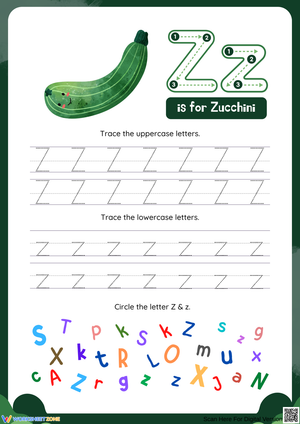
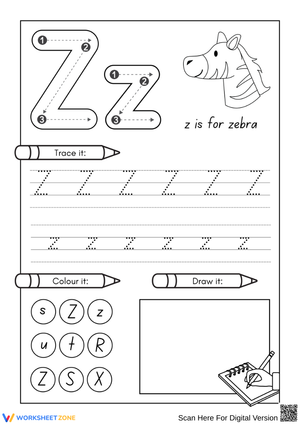
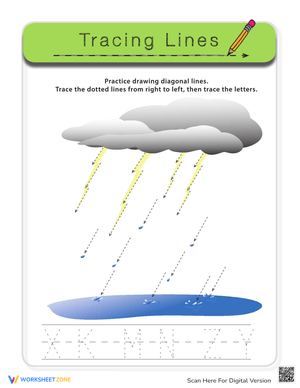
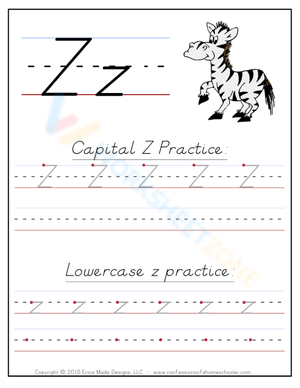
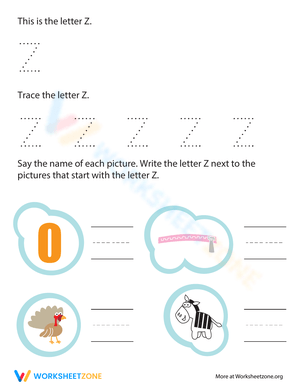
Learning to write the letter Z marks an important milestone in a young child's literacy journey. Letter Z worksheets for preschool connect children with one of the most distinctive shapes in the entire alphabet, requiring a precise combination of diagonal and horizontal strokes that challenge and strengthen developing fine motor skills. When a child grips a pencil and traces those three clean lines, they are not just copying a letter - they are building the muscular memory and hand-eye coordination that will support all future handwriting tasks. This foundational practice gives preschoolers the confidence to approach the full alphabet with a sense of accomplishment.
A well-designed scaffolding approach moves children from guided tracing to independent writing in a natural, supportive progression. Each page in the collection begins with large, clearly dotted stroke paths that help young learners feel the shape of the letter before attempting it on their own. As children complete successive exercises, the guides gradually reduce, encouraging independent formation while still providing enough structure to prevent the frustration that comes from working without direction. This graduated method mirrors the same principles that early childhood educators rely on to build genuine skill rather than simple memorization.
Fine motor practice with letter Z worksheets for preschool also strengthens the small muscle groups in the hand that are essential for academic readiness. Research consistently shows that children who develop strong pencil control in preschool transition more smoothly into the handwriting demands of kindergarten and first grade. The repeated stroke patterns in these pages build grip strength and stroke consistency, two qualities that have a direct impact on the clarity and speed of future written work. Teachers and parents who want to explore broader alphabet activities for preschoolers will find that letter Z practice fits naturally into a complete early literacy routine.
These printable PDF resources work equally well in a classroom station rotation or a quiet home learning session. A teacher can set up a dedicated alphabet corner where students cycle through letter-specific worksheets at their own pace, receiving targeted practice without disrupting the flow of whole-group instruction. At home, a parent can introduce a single page as a calm morning activity that eases a child into focused learning before the school day begins. If you want to extend the alphabet sequence, handwriting practice for letter B provides an excellent starting point for building a complete A-to-Z routine. Worksheetzone is committed to providing the developmental resources that support every stage of a young learner's growth in both classroom and home environments.
Frequently Asked Questions
Question 1: At what age should children start practicing letter Z worksheets for preschool?
Most children are developmentally ready to begin structured letter practice between the ages of four and five. At this stage, the fine motor muscles in the hand are strong enough to manage basic pencil strokes. Letter Z worksheets for preschool are designed to accommodate this age range, offering guided tracing exercises that build skill gradually without overwhelming young learners who are just beginning to explore written language.
Question 2: How does letter Z handwriting practice support overall literacy development?
Tracing and writing the letter Z reinforces the connection between a written symbol and its sound, which is a core component of phonological awareness. When children practice letter Z worksheets for preschool consistently, they strengthen both visual recognition and motor recall simultaneously. This dual reinforcement makes it easier for young learners to decode words that contain the letter Z when they encounter them in early reading activities and classroom lessons.
Question 3: Can letter Z worksheets for preschool be used for children with different skill levels?
Yes, these resources work well across a range of developmental stages. Children who are just beginning can focus on the large tracing guides, while more advanced learners can move to the independent writing sections. Because letter Z worksheets for preschool follow a scaffolded structure, teachers and parents can easily differentiate by selecting the pages that match each child's current handwriting ability and fine motor development level.
Question 4: How many times should a child practice the letter Z before moving on?
Repetition is key in early handwriting development, and most early childhood educators recommend consistent daily practice over short sessions rather than one lengthy exercise. Completing one or two pages of letter Z worksheets for preschool each day over the course of a week provides enough repetition to build reliable muscle memory. Focusing on stroke quality and steady improvement rather than speed ensures that children develop accurate and confident letter formation habits.