


























Views
Downloads

Printable Volume of a Cone Worksheet | Grade 8 Math
Paste this activity's link or code into your existing LMS (Google Classroom, Canvas, Teams, Schoology, Moodle, etc.).
Students can open and work on the activity right away, with no student login required.
You'll still be able to track student progress and results from your teacher account.
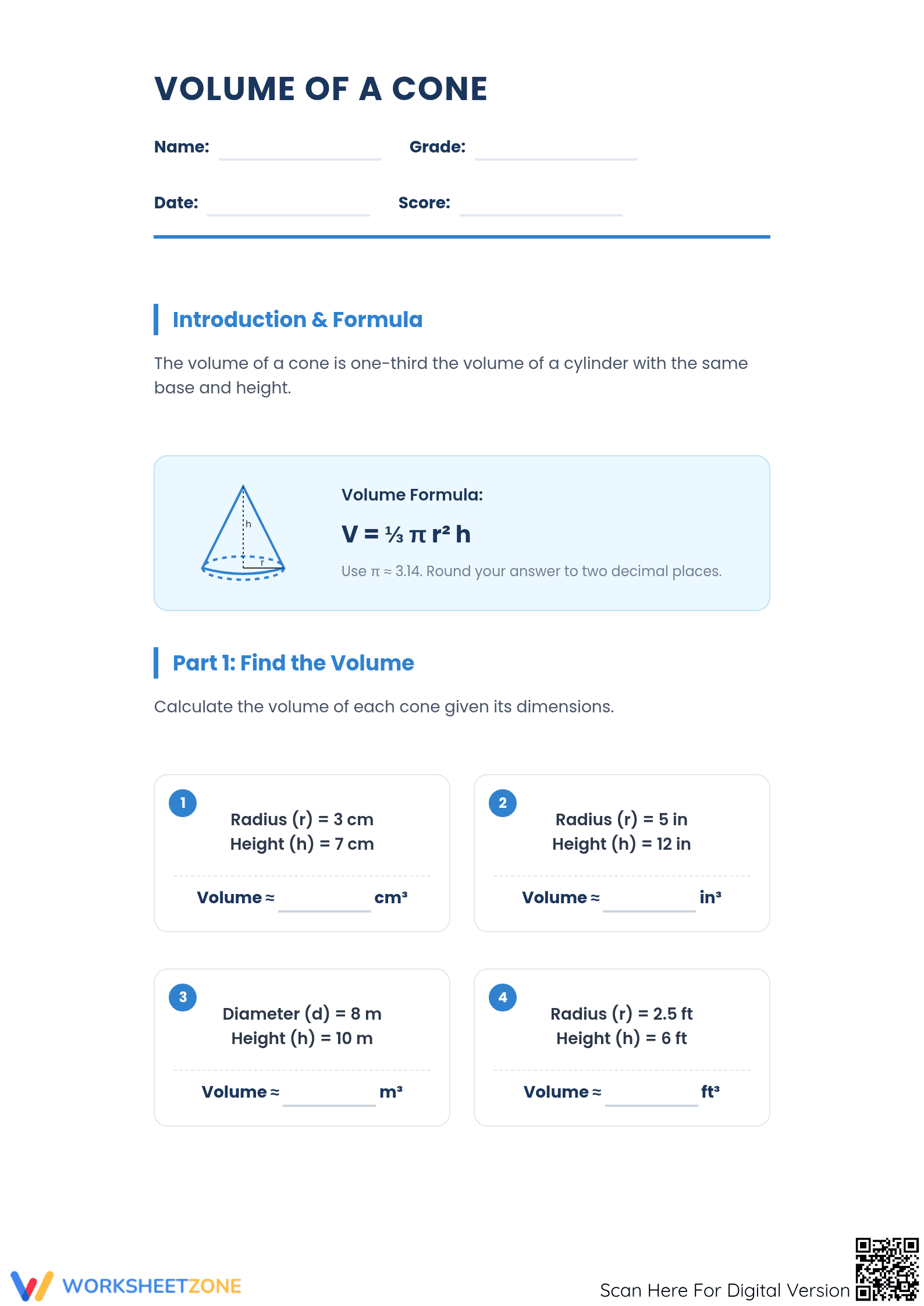
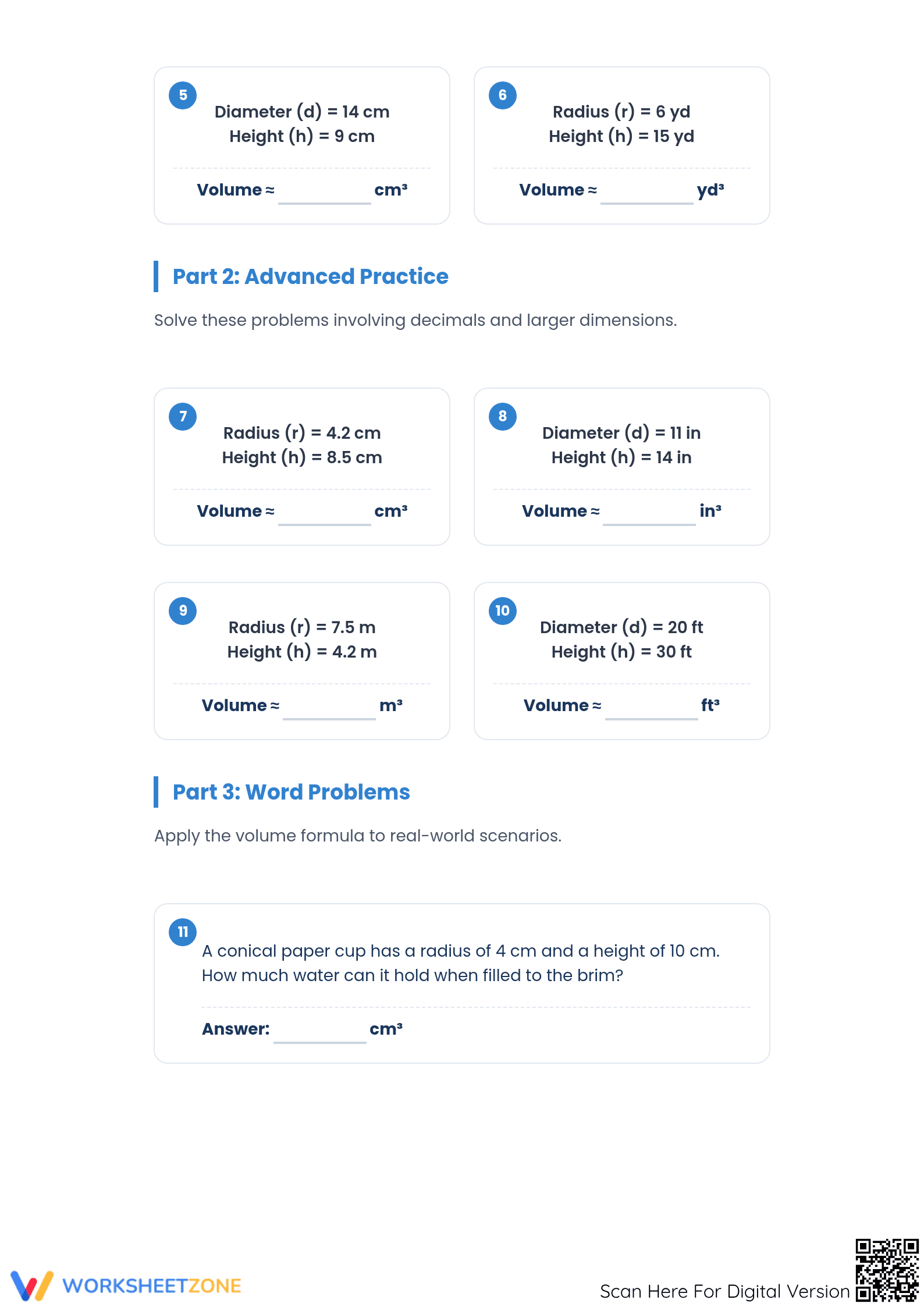
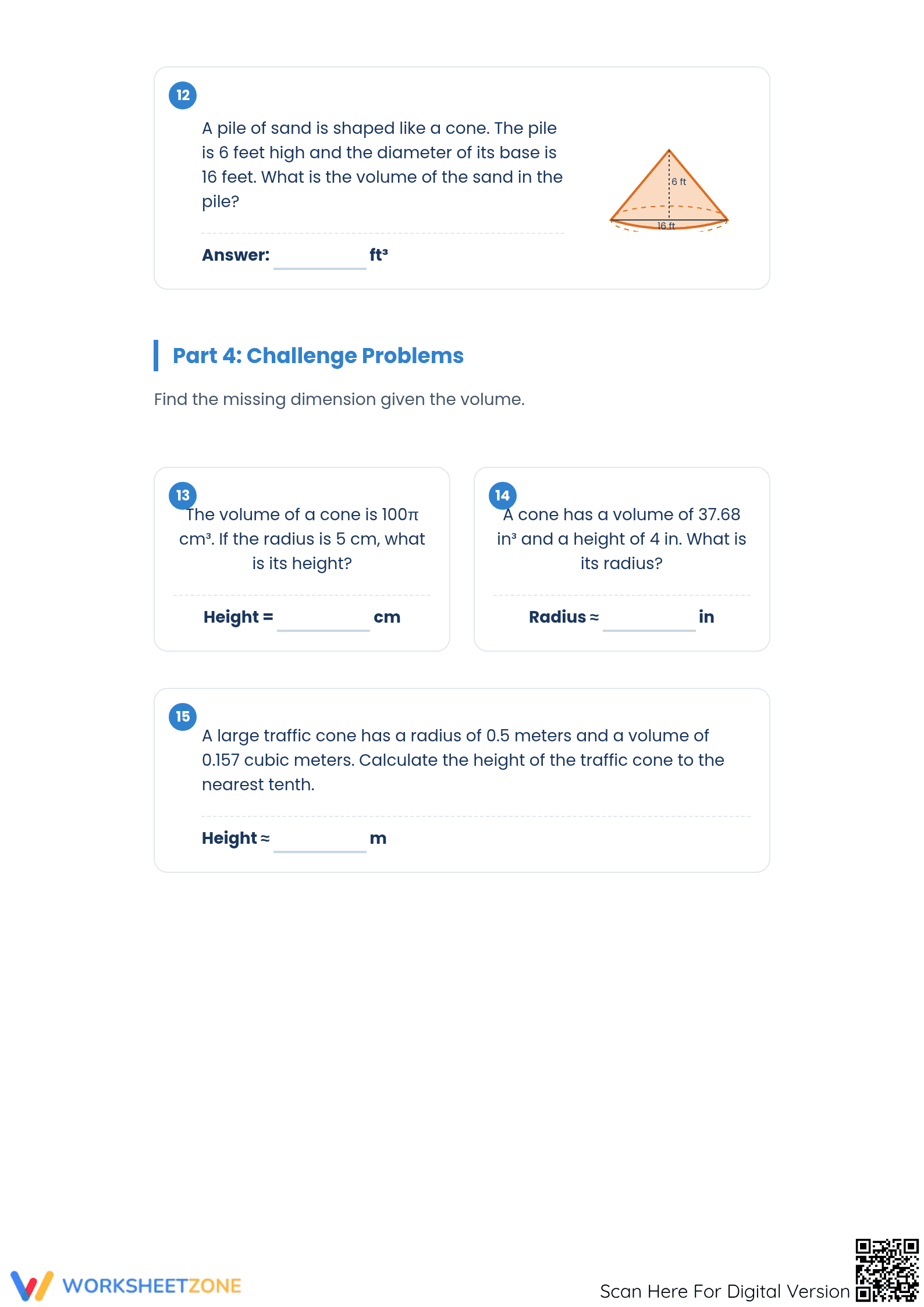
This printable volume of a cone worksheet provides a comprehensive set of practice problems designed to help students master the geometric formula for conical volume. Students will calculate volume using radius and height, solve real-world word problems, and find missing dimensions. This resource ensures high-school-ready competency in fundamental three-dimensional geometry concepts.
At a Glance
- Grade: 8 · Subject: Math
- Standard:
CCSS.MATH.CONTENT.8.G.C.9— Use the formula for the volume of a cone to solve mathematical problems- Skill Focus: Volume Calculation & Missing Dimensions
- Format: 3 pages · 15 problems · Answer key included · PDF
- Best For: Geometry skill practice and formative assessment
- Time: 25–40 minutes
The worksheet is organized into four distinct parts across three pages. It begins with a clear introduction to the formula (V = 1/3 π r² h) and established rounding rules for precision. The 15 problems include straightforward calculation tasks, advanced decimal practice, word problems involving sand piles, and challenge questions where students must isolate variables to find missing heights or radii. A full answer key is included.
- Guided Practice: The first six problems provide basic dimensions like radius and height, allowing students to focus on the procedural application of the formula with integers.
- Supported Practice: Problems 7 through 12 introduce decimal values and real-world scenarios, requiring students to interpret text and apply rounding rules to two decimal places.
- Independent Practice: The final challenge section forces students to reverse-engineer the formula, solving for unknown dimensions given a total volume, representing the highest cognitive demand.
This sequence follows a gradual-release model, moving from direct calculation to abstract problem-solving.
This resource is directly aligned with CCSS.MATH.CONTENT.8.G.C.9, which requires students to know and use the formulas for the volumes of cones. The worksheet extends this requirement by including multi-step word problems and algebraic manipulation of the volume formula. This standard code can be copied directly into lesson plans, IEP goals, or district curriculum mapping tools.
This worksheet is ideal for use as a primary practice set during a geometry unit on three-dimensional figures. Teachers should assign Part 1 and 2 immediately after direct instruction to gauge initial understanding. Parts 3 and 4 can be used as an extension activity or a collaborative partner challenge. Use the challenge problems as an exit ticket to identify students ready for high school geometry.
Designed for 8th-grade math students and high school geometry learners, this resource supports diverse learners through its scaffolded structure. It is particularly effective for students requiring extra practice with multi-step formulas or those preparing for standardized testing. It pairs naturally with a volume-focused anchor chart or direct instruction lesson.
The strategic design of this volume of a cone worksheet aligns with the instructional principles highlighted in the EdReports 2024 analysis of mathematics curriculum effectiveness. By providing a clear transition from procedural fluency in Part 1 to conceptual application in Part 3, the resource supports the rigorous demands of the CCSS.8.G.C.9 standard. Research from NAEP indicates that students often struggle with the transition between identifying geometric properties and applying them in non-routine contexts, such as finding missing dimensions. This worksheet addresses that gap by including specific challenge problems that require algebraic manipulation. The inclusion of word problems provides the real-world context necessary for deep mathematical understanding and long-term retention. Teachers can utilize this 15-problem set to provide the structured repetition necessary for mastery while also offering the cognitive complexity required for advanced learners. This evidence-based approach ensures that Grade 8 students develop a robust foundation in three-dimensional measurement and spatial reasoning.


