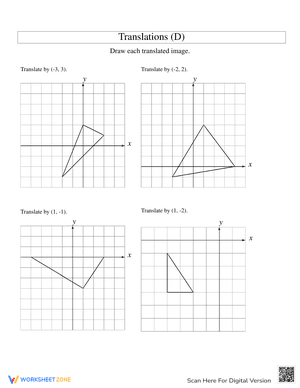
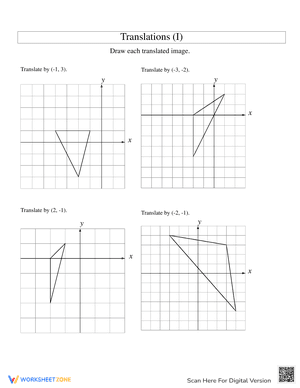
Translations worksheets give teachers a low-stakes way to check whether students can slide a point or a shape across a coordinate plane before layering on the more abstract notation that comes later in the unit. Because a translation does not change size, shape, or orientation, it is the easiest transformation for students to visualize, which makes it a natural first stop for building confidence with coordinate geometry.
For US K-8 classrooms, this matters because translations sit at the foundation of the Grade 8 geometry standards. Curriculum leads and intervention specialists can use translation practice sets as a diagnostic: if a student struggles to slide a triangle five units right and two units down, that gap will resurface later when the same student is asked to describe a full congruence sequence.
What a Translation Actually Does to a Figure
A translation is a slide. Every point of a figure moves the same distance in the same direction, and nothing about the figure itself changes. The pre-image and image stay congruent, and corresponding sides stay parallel. Worksheets that isolate this single idea, without mixing in reflections or rotations, help students build a clean mental model before things get more complex.
Good translation worksheets usually start concrete: moving a single point on a grid, then a segment, then a full polygon. This progression matters because students who skip straight to abstract notation often memorize a rule without understanding what physically happens to the shape.
Building the Coordinate Rule: From Grid Slides to Notation
Once students can slide shapes on grid paper, translation worksheets typically introduce the coordinate rule. A translation is written as (x, y) maps to (x + a, y + b), where a shifts every point horizontally and b shifts every point vertically. Practice sets that pair a visual grid slide with the matching rule help students see that the notation is just shorthand for the movement they already understand.
One point worth flagging for intervention planning: many students can slide a shape correctly on a grid but cannot generate the matching rule, or vice versa. Worksheets that require both a drawn image and a written rule on the same page catch this specific gap, which purely visual or purely symbolic practice sets often miss.
Common Misconceptions: Translations vs Reflections and Rotations
Students frequently confuse translations with reflections, especially when a shape is moved across an axis. A translation never flips or rotates a figure; it only slides it. Worksheets that place a translation problem directly next to a reflection or rotation problem, using the same starting figure, force students to notice the difference rather than guess based on shape.
Another common error is applying the horizontal shift to the y-coordinate or the vertical shift to the x-coordinate. Repeated practice with labeled grids, where students track each coordinate separately, helps correct this before it becomes a habit that resurfaces on formal assessments.
Teacher Tips
Start every translation worksheet with a quick check of prior knowledge: can students plot and read ordered pairs accurately? A shaky grasp of coordinates will look like a translation problem when it is really a plotting problem. Pair grid-based practice with a few notation-only problems on the same worksheet so students see both representations together.
Use color to separate the pre-image and image on printed worksheets, since many students lose track of which shape is which once several transformations appear on one page. For intervention groups, keep the same figure across several worksheets and vary only the translation rule, so students focus on one variable at a time.
According to the Common Core State Standards for Grade 8 geometry, students are expected to verify experimentally the properties of rotations, reflections, and translations, then use coordinates to describe the effect of these transformations on two-dimensional figures. This sets translations worksheets up as direct evidence toward 8.G.A.1 and 8.G.A.3 mastery, not just supplemental practice.
Frequently Asked Questions
1. What grade level typically covers translations on the coordinate plane?
Translations are typically introduced in Grade 8, as part of the broader transformations unit that also covers reflections, rotations, and dilations.
2. How is a translation different from a rotation or reflection?
A translation slides every point of a figure the same distance in the same direction without changing its size, shape, or orientation, while reflections flip a figure and rotations turn it around a fixed point.
3. What is the coordinate rule for describing a translation?
A translation on a coordinate plane is written as a rule such as (x, y) maps to (x + a, y + b), shifting each point horizontally by a and vertically by b.
4. How can teachers check student understanding of translations before moving to congruence proofs?
Worksheets that ask students to identify the translation rule from before-and-after coordinates, rather than only applying a given rule, reveal whether students truly understand the transformation or are just following steps.
5. How do translation worksheets fit into the broader CCSS geometry progression?
Translation worksheets build directly toward CCSS.Math.Content.8.G.A.1 and 8.G.A.3, which require students to verify the properties of translations and describe their effect using coordinates, laying the groundwork for the congruence standard 8.G.A.2.
















 Interactive Worksheet Maker
 Quiz Maker
 Word Search Maker
 Crossword Puzzle Maker
 Word Scramble Generator
 Sentence Scramble Generator
 Handwriting Worksheet Generator
 Name Tracing Generator
 Fill In The Blank Generator