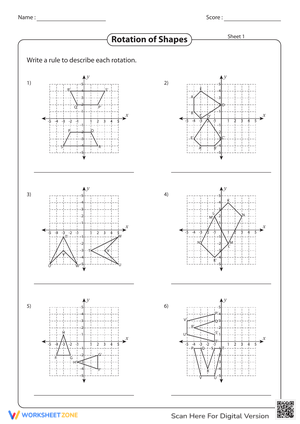
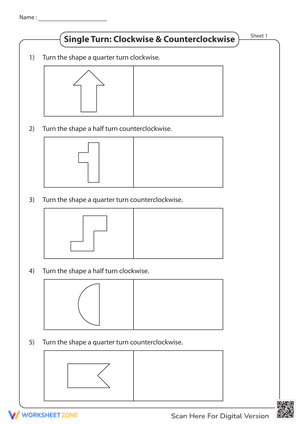
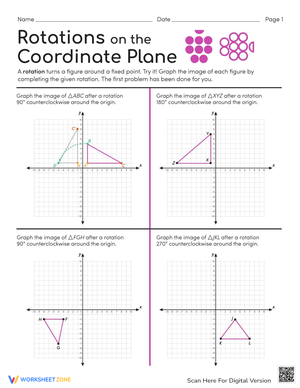
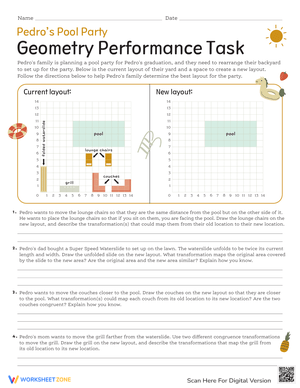
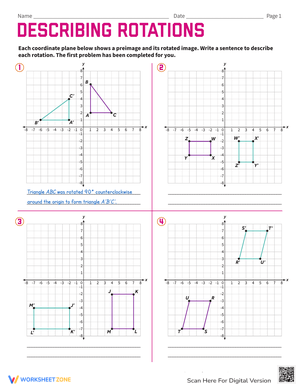
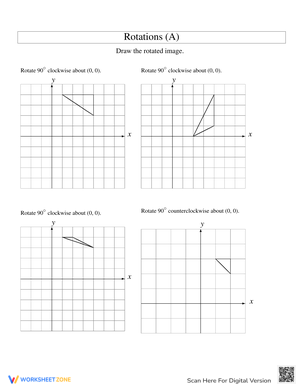
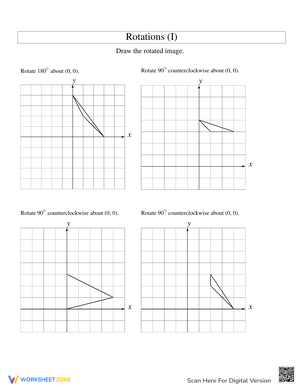
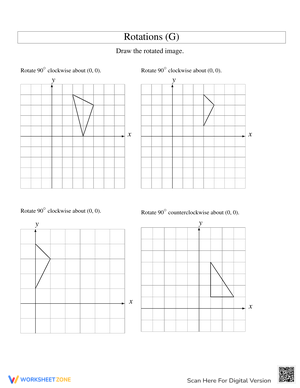
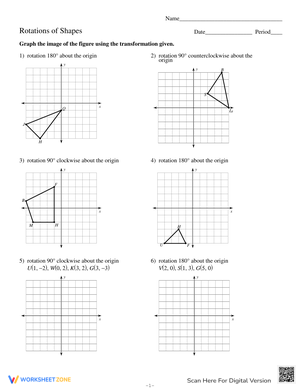
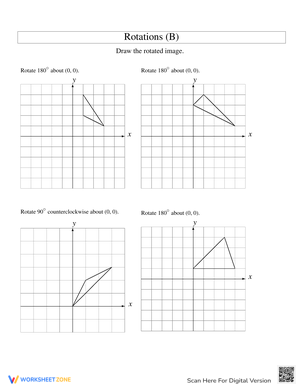
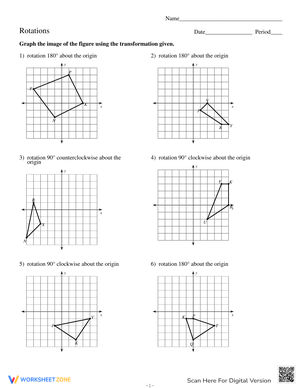
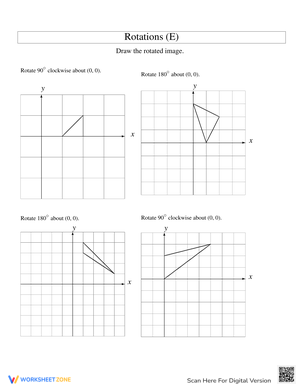
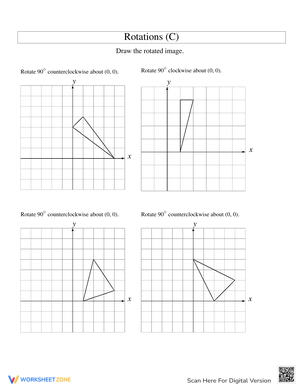
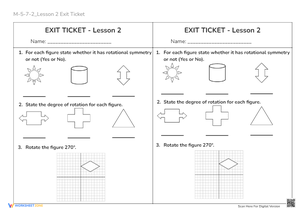
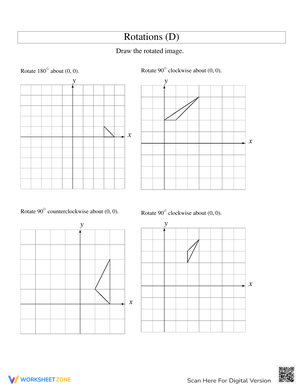
These rotations worksheets give 8th grade geometry teachers a structured set of coordinate-plane exercises covering the three standard rotation angles — 90°, 180°, and 270° — in both directions, with formats that move students from single-point practice up through multi-vertex polygons and reverse-identification problems. Each page is print-ready, grid-included, and built around the specific procedural demands the CCSS 8.G standards place on middle school learners.
The Coordinate Rules Students Need to Know
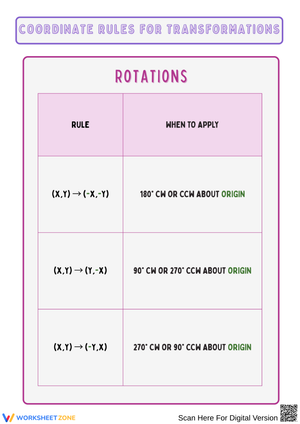
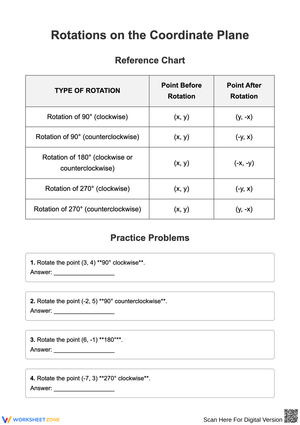
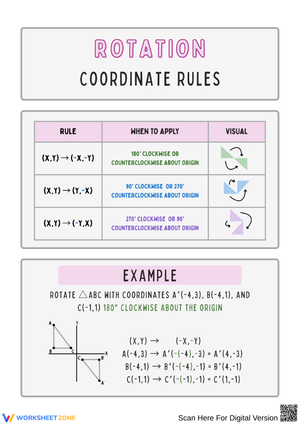
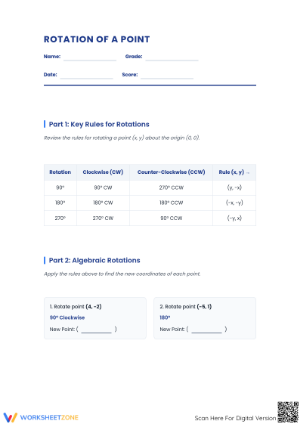
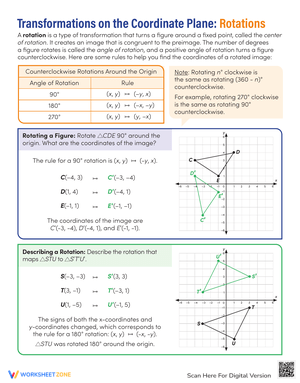
Three transformation rules sit at the center of every problem in this set. For rotations about the origin: a 90° counterclockwise turn sends (x, y) to (−y, x); a 180° rotation sends (x, y) to (−x, −y); and a 270° counterclockwise turn — equivalent to a 90° clockwise — sends (x, y) to (y, −x). Students who can recite these rules in isolation still lose points on assessments because they apply them mechanically without checking direction or sign. The worksheets build fluency by requiring students to write the rule they're using before they plot anything, which slows the impulsive "just switch the numbers" approach that generates most errors.
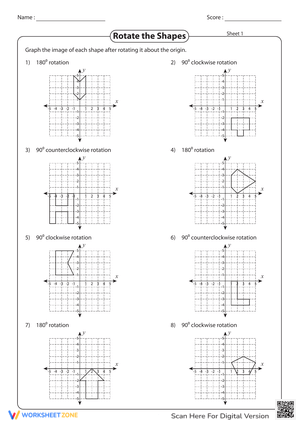
Grids in every problem extend into all four quadrants deliberately. When a student drops a negative sign on the x-coordinate of a 90° rotation, the image vertex lands visibly in the wrong quadrant — the grid makes the error self-evident in a way a blank answer line does not.
What's Included in These Worksheets
The set moves through four problem formats, loosely sequenced by difficulty. Point-rotation problems appear first: rotate A(3, −2) by 90° counterclockwise, state the coordinates of A'. These isolate rule application from the added work of tracking multiple vertices, which matters during initial instruction when cognitive load is already high.
Polygon problems come next. Students apply the rotation rule to every vertex of a triangle or quadrilateral, plot each image point, and connect them in order. One misplotted vertex distorts the whole figure, which motivates careful work more effectively than a rubric reminder does. Following those are reverse-identification exercises: a pre-image and its image are both shown on the grid, and students determine the angle and direction of the rotation. This format is worth using as a formative check — a student who can execute a 90° rotation may still fail to recognize one when shown the result.
The final format mixes rotation problems with reflections and translations on the same page. That mixing is intentional: state tests rarely label which transformation is being tested, and students who have only practiced transformations in isolated units often freeze when the problem doesn't announce its type upfront.
Standard Alignment
CCSS 8.G.A.1 establishes that rotations preserve lines, line segments, and angles — the conceptual foundation. 8.G.A.3 asks students to describe the effect of rotations on two-dimensional figures using coordinates, which is the direct target of most problems here. 8.G.A.2 connects to the reverse-identification format: students use sequences of transformations to establish congruence, and recognizing a rotation from a pre-image/image pair is exactly that skill in practice.
These standards mark the first time most students encounter transformations in a coordinate system rather than as informal paper-folding or tracing activities. The procedural layer — applying coordinate rules — is new at Grade 8, which is why the early pages include the rules in a reference box rather than assuming students have memorized them. By the polygon pages, the reference is removed.
Where These Fit in the Instructional Week
The point-rotation pages work well as the first independent practice after direct instruction — typically the day students see the coordinate rules for the first time. Assign four to six problems, then debrief as a class before moving to polygons. The 8 minutes before the end of a period is enough time to complete one polygon problem and compare answers with a neighbor, which surfaces errors without requiring you to collect and grade anything.
The reverse-identification pages belong in the middle of the unit, after students have practiced executing rotations but before the unit test. Handing one out during a Monday warm-up after a weekend gap gives you useful retrieval data — students who could plot a 180° rotation on Friday but struggle to identify one on Monday are showing you that the rule isn't yet consolidated.
Mixed-transformation pages are best reserved for the review block before assessment. Using them earlier, when students are still building fluency with rotations specifically, tends to increase confusion rather than reduce it.
Where Students Struggle Most
The most persistent error isn't mixing up the rules — it's confusing clockwise and counterclockwise. Students who learned to associate "clockwise" with a clock face often reverse the association under test pressure, especially when a problem specifies direction in a subordinate clause rather than leading with it. The worksheet headers state direction in bold before every problem set, which builds the habit of checking direction as the first step, not an afterthought.
A subtler error appears with the 90° rules specifically: students frequently apply (−y, x) when they mean (y, −x) because both involve swapping the coordinates and changing one sign. The difference is which sign changes. Problems that place a 90° CCW and a 90° CW rotation side by side — same starting point, different direction — make this distinction concrete. Students who see A(4, 1) produce A'(−1, 4) in one column and A'(1, −4) in the other column tend to remember the distinction far better than students who encounter each rule in a separate lesson.
Students rotating polygons also tend to rush the vertex labeling. They'll correctly calculate all four image vertices but connect them out of order, producing a crossed or inverted figure. A few of the polygon pages include a column for listing transformed coordinates before plotting, which slows this step down enough to catch the error before it compounds.
Frequently Asked Questions
Can these be used in high school geometry, or are they strictly Grade 8 material?
Both. The coordinate-rule fluency targeted here is introduced in Grade 8 under CCSS 8.G but appears again in high school geometry in the context of geometric proofs and function composition. High school teachers often use the polygon-rotation and reverse-identification pages as a review tool at the start of a transformations unit, particularly for students who had gaps in their middle school math experience.
How do I use the mixed-transformation pages without overwhelming students who are still building rotation fluency?
Hold them until students can complete a polygon rotation correctly without the reference card. The mixed pages aren't an introduction to any new skill — they're a discrimination exercise. Students need a stable base with each transformation type before being asked to identify and distinguish them on the same page. Using mixed pages too early produces random guessing, not retrieval practice.
Do these worksheets address rotations in degrees other than 90, 180, and 270?
No. Rotations at non-standard angles — 45°, 60°, or arbitrary measures — require trigonometric tools that fall outside the 8.G scope and most standard high school geometry curricula. If a student asks about those cases, it's worth acknowledging them as real and interesting, but the coordinate-rule approach taught here applies specifically to multiples of 90°.













 Interactive Worksheet Maker
 Quiz Maker
 Word Search Maker
 Crossword Puzzle Maker
 Word Scramble Generator
 Sentence Scramble Generator
 Handwriting Worksheet Generator
 Name Tracing Generator
 Fill In The Blank Generator