




























1 / 2
0
Views
0
Downloads

0.0
0
Save
0 Likes
Share
Practice Translations with this Geometry Worksheet
0 Views
0 Downloads

Paste this activity's link or code into your existing LMS (Google Classroom, Canvas, Teams, Schoology, Moodle, etc.).
Students can open and work on the activity right away, with no student login required.
You'll still be able to track student progress and results from your teacher account.
Information
Description
What It Is:
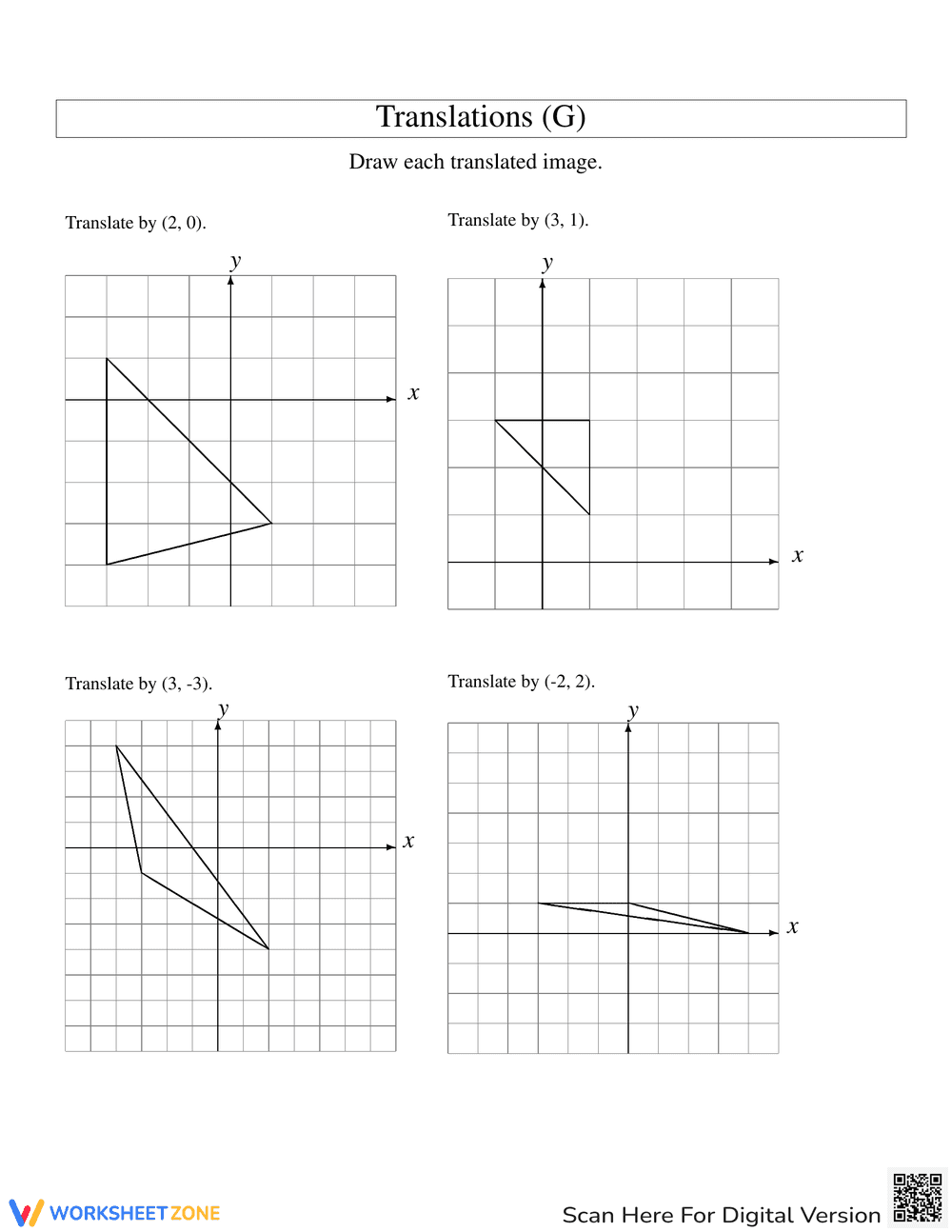
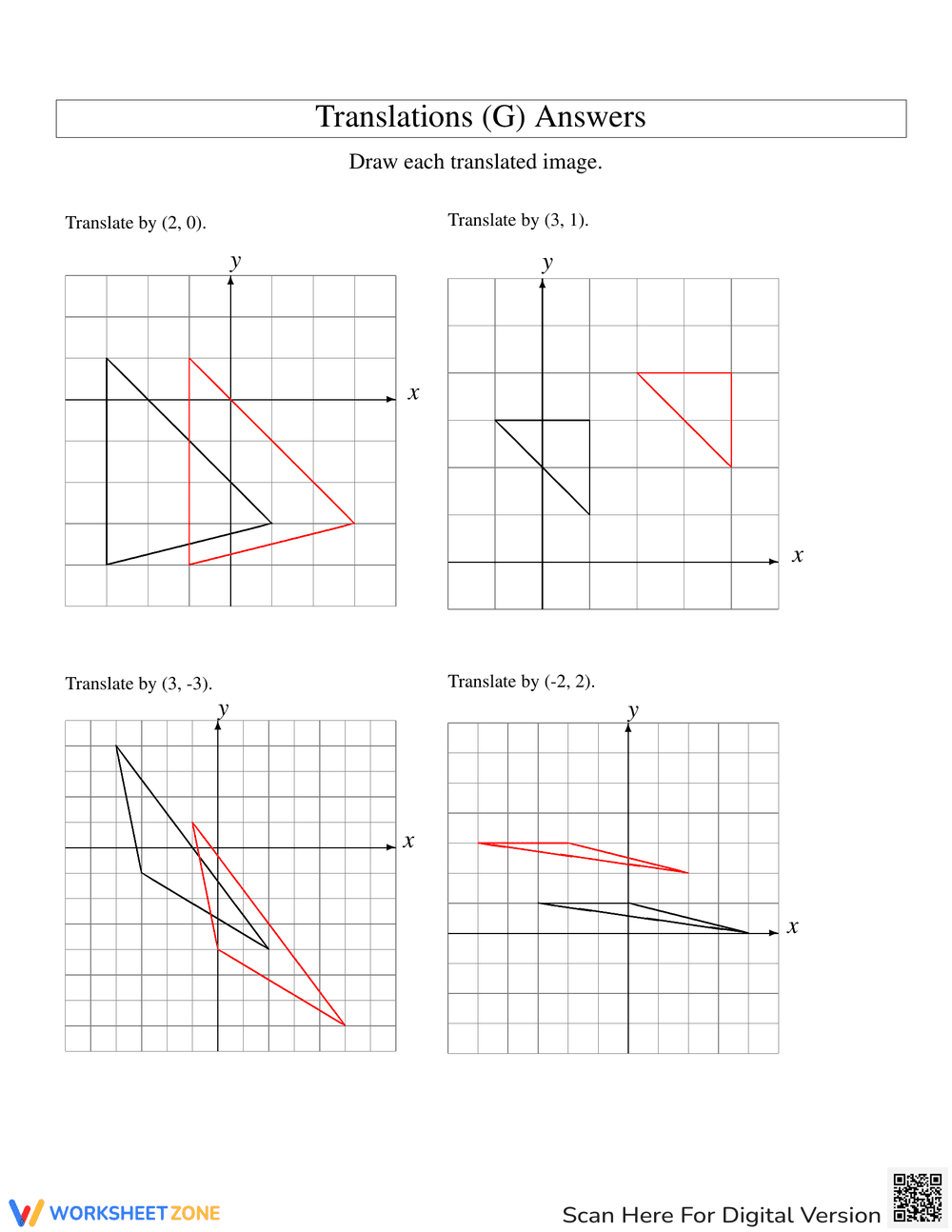
This is a math worksheet focusing on geometric translations. It presents four coordinate plane grids, each displaying a shape. Underneath the title 'Translations (G)' and the instruction 'Draw each translated image,' each grid has instructions to translate the shape by a given vector: (2,0), (3,1), (3,-3), and (-2,-2). The student is expected to draw the translated image on the provided grid.
Grade Level Suitability:
This worksheet is suitable for grades 6-8. It requires understanding of coordinate planes and the concept of translating geometric shapes, which are typically introduced in middle school math curricula.
Why Use It:
This worksheet reinforces the understanding of geometric transformations, specifically translations. It helps students visualize how shapes move on a coordinate plane based on given vectors. It also strengthens skills in reading and interpreting coordinate pairs.
How to Use It:
Students should first understand the translation vector provided for each grid. For example, 'Translate by (2,0)' means to move the shape 2 units to the right and 0 units up or down. They should then translate each vertex of the original shape according to the vector and connect the new vertices to draw the translated image.
Target Users:
The target users are middle school students learning about geometric transformations. It's also useful for students who need extra practice with coordinate planes and visualizing translations. It can also be used as a review activity.
This is a math worksheet focusing on geometric translations. It presents four coordinate plane grids, each displaying a shape. Underneath the title 'Translations (G)' and the instruction 'Draw each translated image,' each grid has instructions to translate the shape by a given vector: (2,0), (3,1), (3,-3), and (-2,-2). The student is expected to draw the translated image on the provided grid.
Grade Level Suitability:
This worksheet is suitable for grades 6-8. It requires understanding of coordinate planes and the concept of translating geometric shapes, which are typically introduced in middle school math curricula.
Why Use It:
This worksheet reinforces the understanding of geometric transformations, specifically translations. It helps students visualize how shapes move on a coordinate plane based on given vectors. It also strengthens skills in reading and interpreting coordinate pairs.
How to Use It:
Students should first understand the translation vector provided for each grid. For example, 'Translate by (2,0)' means to move the shape 2 units to the right and 0 units up or down. They should then translate each vertex of the original shape according to the vector and connect the new vertices to draw the translated image.
Target Users:
The target users are middle school students learning about geometric transformations. It's also useful for students who need extra practice with coordinate planes and visualizing translations. It can also be used as a review activity.


