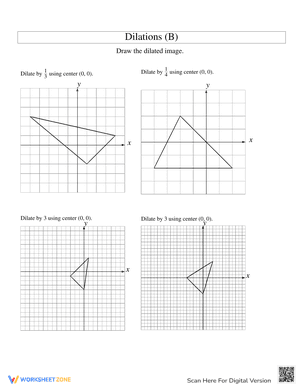
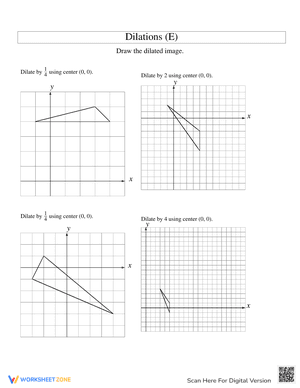
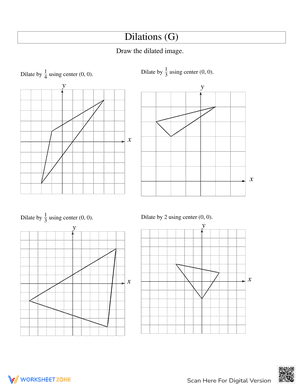
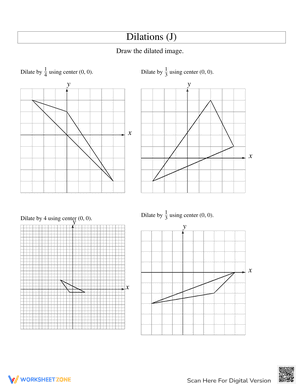
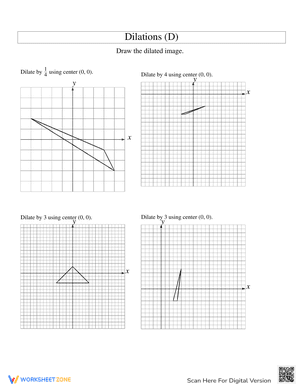
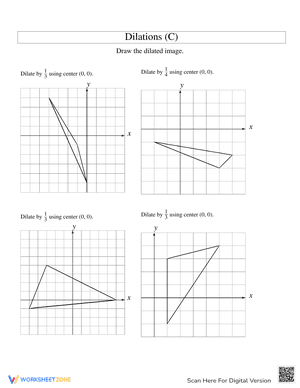
If you teach Grade 8 coordinate geometry, dilations are the transformation that tends to trip students up the most. Translations slide, reflections flip, and rotations turn, but dilations change size, and that shift from motion to scaling asks students to think differently about coordinates. A focused set of dilations worksheets gives you a low-prep way to build that skill before students hit a unit assessment on transformations and similarity.
Dilations are one of the four core transformations named in Grade 8 geometry standards, alongside translations, reflections, and rotations. Teaching them as a set helps students see the pattern: each transformation has a coordinate rule, and dilations are the rule that multiplies rather than shifts or swaps signs.
CCSS.Math.Content.8.G.A.3 specifically requires students to describe the effect of dilations, translations, rotations, and reflections on two-dimensional figures using coordinates, which means dilation practice cannot stand alone. Worksheets that mix all four transformations, with dilations woven in rather than isolated, more closely match how this standard is assessed.
The Coordinate Rule Students Need to Internalize
At the center of every dilation worksheet is one rule: multiply each coordinate by the scale factor relative to the center of dilation. In most Grade 8 tasks, that center is the origin, which simplifies the rule to (x, y) becomes (kx, ky), where k is the scale factor. Students who memorize this rule without understanding it often forget to apply it to both coordinates, or they apply it only to one axis. Worksheets that ask students to plot the dilated image, not just calculate coordinates, catch that error immediately because the shape will look distorted rather than proportionally scaled.
Once students are comfortable with origin-centered dilations, worksheets can introduce a center of dilation away from the origin. This is a natural next step, not a starting point, because it adds a translation step before and after the scaling multiplication.
Scale Factor Greater Than 1 vs. Between 0 and 1
A scale factor greater than 1 produces an enlargement, and a scale factor between 0 and 1 produces a reduction. Students often assume dilation always means the figure gets bigger, so worksheets need to include both cases side by side. A page with mixed scale factors, some fractional, some whole numbers greater than 1, forces students to check the value before assuming the direction of the change. This is also a good moment to connect dilations to fraction and ratio skills students already have from earlier grades.
Coloring or puzzle-based dilation activities work well here because they reward accuracy rather than speed. When a scale factor is applied incorrectly, the resulting picture or pattern will not match, which gives students immediate visual feedback without you having to check every point by hand.
Connecting Dilations to Similarity
Dilations are the mathematical foundation for similarity: a dilated figure has the same shape as the original, with proportional sides and equal corresponding angles. This connection sits within the broader Grade 8 Geometry domain that links transformations to congruence and similarity concepts. Worksheets that ask students to verify similarity after a dilation, by checking angle measures or side ratios, reinforce this link and prepare students for the reasoning they will need in high school geometry.
A simple worksheet routine that works well: give students a preimage and a dilated image, and ask them to state the scale factor, identify the center of dilation, and explain why the two figures are similar. This routine turns a computation task into a reasoning task, which better matches how 8.G.A.3 is typically assessed.
Classroom Implementation
For a typical Grade 8 lesson, start with a warm-up that reviews the coordinate rules for translations, reflections, and rotations before introducing dilations as the fourth transformation. This keeps dilations connected to the transformations students already understand rather than presenting it as an unrelated new topic.
During guided practice, use worksheets centered at the origin first, with whole-number scale factors greater than 1, so students can focus on the multiplication rule without added complexity. Move to fractional scale factors and non-origin centers only once most students can plot an origin-centered dilation independently. For formative assessment, a short exit ticket with one dilation problem, asking students to state the scale factor and plot the image, gives a quick read on whether the concept is ready for a mixed-transformations quiz. Small-group intervention can focus specifically on the coordinate multiplication step, since that is where most errors originate.
Frequently Asked Questions
1. What grade level typically covers dilations worksheets
Dilations are primarily a Grade 8 topic, taught alongside translations, rotations, and reflections as part of the coordinate geometry and transformations unit.
2. How do you find the coordinates of a dilated point given a scale factor and center
When the center of dilation is the origin, multiply each coordinate of the original point by the scale factor. For a center away from the origin, translate the center to the origin first, apply the scale factor, then translate back.
3. What is the difference between a dilation and other transformations like rotation or reflection
Dilations change the size of a figure using a scale factor, while translations, rotations, and reflections change the position or orientation of a figure without changing its size.
4. How do dilations worksheets connect to teaching similarity
Dilations produce figures that are the same shape with proportional sides and equal angles, which is the definition of similarity. Worksheets that pair a dilation with a similarity check help students see this connection directly.
















 Interactive Worksheet Maker
 Quiz Maker
 Word Search Maker
 Crossword Puzzle Maker
 Word Scramble Generator
 Sentence Scramble Generator
 Handwriting Worksheet Generator
 Name Tracing Generator
 Fill In The Blank Generator