




























Views
Downloads



Printable Scale Factors and Dilations Worksheet | Grade 8

Paste this activity's link or code into your existing LMS (Google Classroom, Canvas, Teams, Schoology, Moodle, etc.).
Students can open and work on the activity right away, with no student login required.
You'll still be able to track student progress and results from your teacher account.
Master geometric transformations with this comprehensive Scale Factors and Dilations practice worksheet. Designed for Grade 8 students, this resource bridges the gap between theoretical vocabulary and practical coordinate geometry. Students will define key terms, calculate scale factors, and apply transformations to figures, ensuring a deep understanding of how figures change size while preserving shape.
At a Glance
- Grade: 8 · Subject: Mathematics
- Standard:
CCSS.MATH.CONTENT.8.G.A.3— Describe the effect of dilations on two-dimensional figures using coordinates- Skill Focus: Dilations and Scale Factors
- Format: 5 pages · 24 problems · Answer key included · PDF
- Best For: Geometry transformations unit practice and assessment
- Time: 45–60 minutes
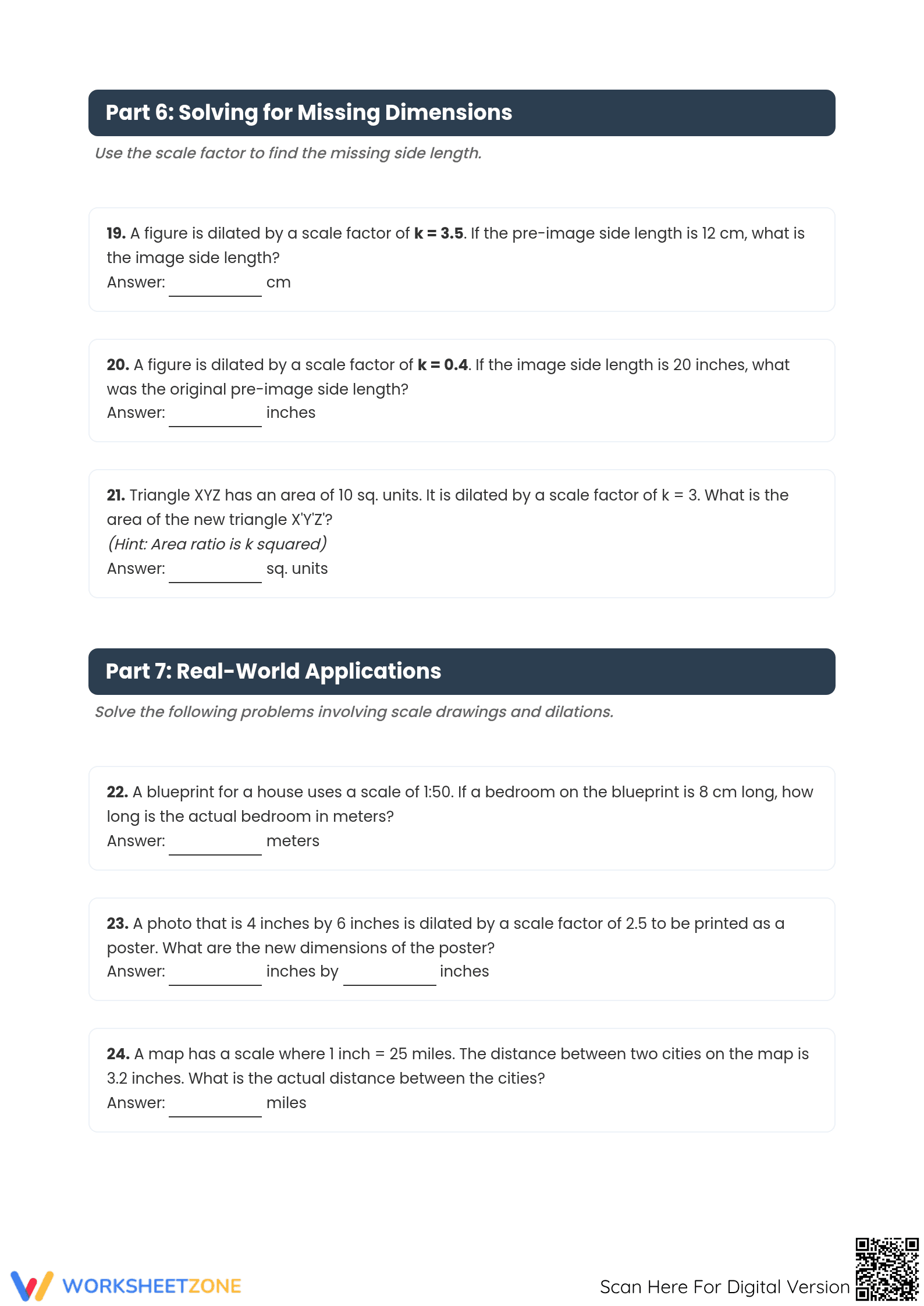
This five-page instructional packet contains 24 diverse problems organized into seven strategic sections. It begins with a vocabulary word bank and progresses through enlargement identification, scale factor calculation, and coordinate rules. Students will perform manual graphing on coordinate planes and solve missing dimension and real-world application problems involving blueprints and maps. A full answer key is included for immediate feedback.
Skill Progression
- Guided practice: The worksheet starts with vocabulary and basic identification (Parts 1-2) with 10 problems that define enlargement and reduction using a word bank for support.
- Supported practice: Students transition to calculation and coordinate rules (Parts 3-4) using 6 problems that provide specific formulas and structured table templates.
- Independent practice: The final 8 problems (Parts 5-7) require students to graph figures from scratch and apply concepts to real-world scenarios without scaffolding.
This gradual-release model follows the I Do, We Do, You Do instructional framework to build student confidence and mastery.
Standards Alignment
The primary focus of this resource is CCSS.MATH.CONTENT.8.G.A.3: "Describe the effect of dilations, translations, rotations, and reflections on two-dimensional figures using coordinates." This worksheet specifically targets the dilation component of the standard. Additionally, it supports HSG.SRT.A.1 by investigating the properties of dilations given by a center and a scale factor. Both standard codes can be copied directly into lesson plans, IEP goals, or district curriculum mapping tools.
How to Use It
Use this worksheet during the middle of a transformations unit after students have been introduced to the basic definition of a dilation. It serves as an excellent bridging activity between direct instruction and a formal unit assessment. As a formative assessment tip, observe students during Part 4; if they struggle with the coordinate rules for scale factors less than one, provide a quick review of fraction multiplication. Total completion time is approximately 50 minutes.
Who It's For
This resource is tailored for Grade 8 Pre-Algebra or High School Geometry students working on similarity and transformations. It is particularly beneficial for visual learners who need the concrete support of coordinate grids. Pair this worksheet with colored pencils for graphing or a physical architect's scale to enhance the real-world blueprint application section.
Geometric transformations are foundational to spatial reasoning. According to the NAEP, proficiency in coordinate geometry and describing changes through scale factors is a critical predictor of success in higher mathematics. This worksheet provides 24 structured opportunities for students to engage with standard CCSS.MATH.CONTENT.8.G.A.3, moving from vocabulary to real-world applications. By requiring students to calculate, graph, and interpret dilations in contexts like blueprints and maps, it reinforces math as a tool for modeling. Research in the EdReports 2024 analysis of middle school math emphasizes providing varied practice that includes procedural fluency and conceptual application. This resource delivers that balance, ensuring students can accurately apply the scale factor k to any pre-image coordinate (x, y) while understanding the broader implications of geometric change. Such rigorous practice is essential for preparing students for high school geometry standards.


