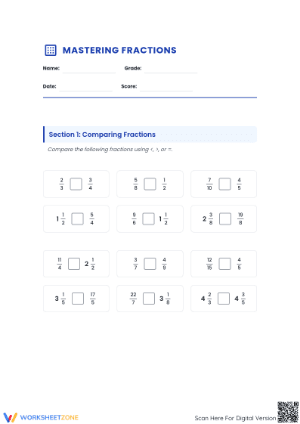
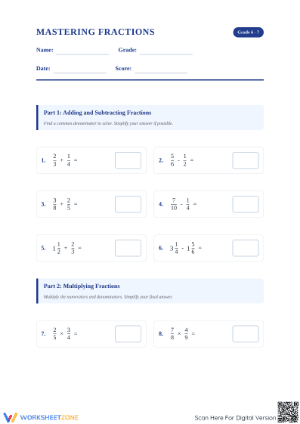
A complex fraction has a fraction in its numerator, denominator, or both, and it usually shows up right when students are already stretched thin juggling ratios, unit rates, and rational number operations. If you teach grade 6 or grade 7 math, you have probably seen a student stare at a fraction stacked on top of another fraction and freeze because they cannot tell where the main fraction bar is. Complex fractions worksheets give you a low-prep way to isolate that one skill and drill it until it becomes automatic, rather than trying to teach it inside a longer word problem where the fraction structure gets lost.
The skill also does not appear out of nowhere. Complex fractions are introduced through unit rate contexts in grades 6 and 7, such as computing one-half divided by one-quarter miles per hour as a complex fraction. That means a worksheet built around complex fractions is really reinforcing two things at once: the mechanics of dividing fractions and the conceptual link to rate language your students will need again in Algebra 1 rational expressions.
How Complex Fractions Worksheets Support 7.NS.A.3 Progression
CCSS.Math.Content.7.NS.A.3 requires students to solve real-world and mathematical problems involving the four operations with rational numbers, and complex fractions are one of the places where that standard gets stress-tested. A worksheet sequence that moves from simple fraction division, to complex fractions with whole-number components, to complex fractions with mixed numbers gives you a built-in progression you can use across a unit rather than reteaching from scratch each week.
Standard fluency work for complex fractions builds on the generalization that a over b divided by c over d equals a times d over b times c, and students construct this rule through repeated reasoning rather than by memorizing it cold. That is the pedagogical argument for using worksheets with many short, structurally similar problems instead of a handful of elaborate word problems: repetition is what lets students notice the pattern themselves.
Two Methods Worth Teaching Side by Side
There are two common simplification methods worth putting on the same worksheet so students can compare them directly. The first is the LCD method: multiply the numerator and denominator of the complex fraction by the least common denominator of all the inner fractions, which clears the inner fractions in one step. The second is the reciprocal method: rewrite the complex fraction as a division problem and multiply by the reciprocal of the divisor.
Some students strongly prefer one method over the other, and a worksheet that requires both methods on parallel problems, then asks students to circle which method felt faster, turns a computation task into a moment of mathematical practice around strategy selection. That kind of reflection question costs you nothing to add and gives you useful formative data on how flexibly a student is thinking about the problem.
Common Student Errors and How Worksheets Address Them
Two errors show up constantly on complex fractions problems. First, students misidentify the main fraction bar, especially when the complex fraction includes mixed numbers, and end up dividing the wrong two quantities. Second, students apply the reciprocal to the wrong fraction, flipping the dividend instead of the divisor.
Targeted worksheet practice addresses both errors because you can design problems that isolate each mistake. A worksheet section with only whole-number-over-fraction complex fractions forces students to practice identifying the main bar without the added complexity of mixed numbers. A separate section with clearly labeled dividend and divisor fractions lets you check whether students are reciprocating the correct term before you move on to messier, unlabeled problems.
Classroom Implementation
Start a complex fractions unit with a short diagnostic worksheet covering basic fraction division, then move to complex fractions with whole-number numerators or denominators before introducing mixed numbers. Keep each worksheet to eight or ten problems so you can grade it during a single planning period and return feedback the next day.
Pair every worksheet with a brief method-comparison prompt, asking students to solve using both the LCD method and the reciprocal method on at least two problems. This habit keeps students flexible instead of locking into one procedure they might misapply later. For enrichment groups, add a worksheet section connecting complex fractions back to unit rate language, since that framing previews the rational expression work students will see in Algebra 1.
Frequently Asked Questions
1. What grade level typically learns complex fractions?
Complex fractions are typically introduced in grade 6 through unit rate contexts and formalized as part of rational number operations in grade 7 under CCSS.Math.Content.7.NS.A.3.
2. What is the difference between a complex fraction and a compound fraction?
A complex fraction contains a fraction in its numerator, denominator, or both. The term compound fraction is sometimes used interchangeably in classroom materials, though complex fraction is the term used in the CCSS 7.NS.A.3 progression.
3. What is the fastest method for simplifying a complex fraction?
Many students find the reciprocal method faster once they are fluent with fraction division, since it reframes the complex fraction as a straightforward division problem. Others prefer the LCD method because it clears inner fractions in one multiplication step.
4. How do complex fractions worksheets align with Common Core standard 7.NS.A.3?
7.NS.A.3 requires students to solve real-world and mathematical problems using the four operations with rational numbers, and complex fractions worksheets give direct, gradeable practice with the fraction division skill that standard depends on.
5. How can teachers use complex fractions worksheets for intervention versus enrichment?
For intervention, use worksheets to diagnose gaps in basic fraction division before introducing mixed-number complex fractions. For enrichment, extend worksheets into unit rate and early rational expression contexts that preview Algebra 1 content.
















 Interactive Worksheet Maker
 Quiz Maker
 Word Search Maker
 Crossword Puzzle Maker
 Word Scramble Generator
 Sentence Scramble Generator
 Handwriting Worksheet Generator
 Name Tracing Generator
 Fill In The Blank Generator